
Four centuries ago
Elaria
Once there was one country, from the eastern sea to the far mountains.

Two nations. One girl. A name she did not choose.
Opening the way
Best with headphones. You can turn the sound on or off at any time.
 Light & Dark
Four centuries ago
Once there was one country, from the eastern sea to the far mountains.
In time its people fell to quarreling over it: what magic was for, how much of it one person might take, and whether the measure the gods had set on the living was a gift or a fence.
It split the country down the middle.
They went north over the mountains and made a country where no one could tell them what they might not want. People call it the Dark Nation, though not in front of the shrine.
What was left in the south kept the measure, and called itself the Light Nation.
What was left in the south
The nation
The Light Nation is a country of walled cities. Avilon is one of the smallest, and one of the nearest to the mountains.
What stands over it
It stands in the south, high over the roofs: a pale steadiness that never rises and never sets.
The gods are there, people say, keeping the measure of everything. Children are taught not to stare. They’re working.
What keeps it safe
Six watchtowers stand on Avilon’s wall. Their lanterns of tower glass catch the light, and from each one a line of gold, finer than thread, runs up and leans into the bright place.
The barrier is made of what the towers catch. A blow against it is passed from tower to tower until it is nothing.
Life under the light
Magic
About one person in ten is born able to use magic, and no one knows who until they are taught.
The Light Nation teaches the magic that heals, shields and helps. Dark magic is forbidden, even to study.
The law
Every household is written in its district’s register. The king’s notices go up on the board outside the district office, and they always begin the same way: by the grace of the measure.
To be on no list is to have a claim on nothing.
The border
Twice a year the office posts the border lists: the names of people the Dark Nation has sent back, through whatever arrangement is made at the exchange station in the mountains.
There are never many. Eight one spring. Three the autumn after. Once, only one.
The dead
When someone dies, the priests say the words that are always said: Go up, and be measured, and be kept. Threads of light rise from the dead toward the bright place, and thin, and are gone.
The living do not hold the dead. Holding, they say, is a northern thing.
Follow me.
The castle on the hill
Avilon’s castle
Avilon is ruled from the castle above the city. It has its own wall, its own six towers, and its own king.
The King and Queen of Avilon
Harunobu has been king since his father died. Sayuri is his queen. They rule this one city, not the nation.
Select the people you meet
The ones who stayed
The wall and the bridges
The towers hold the barrier. The Defensive Guard holds the wall, the gates and the bridges beneath it.
Its Guardians are mages of wards: gold light shaped into a shield, a wall, or a blade.
South Market
Third door from the public well. Chiyo Komatsu’s bakery has stood here for more than thirty years. It feeds the market, the bathhouse, and every stray that finds the back step.
Through the back door
The ovens on the lane are fired two hours before light, and the back doors stand open to let the heat out. Inside it is warm, and smells of yeast and the banked oven.
The western lane
Most of Avilon lives like this: no magic, not much money, and a great deal of mending. Kenichi Sakurai carries charcoal. Misaki keeps the house. Their daughter is Aiko.
Autumn
Aiko was eight that year.
Every night of her life, a line of gold had stood over the roofs of the western lane.
On the evening of the third, it went out.
Over the mountains
Soldiers of the Dark Nation came down out of the mountains and through the western quarter.
In the house on the western lane, Aiko lay under the bed. She saw three pairs of black boots.
A white flash took her father. Her mother’s voice stopped in the middle of a word.
Somewhere a bell was ringing, unevenly. It did not stop all night.
The western bridge
The bell was Hikari Tachibana’s. She had knotted its rope round her wrist, so that it rang whenever she moved.
She held the bridge alone, with a wall of gold light and then without it. The soldiers did not cross.
A little before dawn, the bell rang once more.
Morning
Kenichi and Misaki Sakurai were dead. Hikari Tachibana was dead, and somebody had painted two words on the bridge post: the Guardian.
A family from the burned streets was given the house on the western lane.
Aiko had never been written into the register. At the district office the clerk went down his lists.
You’re not on anything.
To be on no list is to have a claim on nothing.
From eight to fifteen
She slept where the warmth was. The bathhouse wall first, then the bakehouse lanes, then the fish market.
She stopped speaking. She ate with her back to a wall.
One year after
On the anniversary, Avilon set lanterns on the river for its dead, each with a name written on it.
Aiko had no lantern, and nobody to ask how the names were spelled. She climbed the bridge post instead.
She knocked the bell. Once.
Oven Lane
It was the dog who found it. Third door from the public well: a bowl on the back step, a cloth over it, and a stone on the cloth.
She ate, rinsed the bowl, and left it upside down with the cloth folded and the stone on top.
Some mornings it was there again. Not always. Like weather.
It was nearly five years before the old woman said anything to her at all.
Can you knead?
Chiyo gave her an apron. Reika taught her the dough. When she was fifteen they cleared the loft over the flour store and told her it was hers.
After the rains, she said.
Early spring. Aiko is fifteen
The rains were nearly over. Above the western quarter the barrier drew into a knot, and snapped.
This time the soldiers had orders about the young.
South Market
A boy lay by the well with a broken foot, and Maru stood over him. Aiko went back for the dog.
Chiyo’s fingers were on her sleeve, and could not hold.
They caught her behind the pottery stalls.
Careful with the young ones. You know the orders.
Behind the carts the barrier closed again, the way a cut draws closed.
Nine days over the mountains
That first day the bright place sank behind a ridge, for the first time in her life. The sky ahead was a gray she had never seen, with no light in it anywhere.
A woman in the cart shared her bread with her.
Her father’s flawed piece of tower glass had always shown a thread of red when she held it to the light.
Out here it showed nothing.
The Dark Nation
A city built up the flank of a mountain, the way a wasps’ nest is built up a wall. Black stone, and bridges between the spires.
From here the bright place is only a stain on the southern horizon.
The ninth day
They were taken down from the carts in the rain, and sorted into two lines.
At the head of her line a clerk asked her name, and wrote down another.
Her name
Aiko Sakurai, she said. In Avilon her name is written with the character for love.
Not on this register, said the clerk. He did not look up.
The southern sound doesn’t go. This does. Near enough.
Yamiko. Instructional register.
He wrote it on a wooden tag and held it out on a string. The characters had been cut with a hot point, and were still brown at the edges.
What the north made of itself
The Emperor
Mordveyn was the greatest mage of Elaria. He refused the measure the gods set on the living, and led the north out of the old country. In the last battle his own power turned him to stone where he stood. His will survived the stone.
Death was offered him, and he would not have it; and death, which forsakes none, forsook him.
The sky
The sky is the colour of a pot that has been scoured too many times. The light is flat, and nothing casts a shadow.
At dusk a man goes along each street lighting the lamps with a touch of his fingertip, while a girl behind him carries the oil.
What it is all for
For four centuries Northorn has been preparing a war against the gods’ own city, at the bottom of the light. The court has a name for it.
The Great Divine Tarnishing.
The register
Those taken who have magic are provisionally enrolled for three years. Their food, their lodging and their instruction belong to an account held by the army. Leaving the precinct without a pass is desertion from custody.
The tiers
Mages are ranked in three tiers, the first the highest. Tier Two, a clean record and an officer’s recommendation make a student eligible for a posting, and a posting carries the right to send a letter.
The commission
Rank, pay, a room in the officers’ wing, and no travel south of the mountain road. At the end of it, the right to apply for discharge.
Not release.
Service
Those with no magic serve. A number is stitched inside the collar, in white. A family can sell a child’s years against a debt.
The instructional register
The east practice room
General Mordrath Veyr does not teach first years. He took her on himself: a small warm room, a desk, a shelf, a lamp with its own oil, and a key on a nail by the door.
If you do not meet my standard, it will not be there.
He praised nothing. He said adequate, and again, and once, that will do.
One good thing
Tell me one thing thou lovest here, the Empress would ask her one day. Only one.
The library stays open after supper, she said.
The east yard
What the first-years strike
Half as tall again as a grown man, and very nearly the shape of people. One wears a crown that has sunk into its brow; another has a sunburst off some old shrine standing up behind its head like a halo.
Training objects. Animated through the palace array. Durable. Self-repairing.
The trough by the shed door
In the evenings the servants wash the puppets down, with buckets and long-handled brushes, before they are put away.
They cry, said the boy who washes them.
They’re china, said Kureha. China sweats. It’s called condensation.
By the military bridge
Eighteen
She was eighteen before she had a pass out of the academy precinct. Kureha took her down through the military quarter to the river, to an old warehouse with a great barrel over the door, painted gold so long ago that most of the gold had gone.
The board over the counter
No officers on credit. No knives on the tables. No politics where the walls can hear.
Underneath, smaller, in a different chalk: No singing after midnight unless it’s good.
At the counter
The landlady asked her name. She had been going to say Aiko, and found that she did not want to. That name had been said in a kitchen in South Market, once, and it lived there.
Yamiko, she said.
What the walls hear
At the next table, soldiers complain about the siege yards: four hours in the sleet, knocking glass out of a scaffold a hundred feet high so that the engineers can write down how it falls.
Name me one town in the south with a hundred-foot tower. An older man says into his cup: There’s one.
At the top of the mountain
The invitation
An envelope of heavy cream paper, sealed in black wax with a crown and, under it, a broken circle. Her name was written across the front in a slanting hand, very beautiful: Yamiko Sakurai. And under it, smaller: of Avilon.
The palace
A succession of walls and roofs and towers going up the last of the mountain, windows behind windows; and at the top, so high it is hard to see against the gray, a single black spire like a needle.
My father has been trying to get into that building for twenty years, said Kureha.
At the doors
A servant in black religious robes, a band of pale cloth bound across her eyes. Round her head sits a crown of dark twisted stems. They do not sit on it. They go into it.
Her Majesty’s house
Life-size figures in white stone, down the length of a hall.
Carving cannot keep the small things, the Empress says. I would rather have what a body does before it has had time to think how it looks.
Do they know? asked Yamiko.
None hath ever complained.
The robing passage
Crimson hair, folded wings, small horns, and eyes that are red like a coal. Her voice is very young.
They send her to the battles. She drinks blood and takes the mana from it, and grows stronger the more she takes. They call her a success.
The audience
His face has the texture of old stone left out in the weather, crazed all over with fine lines like the glaze on the puppets in the yard. Where his eyes should be there is darkness.
And the nation that left thee in its drains. Is thy loyalty with it yet?
There are people in Avilon I owe, she said.
A debt. I asked thee of loyalty.
General. Teach her a debt from a command.
North of the city
Twice in ten years
Twice in ten years Northorn put a force against Avilon’s barrier and pressed until it broke. Its engineers stood on the hills with their instruments and their notebooks and wrote down exactly how it broke: which tower failed first, how long the others took to carry the load.
They had not been raids. They had been measurements.
Glass and timber
For three years soldiers knocked the glass out of single frames a hundred feet high, so that the engineers could write down how it fell. Now the yards build rings: towers all the way round, and the big one in the middle.
Thirty-one of them, built to the measure of the thirty-one round Akarimine, at the bottom of the light.
The board in the officers’ wing
Southern army. Fourth Ranged. The ranged officer Sakurai, attached to the general’s command. To march in the second week of spring.
The date was set for the week her commission ended, because Mordrath liked his papers to come out even.
The march south
On the ninth night the army went past Avilon.
It did not stop. It went by on the eastern road in the dark, three miles off, in silence, without lights, the way a river goes past a town it has no business with.
Six lines of gold went up into the sky from six towers on a low hill, very fine, very straight, the way they had gone up over her whole childhood.
Somewhere on the hill the alarm began, very faint, a fast uneven ringing.
She did not stop walking. Nobody stopped.
The fourteenth day
At the bottom of the light
A white city on a river, with the great shrine on the top of the hill and a single tower beside it, taller than anything she had ever seen built by hands.
The ring
Round the city, on the hills that ringed the valley, there were other towers. She counted them because she counted things.
From every one of them, and from the tall one in the middle, a line of gold went up, very fine and very straight, to the bright place.
The order of the day
The ring would be broken in the engineers’ sequence, tower by tower, from dawn. At noon, when the light stood straight overhead, the tall one would be brought down.
The ring went down all morning.
By the end of the morning
Six towers were left standing in the ring, then three, then one, then none.
Every gold line in the valley went up from that one tower now, thirty-two lines in one, into the light overhead.
On the top of the hill
Its doors stood open on the dark inside, full.
The tall tower stood beside it, a long stone’s throw from its western wall, and leaned, very slightly, the way old towers lean, toward it.
Sakurai, said the General. The center.
Noon
She did not strike the glass.
The tower went north.
It went over away from the shrine, away from the open doors and the people inside them, out over the north slope and the empty market square.
Then, for a moment, everything was very quiet.
The thirty-two lines of gold whipped away upward together, the way a cut bowstring whips, all at once, into the light.
On the hill to the north, the Emperor lifted his stone hands.
Then there was a sound: one long low note under everything, as if the whole sky had been struck once, very lightly, like a bowl.
And the light changed.
The bright place did not go out. It stood where it had always stood, straight overhead. But it was not bright. It had gone down, in the space of that one long note, to something dull and deep and red-gold, the color of a coal under ash.
In the white streets the people who had been running had stopped, every one of them, and were looking down at the ground; and every one of them had a shadow.
It was noon, in the city at the bottom of the light, and for the first time in the history of that place, nobody stood without one.
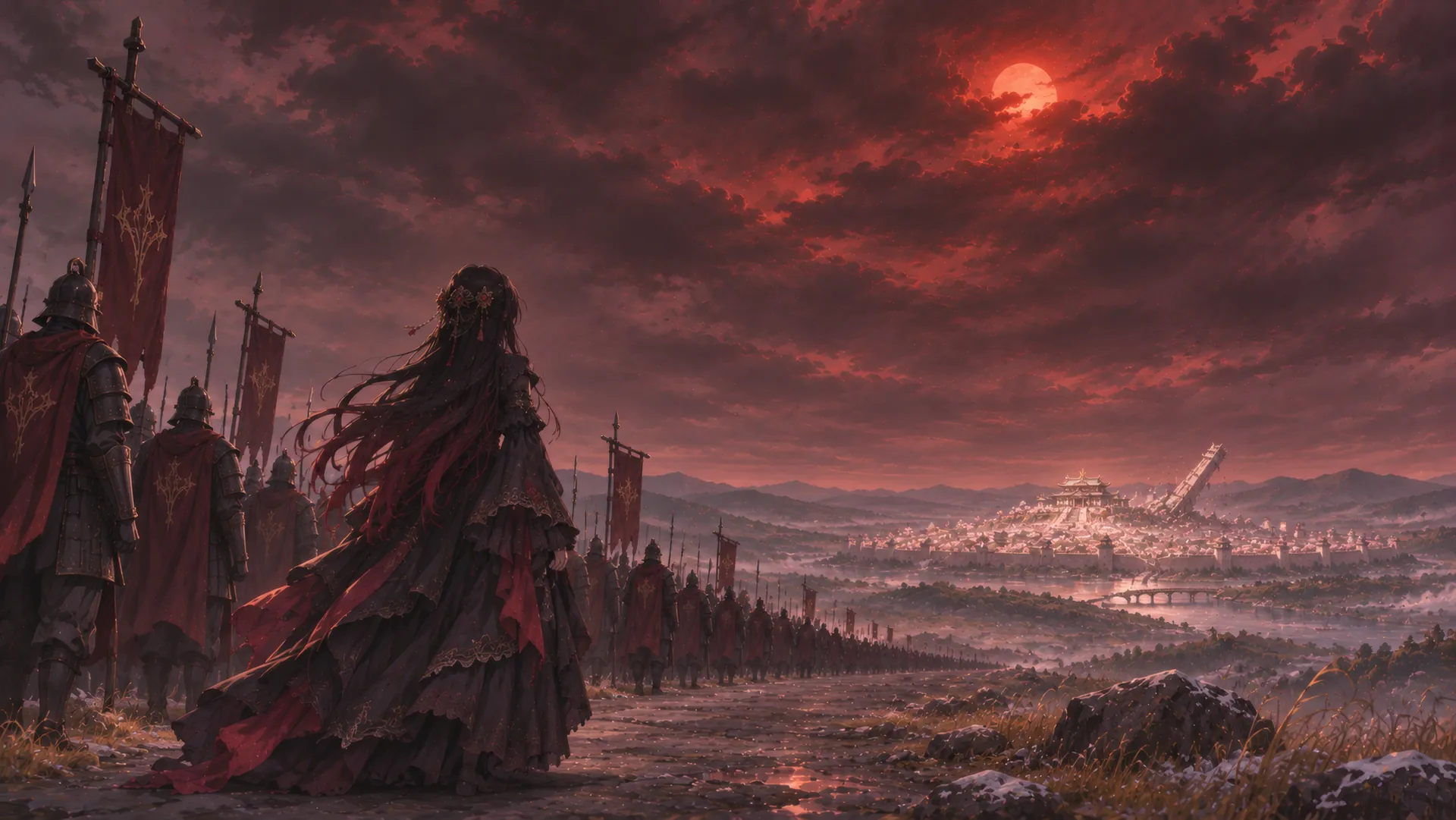
A novel of Light & Dark
From a back step on Oven Lane to the halls of Northorn, and a war the court has been preparing for four hundred years.