
Skip to the story

The Names We Carry

Light & Dark — Book One

The Names We Carry

Everything her father touched kept a little of him. When the raid comes over the mountains, eight-year-old Aiko Sakurai loses the house in the western lane, the people in it, and her place on every register in Avilon. What she keeps is a flawed crystal, a carved comb, and a name.

4 parts · 36 chapters · about 8 hours of reading

Nov 9, 2026 · @yonaka

Part One

Oven Lane

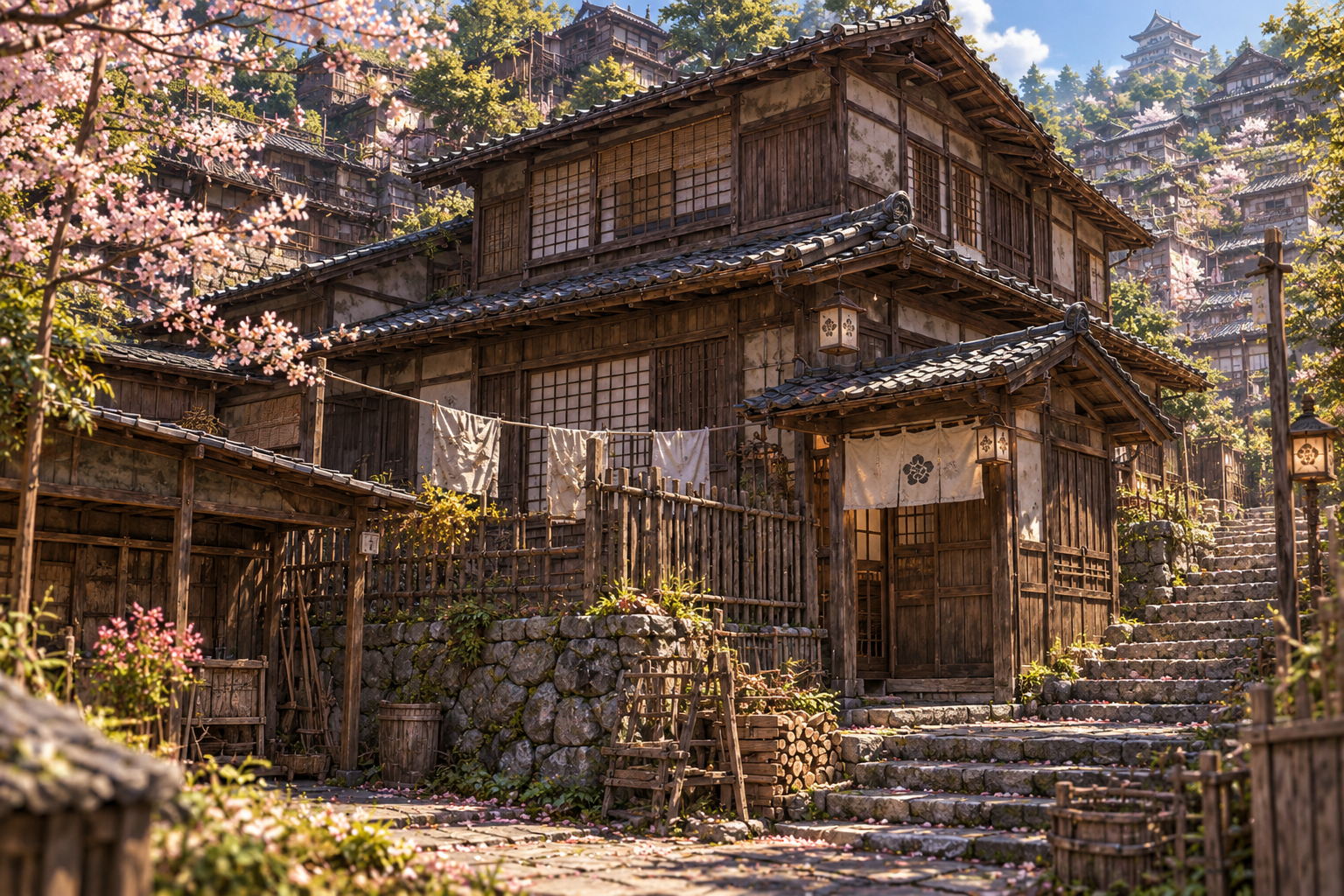
South Market. Oven Lane. Third door from the public well.

Chapters 1–8 · about 1.6 hours

Begin Part One

Part One: Oven Lane

Chapter I

Gray Hands

13 min read

Everything her father touched kept a little of him.

Kenichi Sakurai carried charcoal for a living, sacks of it, from the burners’ yards beyond the east wall to every kitchen and forge in Avilon that could pay, and no scrubbing at the lane pump ever got his hands clean. The gray lived in the creases of his knuckles and under his nails and along the lines of his palms, so that when he held them up to the lamp they looked like maps of a country made entirely of rivers. He left marks on the door latch, on the lip of the water jar, on the edge of the table where he leaned to pull off his boots. On the frame of the kitchen doorway, at the height of his shoulder, there was a thumbprint that had been there so long it had gone glossy, because he set his hand on that spot every time he came through. He was not a tall man. He had never once needed to duck.

“He’s checking it’s still there,” her mother said, when Aiko asked.

“The door?”

“Him.”

There was a second print lower down, made the year Aiko was four, when her father had rubbed her thumb across his palm and pressed it to the wood. She looked at it most mornings. It was smaller than his, and paler, and every winter she was afraid it had faded a little more.


On the morning she turned seven, he came in from the yard with his hands behind his back and stood in the middle of the kitchen while the snow on his shoulders turned to water.

“You’re dripping on my floor,” said Misaki, at the stove.

“I’m waiting to be asked something.”

Aiko considered him from the table. There was soot in one eyebrow, and on his face an expression of enormous, suffering patience.

“Why are you dripping on the floor?”

Apparently that would do. He brought his hands round. In them was a twist of white cloth, the cleanest thing she had ever seen him hold, and in the cloth was a crystal no bigger than the end of his thumb. It had been polished smooth everywhere but one edge, where a small notch showed, as though something had once taken a bite of it and thought better of it. When Aiko tipped it, green slid under amber like weed under river water.

“It isn’t magical,” her father said.

“You’ve said that already,” said her mother, though he hadn’t.

“It’s from the glass yard. They grind the panes for the watchtowers there, and anything with a flaw goes in the sweepings.” He crouched so that his face was level with hers. “This one had a flaw. I asked the yard master if I could have it.”

“What did he say?”

“He said, what for? I said it was for the most important person in Avilon. He said the king doesn’t want your rubbish, Sakurai. I said I didn’t mean the king.” He tapped the crystal in her palm with one finger and left a gray smudge on it. “There. Now you’ve got a flaw too. Sorry.”

Aiko rubbed the smudge off on her sleeve and carried the crystal to the window.

Every sky she had ever seen had a bright place in it.

It stood in the south, high over the roofs, a pale steadiness that never rose and never set. In summer it was a white coin you could not look at for long. On snowy mornings like this one it was only a warmth behind the cloud, as if someone had left a lamp burning in the next room. The barrier ran up toward it from the six watchtowers on the city wall, lines of gold finer than thread at this distance, and the lines leaned into the light and vanished there, the way a road vanishes into fog. Her father said the towers caught the light, and the barrier was made of what they caught. Her mother said not to stare.

“Why not?”

“It’s rude.”

“Rude to who?”

“Whom. To the gods. They’re working.”

Aiko held the crystal between her eye and the bright place. Nothing happened. Then she turned it the smallest possible amount, and a thread of red appeared down its middle, fine as a hair and so bright it seemed to hum. She gasped and spun round to show her mother, and the thread was gone.

“It was red. There was a red line.”

“I believe you.”

“You have to hold it exactly.” She tried again. The red came only when the crystal pointed straight at the bright place, and only at one angle, and only for as long as she kept perfectly still. “Light goes in,” she announced, “and then it can’t find the way out.”

A small faceted crystal, green with amber light moving inside it.
Green slid under amber like weed under river water.

Her father looked pleased. “That’s what I’d have said.”

“That’s what you did say,” said her mother. “Last night. To me. When you were deciding whether it was good enough to give her.”


That afternoon Misaki sat at the table mending the cuff of his work coat. It had worn through and needed new cloth, and was not going to get any, so she was turning the old cloth instead, putting the worn side inside where no one would see it. She held a pin between her lips. In her hair was the plum-blossom comb.

It was the only beautiful thing they owned: three flowers carved from dark wood, the petals so thin the lamp showed through them, and one petal broken away before Aiko was born, so that the middle flower had only four. Aiko was allowed to touch it after she had washed her hands. Her father was not allowed to touch it at all.

“Once,” he said from the back step, where he was splitting kindling and listening. “I’ve touched it once.”

“Our wedding day,” said her mother, around the pin. “He was meant to put it in my hair.”

“I’d washed.”

“He’d washed three times. There is still a mark on the back.”

“Where?” said Aiko.

“If you know where to look,” said her mother, “you’ll find it.”

She did not take the comb out to show her. Aiko understood that this was a game that had been going on for longer than she had been alive, and that she was not yet allowed to play.

She went back to the crystal. If she set it on the table in the line of light from the window, it laid a small trembling spot of color on the boards, and if she put her finger into the spot, her fingertip turned green.

“Where does the color go at night?”

“Home,” said her mother.

“Where’s home?”

Misaki took the pin out of her mouth. She gave everything Aiko asked the same seriousness, which was one of the reasons Aiko asked her so many things.

“Up there.” She nodded at the window. “The gods keep the measure of everything. How far a stone falls. How hot a fire burns. How long a winter lasts. Where the color goes at night. They hold all of it level, the way you hold a full bowl when you’re walking, so nothing spills.”

“All the time?”

“All the time.”

“Don’t they get tired?”

“I expect so. That’s why we don’t stare.”

Aiko thought about it. Outside, her father lost count of his kindling and started again from the beginning, out loud.

“Could somebody take the bowl off them?”

Her mother’s needle stopped.

“That,” she said after a moment, “is more or less what the north wanted.”

So then there was the story. Aiko had heard it before, but never as the answer to a question of her own, and that made it a different story. Once there was one country, Elaria, from the eastern sea to the far mountains, and in it people fell to quarreling over magic: what it was for, and how much of it one person might take, and whether the gods’ measure was a gift or a fence. Those who called it a fence lost the war. They went north over the mountains and made a country where none could tell them what they might not want. People called it the Dark Nation, though not in front of the shrine. Its emperor was made of stone, they said, and was older than the war. What was left in the south called itself the Light Nation, and Avilon was one of its smallest cities, and one of the nearest to the mountains.

“Were we the good ones?”

Misaki bit off her thread.

“We’re the ones who stayed,” she said. “That isn’t quite the same thing.” She held up the coat. The cuff looked almost new, if you didn’t know where to look. “Take this to your father. Tell him if he wears through it again I’ll sew his hand into it.”


In the autumn of every child’s eighth year, the shrine on the hill presented them. Every child in the lane knew how it went and talked of little else from about the age of six. A priest set a bowl of water on a stone. You held your hands either side of it, not touching, and breathed out slowly, and either the water answered you or it didn’t. Some children made it climb their wrists like a cat. Some made it shiver. Some made nothing happen at all, and went into the register with the other mark, and grew up to keep accounts or carry charcoal.

“What if it doesn’t answer?”

“Then you’ll come and carry with me,” said her father, “and we’ll be the two most useful people in this city. Everyone with magic will have to come to us when they want their supper cooked.”

“And if it does?”

He thought about it properly. He always did.

“Then you can light my lamp,” he said, “and I can stop borrowing matches from your mother, who counts them.”

They practiced over the soup. Aiko held her hands either side of her bowl and breathed out until she was dizzy, and the soup shivered, and she shrieked. Then she saw her father’s knee under the table, nudging its leg, and threw her spoon at him. He ate the rest of his supper with the spoon she had thrown, a gray thumbprint on its handle, and declared it the best soup of his life.


The year turned. Aiko turned eight in the deep of winter. In spring her father caught his hand under a cart wheel, and her mother bound the knuckle every morning in a strip of clean cloth that was gray by noon. In summer the roof leaked over the stove. In early autumn a boy from the shrine came down the lane with a slip of paper for every house that had a child of the right age, and her mother pinned theirs to the doorframe, under the two thumbprints. The presentation was in eleven days.

The raid came on the evening of the third.

Aiko was drying the blue bowl. Her father was at the back door, which had swollen in the rain and stuck halfway, working at it with his shoulder and his bound hand and a low stream of advice. Her mother was folding sheets. There was a change in the light. Aiko looked up. A line of gold ran across the kitchen ceiling, brightened until it hurt, and went out.

Outside, somebody called a name.

Her father stopped working the door. The second call was a scream, and then there were many, all at once, as if a lid had been taken off them. He looked through the gap, then put his shoulder to the door so hard that the frame jumped, and turned, and caught Aiko up under one arm, bowl and all.

“Bedroom,” he said to her mother.

The bowl struck the wall in the passage and broke. Aiko saw a piece of it spin on the boards and wanted to say so, but he had already set her down beside the bed and lifted the hanging cover.

“Under. All the way to the back.”

Her mother knelt beside her. Her hair had come half down and the comb was not in it. She put a hand between Aiko’s shoulder blades and pushed her toward the low dark, firmly, the way she slid the lid onto the rice pot when it was done arguing.

“Not a sound.”

“You too.”

“Whatever you hear. Can you do that?”

Aiko nodded, because her mother was waiting. She crawled in. The cover fell behind her.

It was dusty underneath and smelled of the rope that held up the mattress. Through the gap at the bottom of the cover she could see the doorway and the lower half of the room: her father’s bare feet, gray at the heels; the hem of her mother’s house robe, so close to him it touched his ankle.

The men came in asking about money.

There were three. Their boots were black and their legs were wrapped in some dark stuff that did not shine. One of them laughed at something and nobody laughed with him. One went to the chest by the wall and tipped out everything inside it. One stood in the doorway with his feet apart.

“There isn’t any,” her mother said. “Please. We carry charcoal.”

Her father stepped in front of her.

Something white flashed beyond his shoulder, sharp as a struck spark, and Aiko felt it before she understood it, a hard pressure in her ears as if she had dived too deep at the canal steps. Her father’s hand hit the floor where she could see it. The gray hand, the knuckle still bound in the cloth her mother had tied that morning.

Her mother went down beside him. Her voice rose, very fast, and stopped in the middle of a word.

Aiko waited for her to finish it.

Then something happened that she did not understand and would not understand for years. The pressure in her ears did not go away. It grew, and pushed, and went out from her all at once, like breath let go at the top of a dive. The cover in front of her face lifted as if a wind had got under the bed. On the chest, the lamp chimney cracked from top to bottom with a small clean sound, like a knuckle.

The man in the doorway turned his head.

“Did you feel that?”

“The barrier,” said one of the others. “Coming down on the west side. That’s the point, isn’t it.”

The man in the doorway did not answer. Aiko watched his boots. They came one step into the room, toward the bed, and stopped. She did not breathe. She did not think she would ever need to breathe again.

In the lane somebody shouted, a word she did not know, and the boots turned and went.


The night was very long. Later there was fire in the room above the kitchen. Smoke came under the cover and stood in the air, then thinned when something heavy fell. There were orders in the lane, and running, and a sound like a cart dragged over broken pots. And under all of it, from the direction of the river, a bell was ringing. Not the alarm from the towers, which had stopped. A single bell, struck over and over, unevenly: a run of strokes, a pause, two strokes, a long run again, as though whoever rang it kept being interrupted and kept coming back. She did not know which bell it was. She listened to it because it kept going.

She needed to cough. She swallowed until swallowing hurt.

When she woke, she had not known she was asleep. Gray light lay along the boards. The bell had stopped; she could not remember when. Her leg had gone dead beneath her, and when she moved it the prickling was so savage that she cried out before she remembered the rule.

Nobody told her to be quiet.

She came out backward, keeping her eyes on the underside of the bed until she was clear of it. Then she turned round.

She went to her mother first, because her father slept deeply and hated to be woken before work. She took her mother’s hand. It was cold, so she wrapped it in the hem of her own robe and rubbed it between her palms, the way her mother rubbed hers on winter mornings before the stove was lit.

“Mother.”

She said it again, louder, and then she stopped, because the room did not seem to want it.

Part of the roof had gone over the kitchen. A wet beam lay across the stove, and through the hole she could see the sky, and in it the bright place, exactly where it always was: pale and steady and high, and taking no notice. Her mother had said not to stare. She stared at it for a long time.

Then she laid her mother’s hand down carefully, the way you put down something you mean to come back for.
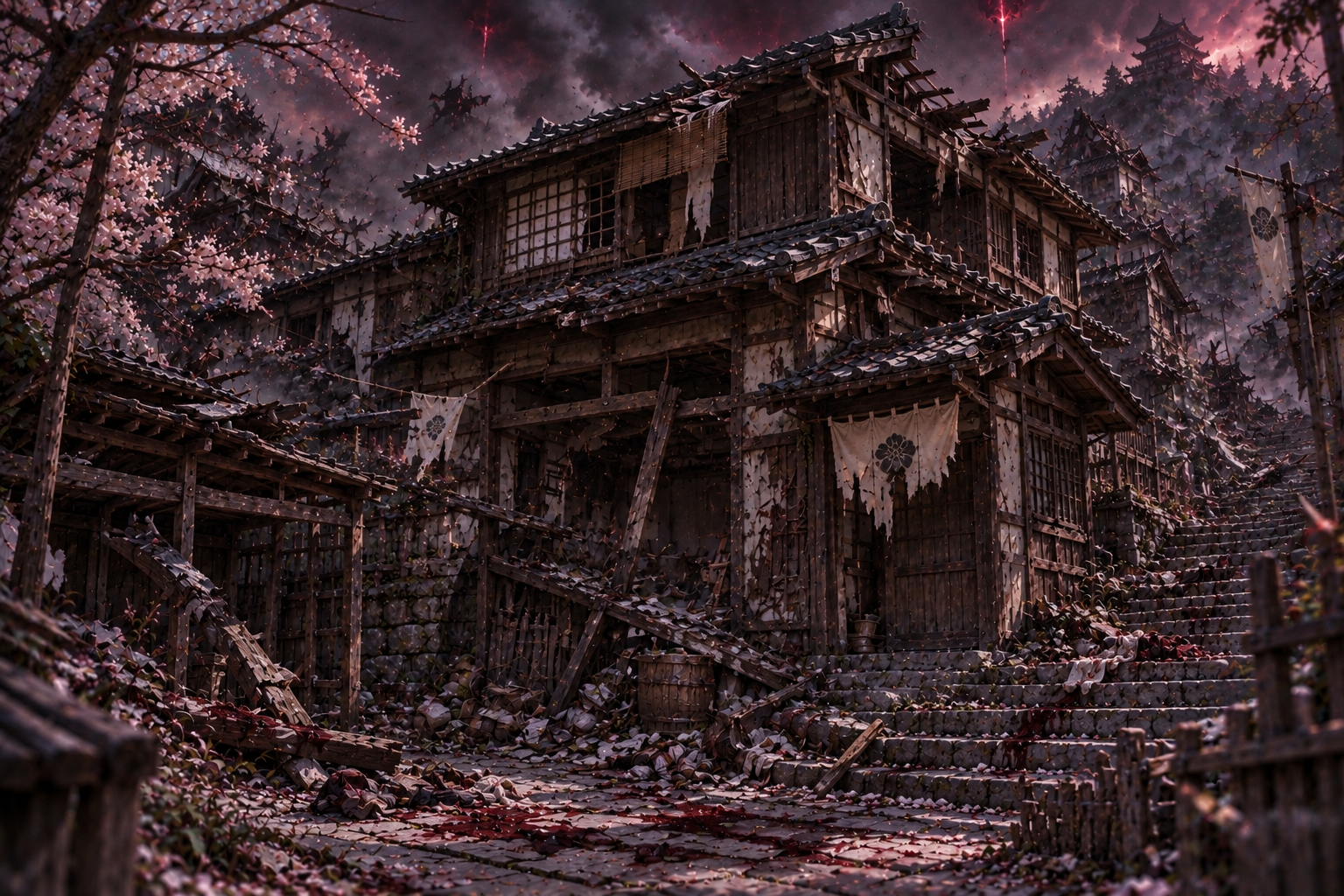
The Sakurai house after the raid, part of the roof fallen in.
Part of the roof had gone over the kitchen.

On the chest, beside the cracked lamp, she found the comb. She did not know how it had got there. Under the fallen plaster in her own room she found the crystal. She rubbed it clean on her robe and held it up to the hole in the roof and turned it until the red thread came. It came. That seemed important, though she could not have said why.

Last, she went to her father. She knelt beside him and turned his hand over. The gray was still in it, in the lines and the creases and around the bound knuckle; it had not gone anywhere. She rubbed her thumb across his palm until it came away dark, the way he had done for her when she was four, and went to the kitchen doorway, and pressed it to the frame beside his.

It was not as good as his. Her hand was shaking. But it was there.
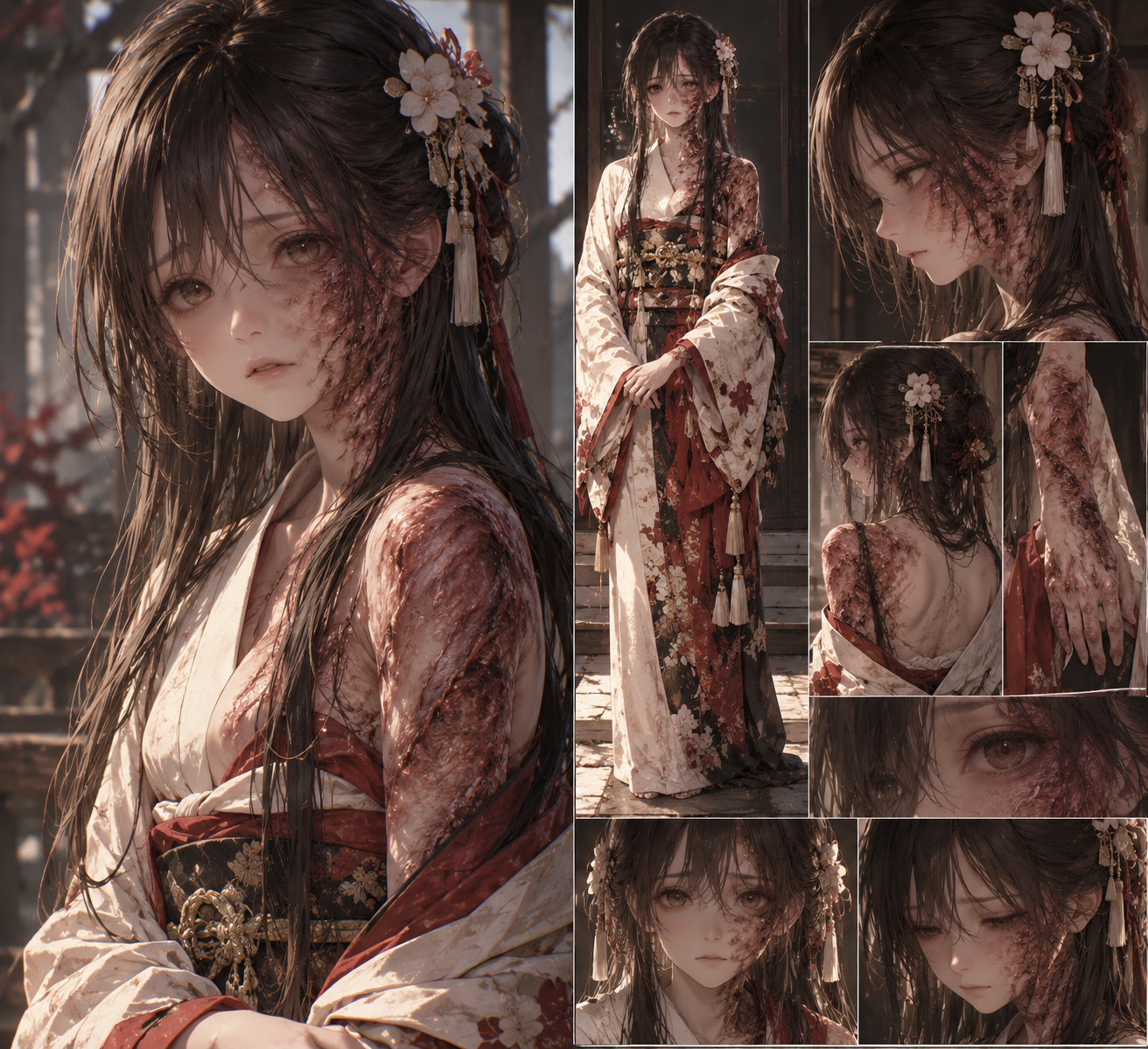
Chapter II

The Bell at the Western Bridge

13 min read

At sixteen, Reika Fujisaki had decided three things about her life and told no one, because in Avilon people who announced their plans tended to have them explained back to them.

She would play the thirteen-string koto at the autumn rite on the hill, in the front row, where the priests could see her hands.

She would not marry the lacquer-maker’s son from Ash Lane, whatever his mother said to hers at the well.

And before she turned twenty she would leave the western lane, the smell of the varnish vats and the grit of the polishing wheel and the workshop where her family lived and ate and quarreled under one long roof, and she would come back only to visit, bringing presents that everyone would be slightly too impressed by.

She was practicing when the window turned gold.

Reika Fujisaki at sixteen.
Reika Fujisaki, the year of the first raid.

Her room was the loft above the workshop. She had fought for it for two years, on the grounds that nobody else wanted to hear the same twelve bars of the autumn piece four hundred times. The koto lay across her knees. The gold came through the cracks in the shutter in three hard lines, crossed the ceiling, and went out.

Then the towers began to ring.

Everyone in Avilon knew the alarm. The watch rang it twice a year to remind the city it existed, a slow triple stroke that people talked over in the street. This was not that. This was fast and uneven, as if the ringers had lost count, or as if there were no longer enough of them to keep it. Beneath it, close by, came a sound like a sack of grain splitting along its seam.

From the workshop below, her mother called her name. Once.

Then there was the smell. Afterward Reika could never describe it to anyone who had not smelled it themselves. Lacquer burns like nothing else: sweet first, then sharp, then black. There were forty pots of it on the shelves below her, and a barrel of polishing oil, and the stacked bowls that had taken her father all summer.

She went to the hatch at the top of the ladder. The ring that lifted it was iron. She took hold of it with her left hand.

For years she would think that anyone would have known better. She had not. The pain arrived a moment after her fingers closed, so that for one long instant she was holding the ring and also being told by every part of her body to let go, and her hand would not listen. When it opened at last it left something of itself on the metal. The hatch had lifted perhaps an inch. Below it the workshop was a throat of orange, roaring softly, as if it were drawing breath.

“Mother!”

The roar answered. Nothing else did.

She went to the window instead, holding her hand against her chest, and got the shutter open with her elbow. Below was the lane, full of smoke and running shapes, two stories down onto stone. She put one knee on the sill and could not make the rest of herself follow it. Behind her, part of the floor gave way with a long, tearing groan, and a gust of sparks came across the room at the height of her face. Her sleeve caught. She beat at it with her bad hand, and the side of her robe caught, and then she was on the floor without having decided to lie down, and the floor was the only place where there was any air, and not much of it.

“Anyone up there?”

A woman’s voice, from inside the fire. Reika thought she had imagined it because she wanted to hear something. Then it came again, nearer and quite unhurried, as though its owner were looking for a friend in a crowded market.

“Anyone? Say something if you can.”

“Here.” It came out as a cough. She said it again.

“Good. Stay low. I’m coming up.”

The hatch flew back, and a woman climbed out of the burning workshop, and the fire leaned away from her.

Reika saw it happen and did not believe it. The flames on the ladder bowed back from a skin of gold that moved with the woman an arm’s length from her body, so that she came up inside a small traveling room of clean air while the smoke rolled over it like water over a stone. She wore the gray tabard of the Defensive Guard, scorched black down one side. A sword hung at her hip. Her hair was cut short and one side of it had been singed to bristle, and she was not, Reika saw with something like outrage, so very much older than Reika herself. She put out her free hand and the gold went with it, and then Reika was inside it too, and could breathe.

“Anyone else?”

“My mother.” Reika was already trying to get up. “My father. My brother. They’re in the workshop, they were in the—”

The woman looked down through the hatch. It was only a glance. Reika would remember for the rest of her life how short it was.

“Downstairs is gone,” the woman said.

“No, they’re—let me go, I can—”

The woman caught her round the waist as she lunged for the ladder, and held on, and did not let go when Reika hit her, or when Reika screamed down into the fire, or after.

“I’m sorry,” she said into Reika’s hair. “I’m sorry. I can carry one. I’m carrying you.”

She pulled a sodden cloak from her shoulder and threw it over Reika’s head, and the world went dark and dripping and smelled of canal.

“What’s your name?”

Reika could not answer.

“Your name. Tell me.”

“Reika.”

“Reika what?”

“Fujisaki.”

“Reika Fujisaki. Listen to me. We’re going out of the window. You’ll keep your face in that cloak and your hand against your chest, and every time I ask your name, you’ll tell me. Agreed?”

She was lifted. The sill went by under her. Then there was nothing under her at all, a lurch like the top of a stair that isn’t there, and something beneath them flattened and held, like a breath held, and set them down on the stones as gently as a basket.

“Name.”

“Reika.”

“Good.”


The lane was full of firelight and running people. Among them, moving the other way, were men in dark armor who were not running. One of them had seen the gray tabard. He said something to the man beside him, and the two of them came on together, unhurried.

The woman set Reika against a wall and drew her sword. A line of gold ran down the blade from hilt to point and stayed there, as if the steel had been dipped in it. She did not wait for them. She went to them, low and fast, and Reika lost the rest in the smoke: a sound like a dropped pan, a flash along the blade, a man’s grunt that turned into something else. When the woman came back she was breathing hard and holding her left side with her elbow, because her hand was busy with the sword.

“Name.”

“Reika.”

“Still you. Good.” She got Reika’s good arm across her shoulders and hauled her up. “Is there anyone this side of the river? Aunt, cousin, anyone?”

There was not. Everyone there was had been under that roof.

The woman thought about it for perhaps three steps.

“Komatsu’s, then,” she said. “The bakery in South Market. She feeds every stray in the quarter and pretends she doesn’t.”

“I can’t pay her.”

“She won’t ask tonight.”

The western bridge was a long timber span on stone piers, wide enough for two carts, and it was full. People were pouring over it with bundles and children and handcarts and in one case a goat, all of them trying to go faster than the people in front. At the western end the bridge bell hung on its post under a little pointed roof, unrung, its rope looped up out of children’s reach. As they passed it the woman looked up at the bell, and then back down the lane at the fire, and Reika saw her do some kind of arithmetic and not like the answer.

On the far side South Market was dark and shuttered and smelled of fish and wet straw. They went through it by alleys Reika did not know. Once the woman stopped and leaned against a wall with her eyes closed, and Reika felt the gold around them thin and then steady again, like a breath let out and taken back.

“Name.”

“Reika.”

“You’re doing very well.”

“You’re bleeding on me,” Reika said.

The woman laughed, short and surprised. “So I am. Sorry.”

Oven Lane. The public well. The third door. The woman went round by the yard to the back and kicked the door twice, politely.

The old woman who opened it had a lamp in one hand and her gray hair twisted up anyhow, and she was wearing her apron, though it was the middle of the night. She looked at the guard, and at the cloak, and at Reika’s hand, which Reika was holding out in front of her as if she had been asked to carry it for someone else.

“Tachibana,” the old woman said.

“Komatsu-san.” The guard shifted Reika’s weight. “This is Reika Fujisaki. Her house is gone, and her people with it. She needs a bed tonight and a basin for those burns.”

The old woman looked at Reika for long enough that Reika began to be afraid of her.

“Tonight,” she said.

“Tonight’s all I’m asking.”

“It’s never all anybody’s asking.” But she stood back from the door.

Inside it was warm and smelled of yeast and the banked oven. The guard set Reika down on a flour chest and straightened slowly, her elbow still pressed to her side. In the lamplight the gray of her tabard was dark and wet under the soot, more than Reika had thought.

The old woman saw it too. “You’re bleeding.”

“Not much.” The guard was already turning back to the door. “Leave this open tonight, Komatsu-san. They’ll be coming over the bridge until morning, and some of them won’t know where to go.”

“I keep a bakery. Not a shrine.”

“You keep a back door,” said the guard, and smiled for the first time, a quick crooked smile that showed a chipped front tooth. “And there’s bread in here. I can smell it.” She looked at Reika. “Name.”

“Reika.”

“Keep saying it.”

Then she was gone across the yard at a run, and the door swung on its hinges behind her.


The old woman asked no questions that night. She filled a basin from the cistern and put Reika’s hand in it and held it there by the wrist when Reika tried to take it out. She cut away what was left of the robe on Reika’s left side with the bread knife and did not say anything about what was underneath, from the shoulder down the arm and over the ribs to the hip, or about the place on Reika’s neck and cheek that Reika could feel and did not want to touch. She laid honey on clean cloth and wrapped her loosely and told her not to look. Then she went to the oven, opened it, and began taking out bread that had been meant for the morning.

The back door stayed open.

They came all night. Neighbors first, people the old woman called by name and pushed into the yard with a loaf apiece. Then strangers, soot-faced, carrying things they had saved without knowing why: a lamp with no oil, one shoe, a caged bird that had stopped singing. The old woman gave them bread until there was no bread, and then she slapped the dough that had been proving for tomorrow into the pans half-risen and baked it anyway. It came out heavy and pale. Nobody complained. Reika sat on the flour chest with her arm across her lap and watched the old woman’s arms go in and out of the oven mouth, and every so often the old woman glanced at her, as if to check she was still where she had been put.

Sometime after midnight, across the dark market, a bell began to ring.

It was not the towers. It was one bell, struck over and over, unevenly: a run of strokes, a pause, two strokes, a long run again. Someone in the yard said it was the bridge bell. Someone else said that meant the bridge was still open. A woman with a child on her hip started toward the gate, toward the sound, and a man pulled her back and told her there was nothing over there to go back for.

Reika knew whose hand was on that rope. She did not know how she knew. She found she was saying her own name under her breath in time with the strokes, and stopped, ashamed, and then went on, because nobody could hear her.

It rang for a long time. Toward dawn the pauses between strokes grew longer. Then there was one stroke, alone, and nothing after it.

At the oven the old woman had stopped with her hands in the dough. She stood like that for a moment. Then she went on kneading.


The news came in the morning the way news does after such a night, in pieces, from people who had not meant to bring it.

A family came in at first light: a man with a scorched blanket round his shoulders, a woman carrying a baby, two girls holding the back of her skirt. The baby cried the whole time in a thin, unbroken thread of sound, so thin Reika thought something must be wrong with it. The woman sat on the edge of the back step and told the old woman, because the old woman had given her bread, that theirs had been the last cart over. The soldiers had been at the end of the lane behind them. The guard at the bridge had put a wall of light across the western end of the boards, right across, like a door swinging shut, and shouted at them to run and not look back.

“Did you?” the old woman asked.

“Once,” the woman said, and did not say anything else.

Later, men of the watch came through the market asking for bread, and ate it standing in the yard as if they had forgotten how, and from them the name went round. Hikari Tachibana, of the Defensive Guard, twenty-four years old. They had found her at the west end of the bridge with the bell rope knotted round her left wrist, so that every time she moved, the bell had rung. She had held the end of the bridge from the first hour until a little before dawn. The soldiers had not crossed it.

“The bell,” said someone in the yard, slowly, understanding.

By the end of the week the market was calling her the Guardian. Someone painted the word on the bridge post under the bell, badly, and someone else painted over it with more care. Children who had not been there began a game in the alleys in which one of them stood with her arms stretched across a gap and the others tried to get past.


On the second night the old woman took Reika upstairs to a small room under the eaves.

“My daughter’s,” she said. “She won’t mind.”

It was a young woman’s room. A summer robe lay folded on the chest, pale blue, the kind of thing worn to a festival. There was a jar of dried bellflowers on the sill and a basket of embroidery thread in colors sorted from light to dark, and on the wall a small framed picture of a pot, not painted but drawn in ink, the kind of quick, sure drawing a craftsman makes of his own work. Everything was clean. Somebody dusted in here, and folded, and put things back exactly.

Reika assumed the daughter had married and moved to another city, and was glad of it, because it meant she was not taking anything from anyone who would need it back. She lay down in a stranger’s bed with her arm across her chest. When the old woman had gone she lifted her left hand in the dark and tried to open it. Two fingers moved. The others stayed curled, and the skin across the back pulled tight and bright, like varnish.

She thought about the koto. Then, carefully, she made herself stop.

She had not asked the guard her name. She had said her own whenever she was asked, over and over, which was all she had been asked to do, and it had not once occurred to her to ask anything back.

“Hikari Tachibana,” she said to the ceiling, quietly, to see how it sounded.

It did not sound like enough. She said it again anyway, and then her own, and kept saying them, one after the other, until she slept.

Chapter III

Here, For Now

13 min read

The woman who brought Aiko water wore a green sash and smelled of the smoke that had got into everything. She had known Aiko’s mother; she called Aiko by her name. Aiko could not remember hers, and that felt like something she ought to apologize for, so she said nothing at all. The woman sat her on the front step and put a cup in her hands. Two men went into the house carrying a door they had taken off its hinges somewhere else.

They brought her parents out on it, one at a time.

One of the men asked where the child would go.

“Here,” said the woman, “for now.”

Aiko held the cup so tightly that its rough rim cut her lip. When the woman tried to wipe the blood away with the end of her sash, Aiko turned her head.


On the third day the priests sent the dead home.

They were laid in rows in the field below the shrine, under plain cloth, feet to the south. The woman in the green sash held Aiko by the wrist instead of the hand, the way you hold a child who might run at a cart. There were more dead than Aiko had known there were people in the western lanes. Priests in white walked between the rows and set a shallow bowl of water at the head of each. Then they stood in a ring and breathed out, slowly, all together, and said over the field the words that are always said: Go up, and be measured, and be kept.

The water began to shine. Faintly at first, the way a puddle shines when the cloud thins, then brightly. The shine spilled over the rims and ran out across the cloths like water finding its level, until the whole field lay under a thin sheet of light. Then it rose. It lifted in threads, as steam lifts from a pot when the lid comes off, and every thread leaned the same way, south and upward, toward the bright place, and thinned as it went, and was gone. Afterward the cloths lay flatter.

Aiko watched the threads above the row where her parents were. She was waiting for one of them to do something she would recognize, to set a hand on something as it passed, to go the wrong way out of stubbornness. They were only light. They went where all the others went.

The bright place did not change. She had thought that with so many going into it, it would grow brighter, a little, the way a room does when more lamps are carried in. It did not. It stood exactly where it always stood, pale and steady, and Aiko was angry with it in a way she had never been angry with anything that did not have a face.

When the priests began to fold the cloths she pulled her wrist free and went to the nearest of them, an old man with water stains on his sleeves.

“Can’t they stay?” she said. “A bit longer. Until I’m used to it.”

The priest looked down at her. He did not seem surprised. She thought afterward that he must have been asked it a great many times that morning.

“The living do not hold the dead, child,” he said. “What is held back goes wrong. Holding is a northern thing.” He touched the top of her head, briefly, with a wet hand. “They are kept now. That is better than anything you or I could do for them.”

Aiko did not think so. She did not say it.


On the fourth day the family came.

The man had a paper from the district office and read it aloud on the front step in the voice of someone who did not quite believe it: the household of five was assigned, for the duration of the emergency, to the dwelling in the western lane formerly occupied by Sakurai, deceased. He had a scorched blanket round his shoulders. Behind him the woman carried a baby whose crying was so thin Aiko thought something must be wrong with it, and two girls held on to the back of her skirt, one about Aiko’s age and one smaller, with the same flat-cheeked, solemn face.

The woman saw Aiko on the step.

“Nobody said there was a child.”

“Nobody said anything,” said the man.

The neighbor in the green sash came across the lane to explain. Aiko listened to herself being explained. It did not take long.

“Well,” said the woman with the baby at last. “Here, for now.”

Aiko noticed it was what everybody said.

They had blankets, a pot, a bundle of clothes that had all been someone else’s first, and nothing else. The older girl looked at Aiko for a while from behind her mother’s hip. Then she came round and held out half a rice cake without being told. Aiko took it. It was cold and had a thumbprint in it.

At supper that first night, the woman told them how they had come to be alive. She told it to her husband, who had been there and knew, and to her daughters, who had been there and knew, and Aiko understood that she was telling it because she could not stop. They had been the last cart over the western bridge. The soldiers were at the end of the lane behind them. There had been a guard at the bridge, a young woman, and she had tied the bell rope round her own wrist, and every time she swung her sword the bell rang.

“All night,” the woman said. “You could hear it from the market. Every time it stopped, I thought—and then it started again.”

Aiko put down her bowl.

She had thought she was alone under the bed. All that night she had thought there was nobody in the world awake except her, listening, and the men in the lane. But somebody had been awake the whole time, a long way off, on the bridge, making that sound on purpose. Not for her. For people like these. But Aiko had listened to it because it kept going, and it had kept going because someone would not let it stop.

“Who was she?”

The woman looked at her as if she had forgotten Aiko was at the table.

“A guard,” she said. “They’re calling her the Guardian now.”


In the first week the woman scrubbed the house.

She did it with sand and lye and a stiff brush, on her knees, room by room, because the smoke had got into the walls and the soot into the boards and the smell of the night was in everything. She did it with a kind of furious care, and Aiko understood, watching, that she was not only cleaning. She was making it hers. Aiko could not blame her for that. She did not want to blame her for anything. She fetched the water.

She came back from the lane pump on the sixth day with a bucket in each hand, and the kitchen doorframe was pale.

The woman had done it that morning. The wood was clean down to the grain, lighter than the rest of the frame, still damp, smelling of lye. Both prints were gone. The slip of paper from the shrine had gone with them, scrubbed into pulp and swept out with the rest.

Aiko put the buckets down.

She did not decide what happened next. She found she had the scrubbing brush in her hand, wet and gritty, and then it was going end over end through the back door and over the yard wall into the ditch, and the woman was shouting, and Aiko had kicked over both buckets, and the water was everywhere, across the clean boards and under the stove. When the woman caught her by the arm she bit her, hard, in the soft place below the thumb.

She slept in the yard that night. Nobody brought her supper, and she would not have eaten it.

In the morning the woman came out and sat on the back step. There was a bandage on her hand. She did not look at Aiko for a while.

“It was dirt,” she said. “I didn’t know. It was a black mark on a door, and I have a baby who puts her hands on everything. How was I to know it was—”

“It was him,” said Aiko.

The woman looked at her then. Something in her face gave, for a moment, and then closed again over whatever it had been.

“Well,” she said. “It’s done now.”

She went inside. Aiko sat in the yard until the older girl came out with half a rice ball wrapped in a leaf and put it down beside her on the stones without a word and went back in.


There was not enough food.

At the ration office the household drew five portions. Aiko’s had been entered to the emergency shelter in the shrine hall, where people had been put on the first night, though she had never slept there. The woman went once to have it moved and came back after a day in line with the baby asleep on her shoulder and her mouth tight.

“They want your register entry. You’ve never been presented, so you’re only in the birth roll, and the birth roll’s at the shrine, and the shrine is full of—” She stopped. “And the house register burned with the upstairs. The new one has our name on it.” She moved the baby to her other shoulder. “There’s nothing with you on it,” she said, not unkindly, the way you tell someone it is going to rain.

The older girl took Aiko to the shrine hall the next day to ask for the portion there. The shelter list was pinned to a board inside the door. The girl read better than Aiko; she found the name and ran her finger along the line to the mark at the end of it.

“Ticked,” she said. “It says collected.”

“By who?”

The girl looked at the mark for a while, as if it might say more if she waited.

On the way out they passed a notice pasted to the gate. The presentation of children was postponed until the spring rite. Aiko read it twice. In spring nobody took her, and by then it no longer seemed like something she was entitled to ask for.


The woman began cutting Aiko’s share before she put the pot on the table.

“This is yours,” she would say, setting the small bowl down. Then she served the others.

Aiko ate slowly, to make it last, and watched the pot.

She began keeping things. A spoon of rice pressed into a leaf when nobody was looking. A crust. The end of a pickle. She hid them behind the loose board beside the stove, where her father had once hidden matches from her mother, and on bad nights she lay on the kitchen floor and thought about them there in the dark, and that was almost as good as eating them.

The woman found the place in the third week. She said nothing. The board was put back exactly as it had been. The next evening the small bowl beside Aiko’s place held less rice than before by, as nearly as Aiko could judge, the amount that had been behind the board.

The older girl watched this happen. Later, by the woodpile, she said, “She does that to us too.”

“Does what?”

“Knows things.”

It was the closest the two of them came to being friends.


By midwinter the man was coughing. He coughed at night through the bedroom wall, long dragging coughs that ended in a sound like somebody trying to clear a drain, and one morning Aiko saw a dark stain on his cuff as he went out. The older girl stopped going to lessons and went to the dye sheds instead, and came back in the evenings with blue hands. Nobody said Aiko’s name much anymore. The woman called her the Sakurai girl when she spoke of her and you when she spoke to her. The man did not speak to her at all, though once, coming in from the roof, he put his cold hand on the top of her head for a moment as he passed, as if checking that it was still there.

There were arguments through the bedroom wall. In one of them Aiko heard her name said so many times that it stopped sounding like a name, and she pulled her bedding over her head and counted the things behind the board, though she knew there was nothing behind the board.

In the morning her bedding was on the back step.

She had not felt anyone take it from under her. She must have been asleep when the woman lifted it, which meant she had been lifted too, set down on the boards like a much smaller child, and she did not like to think about that. The bedding was rolled and tied. The woman stood in the back doorway with the baby against her shoulder.

“Go to the district office,” she said. “Tell them where you’ve been staying. They’ll find somewhere once they see you’re there.”

Aiko looked at the bedding.

“You can come back for the rest of your things,” the woman said.

There was no rest. Everything that was Aiko’s was in the roll or in her sleeve. She had sewn the comb into the edge of the bedding months ago, in a pocket of doubled cloth, and the crystal was in her sleeve.

“Can I stay until it rains?”

The woman looked up. The sky was the hard pale clear of winter mornings, with the bright place standing in it and the barrier’s lines running up to it gold and straight. Her mouth moved, but she did not say anything.

Aiko picked up the roll. It was awkward to carry; it kept trying to come undone. The woman took one step toward her, perhaps to help. Aiko stepped back out of reach, and turned, and went out through the yard, and at the corner she did not look back at the house.


The district office was a long room in what had been a cloth hall, with a counter across one end and benches along the walls. Above the benches hung a printed notice bearing the names of King Harunobu Ōkimi and Queen Sayuri Ōhi in large letters, over a great deal of smaller writing about the duties of citizens in a time of emergency. Aiko sat beneath it with her bedding on her knees. A man at the end of the counter glanced at her once and told her to wait. She waited. She watched papers go back and forth, and people come in angry and go out tired. She waited to be seen, because the woman had said that was what would happen.

By midday she needed to relieve herself. She went out to find somewhere, and when she came back the shutters were down.

She knocked. She knocked harder, with the flat of her hand, and then she sat on the step with her bedding and waited for them to open. They did not open.

On the third morning she reached the counter. The same man asked her name, wrote it on a slip of paper, and then looked for somewhere to put the slip and did not find anywhere.

“You’re not on anything,” he said, frowning at the slip as though it had misbehaved. “You’d want the children’s hall. They take children who are brought.”

“Brought by who?”

“A guardian. Or the watch.”

The notice on the door of the watch house said the children’s hall was full and would admit no more until the spring rite. Aiko stood in the street and read it again, in case it changed.

It was the first thing about the world after the raid that she understood properly, the way she had once understood that her father could not do magic: a person could be entirely without anyone, and the city would go on around her exactly as before, selling fish.


She found the bathhouse by its smoke.

She had walked past it a hundred times with her mother and never thought about the back of it, where the boiler stood against an outside wall and the bricks stayed warm all night. Now she thought about nothing else. She crept down the gap between the bathhouse and the cooper’s yard, where nobody could see her from the street, and put her back to the bricks, and wrapped the bedding round herself twice, and felt the warmth come through slowly, the way it comes through a wall in winter: as if it had to be persuaded.

She picked open the pocket in the edge of the bedding and took out the comb.

There was just enough light from the bathhouse window to see it by. Three flowers, the petals so thin the light came through. The middle one with four. She turned it over, not for any reason, only to have something to do with her hands. The back was plain, smooth with years of her mother’s fingers.

Almost plain.

On the underside of the middle flower, down in the hollow where the wood had been carved away, was a faint gray smudge, no bigger than a grain of rice. It had been there so long it had gone into the grain. You would never have seen it. You would have had to know where to look.

Aiko held the comb very close to her face and looked at it for a long time.

At first light the bathhouse keeper found her and drove her off with a broom, not hitting her, only sweeping, the way you sweep leaves off a step. She went. The next night she came back to the wall later, after the lamps were out, and left before the boiler was stoked. Some nights he found her anyway. She stopped sleeping deeply. She learned to wake at the scrape of a door three houses away and be gone before she was properly awake, and after a while she could not have slept deeply if she had tried.

Chapter IV

Bread on the Step

12 min read

The first thing the street taught her was that warmth moved.

It lived in the bathhouse wall until the boiler was raked out at midnight. After that it was in the bakehouse lanes, where the ovens were fired two hours before light and the back doors stood open to let the heat out. Then it was nowhere, through the gray worst hour, until the sun had been up long enough to reach the south face of the fish market, where the stones held it the way a cupped hand holds water. Aiko learned to follow it as the cats did. By the end of her first month she could have drawn Avilon as a map of warm places, with the hours written beside each one, and she would not have needed to look at the map.

The second thing was that food moved too, but always away from her, unless she got there first.

She learned the market from the bottom up. The fishmongers sluiced their tables at noon, and the gutters ran silver with scales and, sometimes, a head. The noodle stall behind the shrine steps threw out its broth at dusk into a drain that ran warm for a few minutes after, and if you held a cupped leaf in the right place you could catch some before it went under the grate. The rice merchants swept their floors into the street every evening, and there were grains in the sweepings if you were patient and did not mind grit. Aiko was patient. She did mind grit, but minding, it turned out, was something you could stop doing.

She was not the only one at the drains.

There were seven or eight of them, depending on the night, who slept in the dry culvert under the old market, where the drain had been bricked off years ago. They had an order as fixed as any household’s: who slept furthest from the opening, who went first at the noodle drain, who was allowed to talk. The first time Aiko crouched at the mouth of the culvert in the rain, nobody told her to go. Nobody told her to come in, either. She sat at the edge with her bedding over her head and the water running off the lip in a sheet, and thought that this might be what it was going to be now.

She woke without the bedding.

For a moment she did not understand. She was cold all down one side, her cheek was on stone, and the roll was not under it. Then she sat up and saw it, further in, beneath the tallest of them, who was asleep on it with his mouth open and one hand flung across the place where the comb was.

She did not shout. She had learned that much in the house with the five of them: shouting told everyone exactly what you wanted.

She watched instead. For three days the bedding went where he went. He slept on it, sat on it, once wrapped it round himself and walked up and down the culvert like a king in a robe while the others laughed. He did not know what was in it. If he had known, he would have cut it out and sold it, and the comb would have gone to the pawn tables on Cloth Street, and some woman with clean hands would have worn it to a festival.

On the fourth night she went in when the rain was loudest. She had a shard of roof tile that she had rubbed on the market steps all afternoon until one edge would split a leaf. She did not try for the bedding. She could not have carried it out without waking him, and even if she had, he would have known whose it was. She found the doubled edge by touch, under his outflung hand, and cut along the seam a thread at a time, her heart going so hard she was sure he must hear it. The comb came free into her palm in its little square of cloth.

She left the rest under him. It was the best thing she owned, and the warmest, and she left it.

Outside in the rain she tied the comb into the collar of her robe with a strand pulled from its own hem, high at the back of her neck where no one’s hand would find it without her knowing. Then she went to the bathhouse wall, which was already cooling, and sat against it until there was nothing left in the bricks to have.

She did not go back to the culvert.

Without the bedding the cold got into her properly. Her hands split across the knuckles and bled when she closed them. A cough settled in her chest in the second month and did not leave until the plum trees flowered. She learned to sleep sitting up, knees to her chin and the robe pulled down over her feet, because lying down gave the ground more of her.

She stopped speaking. She did not decide to; there was simply nobody to speak to, and after a while the silence became a thing in itself, like a coat she did not know how to take off. When a stallholder said something to her she looked at his hands rather than his face, to see what they were about to do. She ate with her back to a wall. She did not sleep two nights running in the same place if she could help it. Some mornings she woke and lay listening to the market setting up and could not, for a long moment, remember why she should get up and go into it. Then hunger reminded her.


The dog had been sleeping by the bathhouse wall before she found it, and he did not see why he should stop.

He was a middling sort of dog, the color of weak tea, with one ear that stood up and one that folded over at the tip as if it had been creased and left in a drawer. The first night he lay at the far end of the warm stretch and watched her with deep disapproval. The second night he lay a little nearer. On the fifth, when the frost came, she woke in the gray hour to find him pressed along her back, heavy and rank and warm as an oven, and she kept very still so as not to remind him she was there.

He slept curled so tight his nose touched his tail, a perfect ring of dog. She called him Maru for it, out loud, to see what he would do. He did nothing. It did not seem to trouble him either way.

A shaggy tea-colored dog on Avilon’s streets.
He had other walls. He had, she suspected, other people.

He was not hers. She understood that early and tried to keep hold of it. Some nights he was at the wall and some nights he was not, and she could find no pattern in it. He had other walls. He had, she suspected, other people. Once she saw him trotting down Cloth Street at the heels of a woman with a basket, looking up at her with exactly the face he used on Aiko, and she felt something so sharp and so stupid that she went and sat in the fish market until it passed.

But once, in her first spring, he came round the corner of the bathhouse at a gallop with an entire mackerel in his jaws, flapping, and dropped it at her feet and sat.

Behind him, two streets away, a man was shouting.

Aiko looked at the mackerel. She looked at the dog. The shouting got closer. She snatched up the fish and ran, and Maru ran beside her with his tongue out, and they went over the cooper’s fence and through the tannery yard and under the dry arch of the canal bridge. There she crouched in the mud with her heart slamming and ate half the fish raw, quickly, with her back to the wall, and gave him the rest. Afterward she sat with her hand in the fur of his neck until it was dark. He let her.

It was the best meal she had that month. She did not know what she had done to deserve it, and the not knowing frightened her almost as much as the shouting had.


It was Maru who found the back step.

He led her there without meaning to, one morning near the end of that first winter, trotting ahead down a lane she did not know: a well with a stone lip worn smooth, a row of narrow back doors. At the third door from the well he stopped, put his nose to the step, and looked back at her with an expression of great significance.

On the step was a bowl. Plain and brown, with a cloth over it, and a stone on the cloth to keep it from blowing.

Aiko stood at the end of the lane for a long time. She thought it was put out for a cat. She thought it was a trap of some kind, though she could not think what kind. She thought about the woman in the western lane setting down the small bowl, this is yours, and serving the others. In the end Maru decided for her by trying to get the cloth off with his teeth, and she went and took the bowl from him and lifted the cloth.

Rice. The burnt crust off the bottom of the pot, broken into pieces. A pickled plum.

She did not eat it. She gave Maru a mouthful from her fingers, then crouched against the wall and watched him for the rest of the morning, waiting to see whether he would fall down. He did not fall down. He went to sleep in the sun. At noon, when the rice had gone cold and hard, she ate it quickly, with her back to the wall and her eyes on the lane, and gave him the crust, and the plum stone to roll in his mouth. Then, because her mother would have, she took the bowl to the well and rinsed it and dried it on her sleeve and put it back on the step upside down, with the cloth folded and the stone on top.

There was not always a bowl. That was the first thing she learned about it and the most important. Some mornings there was and some mornings there wasn’t. Once there was nothing for eleven days together, and each morning she stood at the end of the lane and made herself walk away. Once there were two in the same day, and she worried for a week about what she had done. She never saw who put them out. Twice she heard the latch lift while she was still in the lane, and both times she ran.

The bowl was like weather. It came or it didn’t, and there was no use asking. She tried to want it the way she wanted rain in summer: a little, and without expecting anything.

She was not very good at it.

On the days there was nothing, she told herself she had expected nothing, and went hungry. Some of those days the telling was harder than the hunger.

In spring, when the plum trees behind the shrine came out, she broke off a twig of blossom and left it under the stone on the upturned bowl. She did not know why. She was halfway down the lane before she thought that whoever lived behind that door might not like plum blossom, or might think it was a joke, or might think the boy (it would be a boy they pictured, surely) was asking for more.

The next bowl had the twig in it, laid across the rice, carefully, as if it were part of the meal.

She did not leave any more blossoms. She kept the twig until it went brown.


On the first anniversary of the raid, the city floated lanterns from the western bridge.

Aiko had not known it would. She came down to the river in the late afternoon because the market was closing early and nobody was throwing anything out, and found the banks full and the bridge full and every hand holding a paper lantern on a little raft of reeds. The priests came down from the hill in their white. Someone had repainted the word on the bridge post under the bell, in red this time, the strokes thick and careful: GUARDIAN.

She tried to get onto the bridge and was pushed off it. She was not surprised. She smelled, and her robe had gone the color the street turns everything, and people moved their children out of her way without looking at her face. She went down the bank instead and under the first arch, where the river ran black and fast between the piers and nobody wanted to stand.

At dusk they lit the lanterns and let them go.

They came down off the bridge in a slow bright rain, hundreds of them, and settled on the water and turned once and were carried under the arch, past her, close enough to touch. Some had names written on the paper. She read the ones she could. She did not see her parents’ names; who would have written them? She looked anyway, at every lantern that passed, until her eyes ached.

Up on the bridge, an old woman and a girl were setting a lantern down together. Aiko noticed them only because the girl’s face caught the light. One side of it was smooth. The other was shiny and drawn, the skin gone tight and bright from cheek to collar, and she held one hand curled against her chest as though carrying something small. The old woman steadied the lantern on its raft with both hands. Her hands were white. Not pale: white, dusted, the creases full of it, the way her father’s had been full of gray.

They let it go, and stood together, and did not speak.

Aiko watched the old woman’s hands until the crowd closed over them.

Later, when the lanterns had gone round the bend toward the sea and the people had gone home, she came up onto the empty bridge. The bell hung under its pointed roof at the western end, the rope looped high out of reach. The post beneath it had been rubbed smooth that evening by a great many hands. Something dark was ground into the grain of the boards at its foot that might have been anything.

She climbed the post. It was not hard; there were nail heads, and the edges of the painted letters. At the top she wrapped her legs round it, reached up, and knocked the bell once with her knuckles.

It made a small sound. Smaller than she remembered. It went out over the dark water and did not come back.

At the eastern end a watchman shouted. Aiko slid down the post, burning her palms, and ran. She went back under the first arch, where nobody wanted to stand, and sat with her knees against her chest and her burned hands in her armpits. Maru was not there. He had not been there for days. The river went on carrying away the last few lanterns that had caught against the piers, one at a time, out into the dark, and nobody came along the bank looking for anyone, because as far as anybody in Avilon knew, there was no one under the bridge to look for.

She stayed until it was light. She did not cry. She had not cried since the morning she came out from under the bed, and she had begun to understand that she was not going to: that whatever in her did the crying had gone somewhere, and had not come back.

Chapter V

Kiln Winter

10 min read

She taught herself to read from the king.

Her mother had begun teaching her letters the winter before the raid, at the kitchen table, with a stick of charcoal her father lent on condition that it came back. She had got as far as her own name and the word for rice. After that there had been nobody to go on with, so she went on with the king.

His notices went up on the board outside the district office every few weeks, and they always began the same way: HARUNOBU ŌKIMI, BY THE GRACE OF THE MEASURE KING OF AVILON. She knew what that said because a man had once read a notice aloud to a crowd, slowly, with his finger under each word, and she had stood at the back and watched the finger rather than the man. That gave her eleven words she could be sure of. When a new notice went up she found her eleven in it, then looked at the words beside them and guessed. Ration days. Curfew. Wells closed for cleaning. The king, it turned out, mostly wanted people to stop doing things.

The lists were better. Lists were names, and names were made of the same few sounds over and over, so that once you had Ta and Na and Ka you had half the city. By the time she was ten she could read the shelter list from top to bottom, and she did, every month, though she knew her own name was not on it anymore and had stopped expecting it.

Then, in the spring, she found the book.

It was in the heap behind Scribes’ Row, under a broken stool, swollen with rain to twice its thickness. The cover was gone and the first nineteen pages had pulped together into a single gray brick. She almost left it. But page twenty had a drawing on it, a ship with three sails, and under the ship a line of small, neat writing, and she sat down in the rubbish and spelled out the first word, and the first word was harbor.

It was a merchant’s account of a voyage along the eastern sea. She read it at the rate of perhaps a page a week, with her finger under each word the way the man at the notice board had done, saying the sounds under her breath until they turned into something. She learned that in the harbor city of the first chapter the houses were painted blue against the heat, so that from the sea the whole town looked like a heap of broken sky. She learned that past the islands there was a place where, at noon, the bright place stood straight overhead, so that nobody in that country had a shadow at midday and the children were afraid of nothing.

She read that page many times. She had not known a person could go further south. She had thought, without ever thinking it, that the world stopped somewhere below Avilon, at the bottom of the light.

She kept the book wrapped in oilcloth stolen from a fish crate and carried it everywhere. When Maru tried to lie on it she moved him, and he sulked for an entire afternoon.


Twice a year the district office posted the border lists: the names of people the Dark Nation had sent back, through whatever arrangement was made at the exchange station in the mountains. There were never many. Eight one spring. Three the autumn after. Once, only one, and a crowd stood round the board in the rain as though it might grow.

Aiko read them because she read everything. She did not expect her parents to be on them. She knew where her parents were.

The old woman with the white hands came every time.

Aiko knew her at once from the night of the lanterns. She came early, before the crowd, in a plain dark coat with flour at the cuffs, and read the whole list from the top, slowly, and then read it again. On the second reading her lips moved, and Aiko, edging closer along the wall, saw that they moved on the same small word at the end of every line, as though she were checking each name against one she carried and finding it was not that one. Then she went away, walking quickly, the way people walk when they have somewhere to be and want to be seen to have somewhere to be.

Once Aiko got near enough to hear. The word was a name, and it ended in -rina, and the rest of it was swallowed by a cart going by.

She stood in front of the list after the old woman had gone and read it herself, top to bottom, looking for anything that ended in -rina. There was nothing. She did not know why she minded.


In the winter she turned eleven, the watch began sweeping the drains.

It was meant kindly, or at least it was announced kindly: a notice from the king, a new one, which she read with her finger in the frost on the board. Children without household or guardian were to be gathered for their own protection into the winter hall by the river, where they would be housed and fed through the cold months in exchange for light work. Aiko read light work twice. The winter hall was the dye works. She had seen the children who came out of it in spring.

The watch came for the culvert first. She heard about it the next morning in the fish market: the whole of it emptied in one night, the tallest boy fighting, a lantern knocked over. She went past the dye works that afternoon on purpose, to see.

The vat house stood on stilts over the river so that the waste could run straight out of it, and the river below ran blue for a hundred paces downstream, then green, then brown. The doors were open for the steam. Inside, among the vats, she could see small figures working long poles, and stopping to cough, and starting again.

At the door, a girl was carrying out a basket of wet cloth. She was taller now, and thinner, but it was the same flat-cheeked, solemn face. Her arms were blue to the elbow.

She saw Aiko. She stopped. For a moment neither of them did anything at all.

Then the girl from the house in the western lane shook her head. Very slightly, once, the way you would warn somebody across a room without letting anyone else see. Then she went on with her basket.

Aiko did not sleep at the bathhouse that night, or anywhere the watch knew about. She went to the western bridge after dark and climbed the post, which she had done often enough now that her feet knew the nail heads, and wedged herself up into the little pointed roof above the bell, where there was just enough space for a child to fold into if she did not mind the bell itself pressing against her shins.

The watch came along the bank at midnight with lanterns. She heard them under the bridge, and then on it. One of them stood directly beneath her and stamped his feet against the cold and talked about his wife’s cooking. The bell hung an inch from her knees. If she shivered, it would ring.

She did not shiver. She did not know how she did not. She thought very hard about the city where nobody had a shadow, and the watchman finished his complaint about the cooking and moved on, and at dawn she came down so stiff she could not straighten her fingers for an hour.

They did not find her that winter. It did not feel like winning. Two toes on her left foot had gone white in the bell roof and then, over the following days, dark at the tips, and when the color came back it came back wrong. Afterward those two toes ached in the cold before anything else did, and never again felt the ground properly.


She fell ill at the end of it.

The tile works on the north side fired their kilns once a week and the bricks stayed warm for two days after, and a person who came in over the back wall could sleep in the angle between two kilns and not be found. She was there when the fever came. It came the way a tide comes, slowly and then everywhere. By the second night she could not stand. By the third she did not want to.

Maru came on the first night and lay against her and was a comfort. On the second he came, and lay against her, and got up after a while, and went. She understood. She would have gone too.

She did not remember much of the rest. The kilns ticking as they cooled. Her mother’s hand on the kitchen doorframe, pale against the wood, reaching for a mark that was not there. The bell, ringing from very far off, in its uneven rhythm, stopping, starting again. At one point she was certain she was under the bed, and that the men were in the room, and that if she breathed out the lamp would break. She held her breath until the dark came down over her like a cloth.

When she woke it was day, and the fever had gone out of her the way a fire goes out: all at once, leaving her light and hollow and very thirsty.

There was a water trough by the kiln. She had been lying beside it. On the first night it had been skinned with ice.

The ice was broken now. Not melted: broken, burst outward from the middle in a star, the pieces flung up against the sides of the trough as if something had struck it from underneath. On the ground around where she had lain, the frost was gone in a rough ring, and the tile on top of the nearest stack had a crack across it, clean, from corner to corner.

Aiko looked at all of this for a while. Then she drank from the trough, a great deal, with her hands, and decided it had been the kilns.

She was weak for most of that spring. She could walk only short distances before she had to sit down, and some days not that, and the markets went on throwing out their sweepings to whoever was quickest, and she was not quickest. She ate what she could reach. She grew thinner than she had been even in the first winter, so that her own wrists frightened her in the mornings. Nobody had noticed she was gone. She had known nobody would. It was a different thing to know it lying down.


When she could walk as far as Oven Lane again, Maru was on the back step.

He was lying on a flour sack. Someone had put it there for him, folded in four, in the angle of the step where the sun came first. Someone had also tied a strip of red cloth round his neck, knotted at one side, and he wore it with the air of a dog who had always had one.

Aiko stopped at the end of the lane.

She had not been there in weeks. She did not know how many weeks. There was a bowl on the step beside him, covered, with the stone on the cloth.

The back door opened. A young woman came out with a bucket of ash, and Aiko knew her: the girl from the bridge, the girl with the lantern, older now, her hair pinned up on the smooth side of her face and let down over the other. She saw Aiko and stopped.

“If you’re after the dog,” she said, “he isn’t yours.”

“He isn’t anyone’s.” Her voice came out cracked. She had not used it in a long time.

“Then he can choose.”

They both looked at Maru. Maru looked from one of them to the other, thumped his tail twice on the sack, and put his chin down on his paws and closed his eyes.

The young woman tipped her ash into the gutter. When she straightened, Aiko was still staring at her. She did not mean to. It was the scar: the way the light ran over it, glossy, like the inside of a shell.

“Look properly, then,” the young woman said. Her voice was perfectly flat. “Go on. Get it done with.”

Aiko looked properly. She took her time. It seemed rude not to, having been asked.

“It’s like lacquer,” she said.

Something went across the young woman’s face that Aiko could not read. Her good hand tightened on the bucket. For a moment she looked as though she might throw it, or say something that would be worse than throwing it.

Then she turned and went inside, and shut the door, and did not come out again.

Aiko did not take the bowl that morning. She stood at the end of the lane until she was sure she would not, and then she went back to the tile works and sat by the trough with the broken ice in it and read the last pages of her book.

There were not many left. The merchant reached the islands and traded his cloth for pepper, and was cheated, and traded again. He set out from the last island for the place where nobody had a shadow. He described the color of the water, which was green, and then not green. He described a bird that followed the ship for three days and would not land.

Then the book stopped. The last pages had rotted away with the first ones, and the binding ended in a soft brown fringe.

Aiko turned the fringe over, twice, in case. Then she closed the book and sat with it on her knees and tried to decide that he got there. She tried for a long time. She could not make herself believe it.

Chapter VI

The Wrong Hand

11 min read

The apple-seller on Cloth Street kept his best fruit at the front and his worst at the back, polished to the same shine, and he watched his stall the way a heron watches water. Aiko had never stolen from him. That was what made it so stupid when he caught her by the wrist.

She was only walking past. She was thirteen and had grown that year, suddenly and inconveniently, so that her robe stopped above her ankles and her wrists stuck out of her sleeves, and she had become, without doing anything different, a person shopkeepers watched. He had her before she knew she had been seen. He was shouting for the watch with his mouth an inch from her ear.

The guard who came was a big man with a cold. He did not ask her anything. He took the bundle from her shoulder and turned it upside down over the street.

It was everything she owned. A tin cup. Three strips of cloth for her feet. A needle stuck through a cork, which she had found in the gutter on Scribes’ Row two years before and had used so often the eye had worn bright. A comb made of bone, broken, for her hair, because the other comb was not for hair anymore. And the book, in its oilcloth, which hit the cobbles and slid out of its wrapping and lay open on its back in the wet.

No apple.

The guard kicked through it all with the side of his boot. Then he took her arm and went through her sleeves, the way they did, and found the crystal.

He held it up between two thick fingers. It was a gray morning, and the bright place was only a paleness in the south, but it was enough. He turned the crystal idly against it and the red thread sprang down its middle, fine and humming, and he stopped turning it.

“Well, now.” He whistled through his blocked nose. “That’s tower glass, that is.”

“It’s from the sweepings.”

“Is it.”

“My father had it from the glass yard. The yard master gave it him.”

“Your father gave you this?” He looked her up and down, at the robe and the wrists and the feet bound in rags. “Bring him here, then. We’ll ask him.”

She said nothing. There was nothing to say that he did not already know.

Behind the stall the apple-seller’s boy was lifting a cloth off a basket, and under the cloth, at the front, polished, was an apple sitting where an apple should not be. The boy said, “Da,” in a small voice. The apple-seller looked, and went red, and began to talk very fast about how she must have put it there, how they were cunning, these ones, they had ways.

The guard sighed. He jerked his head at Aiko: go on, then. Clear off.

He put the crystal in his own pocket.


She gathered what she could. The cup had rolled into the gutter and she found it. The foot cloths were trodden into the mud and she found those. The needle was gone; the cork lay split in two where a boot had come down on it, and the needle had gone between the cobbles or into somebody’s sole, and she searched on her hands and knees for as long as she dared, until the apple-seller came out from behind his stall with a broom.

A cart had gone over the book. The wheel had split the swollen spine and the pages had come loose and spread out across the street in a long wet fan, and people were walking on them. She picked up every one she could reach. Most of them had become a kind of gray paste in her hands. She kept one: the page with the place where the bright place stood straight overhead and nobody had a shadow. It was torn across the bottom, through the word children. She folded it small and put it in her sleeve where the crystal had been.

Then she went after the guard.

She followed him all morning at a distance, from the watch house to the fish market to a noodle stall where he ate standing, and back to the watch house, where he went in and did not come out. She sat on the step of the shuttered shop opposite and waited. She was good at waiting. It was very nearly the only thing she was better at than other people.

He came out at dusk. She stood up and stepped into his way before she could think better of it.

“It isn’t magical,” she said.

The guard looked down at her. She saw him not remember her, and then remember.

“It’s from the sweepings,” she said. “They grind the panes for the towers and anything with a flaw goes in the rubbish. My father carried charcoal to the glass yard. He asked for it. It’s not worth anything to anybody but me.”

“And where’s your father?”

“Dead. In the raid.”

The guard was quiet for a moment. He took the crystal out of his pocket and looked at it in the last of the light, and for a breath she thought she had found the right words, the words that worked, that her father had known and her mother had known and that she had only now remembered.

“Then it’s no use to anybody,” the guard said, and opened his fingers over the drain grating at his feet.

It went through. She heard it go, a small sound, a tick against iron, and then water.

The guard wiped his nose on his sleeve and walked off toward the market.

Aiko stood over the grating. Then she went three streets west, to the place where the Cloth Street drain came out under the old market wall, and took off her foot cloths, and went in.

She knew the drains. She had slept in their mouths and fished in their outflows and hidden in them from the watch, and she knew which ran into which, and where the silt collected after rain. It was black inside, and it stank, and the water came to her knees and then to her thighs and was so cold she stopped feeling her feet almost at once. She went up it bent double, counting gratings by the faint gray squares of light above her, and at the ninth she knelt in the water and put her arms into the silt up to the shoulder and felt.

Stones. Bones, small ones. Something soft she did not think about. A coin, which she kept. Stones.

It took a long time. She did not hurry. There was no one to hurry for.

When her fingers found the notch along its edge she knew it at once, the way you know your own tooth with your tongue. She came out of the drain with it in her fist and stood in the street in the dark, streaming, shaking so hard her teeth knocked, and did not open her hand until she was sure that she would not drop it.

The silt had cut her. She did not notice until the next day, when her right palm was hot and tight and the line across it had gone yellow at the edges. It took a month to close, and closed badly, and left a ridged seam across her palm like a second life line. For weeks she could not grip anything with that hand, and stealing one-handed was slow, and she was hungry in a way she had not been since the first winter.


She needed a needle.

The comb had been tied into the back of her collar for four years with whatever came to hand, string and hair and thread pulled from hems, and the ties wore through every few months and had to be done again, and every time she felt the comb shift against her neck her heart stopped. Now the crystal needed a place too. She was not going to keep it in a sleeve again where any guard could find it. She needed a pocket, inside, sewn, the way her mother had sewn the cuff of her father’s coat: the worn side turned in where nobody would see.

She had gone back to the bowl on Oven Lane a month after the young woman with the scar had shut the door on her. Hunger outlasts embarrassment; she had learned that too. She came at dawn, when the oven was being fired and the back door stood open for the heat, and she took the bowl and rinsed it at the well and put it back, and she and the young woman did not look at each other if they could help it.

That morning the door stood open and there was no one in the kitchen. On the bench inside the door, in the first of the light, sat a sewing basket. A square of red felt lay on top of the reels, with needles in it, a row of them, bright.

From somewhere upstairs came a sound she did not know at first. A string, plucked. Then another, a different note. Then a little run of three, careful, and a pause, and the first note again, the way a child goes back to the beginning of a word. It was very slow. It was played, she realized, with one hand.

She took three needles. Her hand did it before the rest of her had decided, the way her hand had thrown the scrubbing brush when she was eight. She was back at the end of the lane with the felt’s warmth still on her fingertips before the plucking upstairs stopped.

She sewed in the bathhouse alley that afternoon in the good light: a pocket on the inside of her robe, below the left arm, closed with a flap and three stitches, for the crystal and the folded page. Then the comb, properly, into a doubled seam at the back of the collar, with a loop of thread through the gap between two flowers so that it could not slide. She was slow and her stitches were large and some of them were crooked. When she was finished she pressed her hand flat over the pocket and felt the hard shape of the crystal through the cloth, exactly where she had put it, and it was the first thing in five years that had gone exactly where she put it.

Two days later she went back to Cloth Street and stole three apples from the front of the apple-seller’s stall, the best ones, while he was arguing with a woman about change. She ate them on the western bridge, under the bell, one after another. They were very good apples. She had thought it would feel like something to eat them. It didn’t. She sat with the cores in her lap and felt exactly as she had felt before, only less hungry.


The young woman with the scar was waiting on the back step the next morning.

She was sitting with a shawl round her shoulders and her bad hand in her lap and the bowl beside her, covered. Maru lay across her feet with his red rag askew. She did not get up when Aiko came down the lane, and Aiko, who had stopped at the sight of her, made herself keep walking, because stopping had already said too much.

“Three needles,” the young woman said.

Aiko stood at the bottom of the step. “I don’t—”

“You’ve red thread on your collar. That’s mine. Nobody else on this lane has red that color, because I dyed it myself and got it wrong.”

Aiko put her hand to the back of her neck before she could stop herself.

The young woman watched her do it. Then she held out her good hand, palm up.

Aiko took two needles out of the hem of her sleeve, where she had stuck them, and put them in the palm. The third was in her collar, holding a thread, and she left it there and said nothing about it. The young woman looked at the two needles, and then at Aiko’s collar, and then back at Aiko’s face, and Aiko understood that she had counted and knew, and was deciding.

“If you’d asked,” she said, “I’d have given you one.”

“Nobody gives.”

It came out harder than she meant. The young woman did not flinch at it. She looked down at the bowl beside her on the step, under its cloth, with its stone. She looked at it for a long time.

“Who do you think puts that out?” she said.

Aiko did not answer.

“Four years. Nearly five.” The young woman lifted the stone and turned it over in her fingers. “She does it before she does anything else. Before she’s lit the oven. She calls you the boy with the dog.”

“I’m not a boy.”

“Then you should tell her.”

From inside the house, from the kitchen, an old voice called: “Reika? Who is it? Is that the boy?”

The young woman, Reika, did not take her eyes off Aiko.

“It’s a girl,” she called back.

There was a silence from the kitchen. Something was set down on a table.

“Well,” said the old voice. “Is she hungry?”

Aiko stood on the cobbles with her hand still at the back of her neck. The kitchen door was open behind Reika, and there was warmth coming out of it, and the smell of the oven, and a shape moving inside, small and stooped, coming toward the light.

She did not run, though every part of her wanted to. She bent down and touched Maru once on the head, on the folded ear, and then she turned round and walked back up the lane, not fast, the way people walk when they have somewhere to be and want to be seen to have somewhere to be.

At the corner she looked back. Reika was still on the step. The old woman was beside her now, in the doorway, one white hand on the frame. They were both watching her go. Neither of them called after her.

She did not go back to Oven Lane for a long time.

Being seen was worse than being hungry. She had not understood that until she stood in the lane with two faces in the doorway looking at her as though she were a particular person. Hunger was only hunger; you could carry it. Being looked at like that meant somebody might come looking.

She went back in the end because winter came again, and the markets were thin, and the scar across her palm had tightened in the cold, so that some mornings she could not close her right hand round anything. She came at the hour before dawn, when the lane was darkest, and stood at the end of it for a long time.

The bowl was on the step. Beside it, on the stone, sat a pair of straw sandals, new and small, tied together at the heels with a twist of badly dyed red thread.

She took the bowl. She left the sandals.

They were there the next morning, and the next. On the fourth morning she picked them up and put them down again and walked away without them, and stood at the corner with her heart going, and came back, and took them, and ran. She wore them for a week before she could make herself believe that nobody was going to come and ask for them back.

Chapter VII

Can You Knead?

13 min read

That winter the old woman’s hands stopped.

Aiko saw it before she understood it. She came down Oven Lane in the black hour before dawn, the way she did now, in the straw sandals she still could not quite believe were hers, and stood at the end of the lane as she always stood. The back door was open and the lamp was lit. The old woman was sitting on the step.

She was not doing anything. She sat with her hands in her lap, palms up, looking at them. Behind her, through the door, the oven roared, and a great pale mound of dough sat on the board under a cloth, waiting.

The bowl was beside her on the step.

Aiko did not move. She did not know the rule for this. The rule was: a bowl on the step, nobody there. A person on the step was a different thing.

The old woman looked up. She did not seem surprised. Perhaps she had always known exactly where Aiko stood.

“They won’t close,” she said, as if carrying on a conversation they had been having for some time. She held up her hands. The knuckles were swollen and shiny, the fingers bent a little sideways at the last joint, like twigs that had grown round something and kept the shape. “Every winter a bit worse. This morning they won’t close at all. And Reika’s got the one good hand, and it’s not a kneading hand.” She considered Aiko. “Can you knead?”

Aiko said nothing.

“I’ll take that as no,” said the old woman. “Come in and learn, then. There’s bread in it.”

Chiyo Komatsu at her bakery, holding a basket of bread.
Chiyo Komatsu, Oven Lane.

Aiko took the bowl. She stepped back with it. Then she went.

She went only as far as the well. She sat on its worn lip in the dark with the bowl in her lap and did not eat, and watched the open door. After a long while Reika came out and stood beside the old woman, and they spoke too low to hear, and the old woman got up slowly, one hand on the frame, and went in. The door stayed open. Light came out of it onto the cobbles in a long yellow shape that reached nearly to Aiko’s feet and stopped.

She went back to the bathhouse wall and ate the rice and tried not to think about the door.

The next morning the old woman was on the step again.

“Can you knead?”

Aiko said nothing.

“Well,” said the old woman. “The offer stands.”

On the third morning there was nobody on the step. The door was open and the dough was on the board and the bowl was not there at all.

Aiko stood at the end of the lane for so long that the sky began to go gray behind the roofs. Then she walked down to the door and stood in it. Not inside. In it, with the frame against her shoulder and the lane at her back.

Reika was at the oven. She glanced round once and went back to raking the coals. The old woman sat at the table with her hands wrapped round a cup of something hot.

“Wash your hands,” she said. “Basin’s by your elbow.”

The water was warm. Aiko had not had her hands in warm water since she could not remember when, and she stood with them in it longer than washing needed, and nobody hurried her.

It was Reika who showed her, in the end, because the old woman could not. Reika came and stood on the far side of the board, as far from Aiko as the board allowed, and put her good hand flat on the dough.

“Heel of your hand,” she said. “Push it away from you. Fold it back. Turn it. Again.” She did it once, one-handed, the dough moving under her palm like something alive and sullen. “Don’t fight it. It isn’t trying to get away from you. It only feels like that.”

Aiko pushed. The dough was cold and heavy and much stronger than it looked. The scar across her palm pulled with every stroke. She did it anyway, and again, and again, until her shoulders burned and the dough went from sullen to smooth to something that pushed back against her hand with a soft, living give, and Reika, who had been watching from the oven without seeming to, said, “That’ll do,” and took it from her.

The old woman wrapped a loaf from the day before in a cloth and held it out.

Aiko took it. She did not say anything. She was out of the door and up the lane before the first customer came.


She came most mornings after that. Not every morning. Some mornings she stood at the end of the lane and could not make herself walk down it, and went away, and was hungry, and came the next day as if nothing had happened, and nobody said anything about it.

She never sat down. She never took off the sandals. She stood at the board with the door at her elbow so that she could see the lane, and when Reika reached past her for the salt she flinched, every time, though she knew it was coming. She did not speak. She kneaded, and shaped, and carried trays, and swept flour into the corners, and went away with her loaf before the light came up, and ate it at the bathhouse wall with her back to the bricks.

The old woman talked enough for both of them. She talked about the miller, who was a thief, and his father, who had been a worse one. She talked about the price of salt, and the damp in the north wall, and the dog, whose character she had come to know well and did not think much of. She asked questions sometimes, and did not wait for the answers, and went on to something else, so that the questions passed over Aiko like weather and did not have to be carried. Aiko learned the shop. The sour loaves for every day. The sweet buns for festivals, with bean paste folded into the middle. The flat bread the bathhouse ordered by the dozen. The third tray in the oven, which caught at the back on something nobody had ever found, so that you had to lift it a finger’s width as you slid it in.

Maru lay across the threshold, half in and half out, and was stepped over by everyone, and liked it.


In the fifth week a neighbor came in by the back door before it was light, wanting yeast, and stopped in the doorway.

She was a broad woman from two doors up with her hair still in its night wrapping. She looked at Aiko at the board, and at Aiko’s hands in the dough, and at Aiko’s feet.

“Who’s this, then?”

“My help,” said the old woman.

“That’s the drain girl.” The neighbor said it without malice, with interest, the way you name a bird. “I’ve seen her down the culvert. You want to count your spoons, Chiyo.”

Aiko was gone before the old woman answered. She did not remember going. She was on the western bridge with flour to her elbows and her heart going like a struck bell before she knew she had left the board.

She stayed away nine days.

Nobody came after her. She had been sure somebody would, to ask about the spoons, and she slept each night in a different place and watched the lanes, and nobody came. On the tenth morning she went to the end of Oven Lane, only to look. The door was open. The dough was on the board under its cloth. The old woman was at the table with her cup, and beside the board, on the stool where Aiko never sat, lay a clean apron, folded, as if someone had been expected for nine days and had not minded waiting.

She went in and washed her hands.

The old woman said, “Morning,” and nothing else.


The first thing Aiko said in that kitchen was about the tray.

It was a month after the neighbor. Reika was sliding the third tray in, and it caught, the way it always caught, and a row of buns slid against the back of the oven and folded. Reika swore. Aiko heard herself say, “You have to lift it,” and then stopped, appalled, with her hands still in the dough.

Her voice had come out rough and too loud. It did not sound like anyone she knew.

Reika looked at her. The old woman looked at her.

“A finger’s width,” Aiko said, much more quietly, to the dough. “At the back. As it goes in.”

“It’s caught like that for thirty years,” said the old woman. “I know it has to be lifted.”

“Then why didn’t you tell me?” said Reika.

“I did. Twice a week for ten years.”

Reika pulled out the tray, saved what she could, and slid it back in, lifting it at the back. It went in clean. She did not look at Aiko again, but at the end of the morning she wrapped two loaves instead of one, and handed them over without comment.

A few days later the old woman asked her name.

She asked it the way she asked everything, in passing, while she was trying to get the lid off the salt jar with the heels of both hands. “What do I call you, then? I can’t go on calling you the boy with the dog.”

Aiko kept kneading. The old woman got the lid off. She did not ask again.

It was nearly the end of the morning before Aiko said it. She said it to the board.

“Aiko.”

The old woman, at the oven, did not turn round. “Aiko,” she repeated, trying it out. “Good. I’m Chiyo. That’s Reika, and you know her temper already. I’ve been calling you the boy with the dog for five years and now I’ll have to learn again, at my age.”

Aiko said nothing more that day. But she had said it, and it stayed said, and in the morning the old woman used it, and it did not go wrong.


Reika spoke to her properly only once that spring, and it was about the bucket.

They were alone in the yard. Reika was hanging cloths to dry, one-handed, pinning each corner with her teeth before she reached for the next peg. Aiko was splitting kindling. She had been splitting it for some time and had realized she was counting the strokes out loud under her breath, the way her father used to, and had stopped, and could not now remember what number she was on.

“My father made lacquer,” Reika said, to the washing line. “Bowls, boxes. Trays. That’s what you said, that time. It’s like lacquer.”

Aiko put down the hatchet. “I didn’t know.”

“I know you didn’t. That’s why I didn’t throw the bucket at you.” Reika pinned the last corner. “He used to say: thirty coats to good lacquer, and each one dry before the next. Hurry it and it cracks.” She stood with her bad hand against her chest and looked at the cloths moving on the line. “I thought about that a lot. After.”

She went inside. Aiko picked up the hatchet and split the rest of the kindling without counting, and did not know what she had been told, only that she had been told something, and that she was to keep it.


It was the recipe book that undid her.

Chiyo kept it on a shelf above the flour bin, a fat, soft, stained thing held together with string, and one morning in spring she took it down and could not turn the pages. Her fingers would not separate them. She tried for a while, and then pushed it across the table without a word.

Aiko looked at it.

“The sweet buns,” said Chiyo. “The festival ones. Somewhere past the middle. I know it by heart, but I want to see the amount for the bean paste. My heart’s not what it was either.”

Aiko turned the pages. The writing was in two hands, an older one, cramped and square, and a younger one, quick and slanting. She found the sweet buns. She read the amount out loud before she remembered that she did not speak in this kitchen, and by then it was too late, and she had read the whole recipe, every line, the way she had read the king’s notices with her finger under the words.

Chiyo was looking at her.

“Who taught you to read?”

Aiko’s face went hot. “Nobody.”

“Nobody,” Chiyo repeated. She did not say anything else for a moment. Then she reached out and turned the book a little toward herself with the side of her stiff hand, and touched the margin beside the recipe.

There was a drawing there. Small, in ink, quick and sure: a woman’s hand, resting on the page, holding a pen. The smallest finger was bent away from the others at the middle joint, crooked, as though it had been broken once and set wrong. Under it, in the slanting hand, someone had written: Nothing wrong with this hand. It holds the money.

“My daughter’s,” Chiyo said. “She caught that finger in the shop door when she was six, and it never came straight. She used to hide it in her sleeve when she was a girl. Then she married a potter, and he thought it was the best thing about her. He drew it while she was correcting my recipe. She was always correcting my recipes.” She touched the writing beneath. “That’s her answer to him.”

Aiko looked at the crooked finger in the drawing for a long time.

“Yurina,” Chiyo said. “She’d be—” She stopped. Started again. “She was twenty-two. They came over the mountains. They killed him in his own yard, among his pots. They took her. That was twenty-seven years ago this autumn.” She took her hand back from the book. “Before you were born.”

Aiko thought about the old woman at the border-list wall, reading every name twice, her lips moving on the end of each line. -rina.

“You read the lists,” she said.

Chiyo looked at her sharply. Then something in her face eased.

“Every one,” she said. “Somebody has to.”


After that Chiyo began to sing at the basin.

Perhaps she had always sung there and Aiko had never been in the kitchen late enough to hear. It was at the end of the morning, when the bread was out and the shop was open and Reika was at the counter. Chiyo stood at the stone basin with the water running from the cistern pipe and her stiff hands in it, rinsing the bowls, and sang under her breath, not well, in a thin, worn, private voice:

Little river, carry the rice-water down,
past the mill and the bridge to the sea.
Tell the sea that the bowls are all clean,
and come back in the morning for me.

Always the same verse. When she reached the end she went back to the beginning. Aiko, drying bowls beside her, waited for the next verse and it did not come.

“There’s more,” Chiyo said, without being asked, on the third morning. “Yurina sang it at this basin every day of her life. Only ever that verse. If I asked for the next one she said she was waiting until I’d appreciated the first.” She turned a bowl under the water. “I never heard the rest. Now I can’t even sing that one without the water going. It just goes out of my head.”

Aiko dried the bowl she was holding until it squeaked.

She did not mean to learn it. She heard it every morning for a month, and then one night against the bathhouse wall she found it going round in her head on its own: little river, carry the rice-water down. She sat with it for a long time. She did not sing it. She did not think she could make that kind of sound anymore.


On the first warm morning of the year, Chiyo poured her tea.

She did it as she did everything, in passing, while talking about something else. She took a cup down from the high shelf, white, thin, too fine for a bakery, with a blue rim where the glaze had run in one place into a long, slow drip, and filled it, and set it down at the end of the board, near the door, where Aiko stood.

“My son-in-law’s,” she said. “One of his seconds. He couldn’t sell that sort. Yurina put them in the window and called them the interesting ones and charged nearly full price. I bought that one off her myself, to make a point.”

Aiko looked at the cup. She did not pick it up.

Chiyo went on talking about the miller. The tea steamed and then stopped steaming. Reika came through from the shop and saw the cup where it stood, and stopped, and looked at Chiyo, and Chiyo did not look back at her, and Reika went out to the yard without saying anything.

When the morning was over and Aiko was taking her loaf, she looked at the cup again. The tea had gone cold. She picked it up in both hands, carefully, as if it might come apart, and drank it standing, all of it, and put it down exactly where it had been.

It was the best thing she had held in six years. She went back to the bathhouse wall and sat with her back to the bricks and her hands in her lap, palms up, the way the old woman had sat on the step that first morning, and did not know what to do with them.

The river song went round in her head, the one verse, over and over. She let it. The bricks went cold behind her. She did not sleep, and in the morning she went back.

Chapter VIII

Third Door from the Well

11 min read

She took off the sandals in the middle of the summer.

Nobody asked her to. She simply found, one morning, that she had stepped out of them at the door the way Reika did, and set them side by side against the wall, and was standing at the board in her bare feet on the cool floor with the flour drifting onto her toes. She looked down at them for a long moment. Then she went on kneading, and did not put them back on until she left.

In the autumn she sat on the stool for the first time, because the two bad toes ached so much one wet morning that she could not stand on them. She sat on the very edge of it, ready to get up. Chiyo did not remark on it. Neither did Reika. The next morning Aiko stood again, and the morning after that she sat, and after a while the stool was simply where she was.

She began to answer when Chiyo asked her things. One word at first. Then two. Then, sometimes, a whole sentence, which came out of her slowly and carefully, the way she had once carried the bowl to the well, as though it might spill. She did not ask things back. She did not laugh. When Chiyo told a story about the miller that made Reika snort into the dough, Aiko only went on shaping the buns, and Chiyo looked at her, and did not seem to mind.

She still slept at the bathhouse wall. Every evening she took her loaf and went, and every morning she came back, and the door was open.


On the anniversary of the raid she did not come for four days.

She had not known she would stay away until she found she had. She spent the days by the river and the nights under the first arch of the western bridge, and on the night of the lanterns she watched them come down off the bridge in their slow bright rain and did not look for names. When she went back to Oven Lane on the fifth morning, Chiyo filled the cup with the blue rim and set it at the end of the board and said nothing at all about where she had been.

It was Reika who said something, later, in the yard.

“I saw you. Under the arch.”

Aiko kept her eyes on the kindling.

“I go every year,” Reika said. “We both do. Chiyo puts one down for—” She stopped. “Who do you put one down for?”

“I don’t. Nobody wrote their names.”

Reika was quiet for a while. She was holding a peg in her teeth, and she took it out.

“Who were they?”

“My mother and father. In the western lane.”

“The western lane.” Reika looked at the washing line. “Mine were in Lacquer Row. My mother and father and my brother. Two streets up from you.”

They did not say anything else. There did not seem to be anything to say that would not be smaller than what it was about. After a while Reika pinned the cloth she was holding and went in.

That evening, when Aiko went to take her loaf, there was a small paper boat folded on top of it, the kind the lanterns rode on, with nothing written on it.

“For next year,” Reika said from the oven, without turning round. “You can write. Write them yourself.”

Aiko put it in the inside pocket with the crystal, and did not know what to do with her face.


Reika played the koto in the evenings, in the room under the eaves. Aiko heard it sometimes when she lingered in the yard, which she had begun, without deciding to, to do. One hand. A note, a pause, the next note, slow as somebody feeling for a step in the dark.

One evening she stood under the window long enough to hear what it was. It was the river song: the single verse, picked out note by note, and then from the beginning again.

The playing stopped. Reika’s face appeared at the window.

“Don’t stand there listening. It’s bad enough.”

“It’s the river song,” Aiko said.

It was the first thing she had ever said to Reika that nobody had asked her. Reika seemed to know it. She leaned on the sill and looked down at Aiko for a while with her unreadable face.

“She hums it all day,” she said at last. “I thought if I could play it, she might not have to.”

She closed the shutter. After a moment the playing began again, from the beginning.


The winter Aiko turned fifteen, Chiyo had her write the address.

It was a quiet morning. Snow on the lane. Chiyo had been to the district office the day before and come back tired and angry and said nothing about why. Now she pushed a bread wrapper across the table, blank side up, and a pencil.

“Write where you live.”

Aiko looked at the paper.

“In case anybody ever asks,” said Chiyo. “A guard, a clerk, anybody. You tell them this, and they bring you here, and I deal with them. Go on. South Market.”

Aiko wrote South Market.

“Oven Lane.”

She wrote it.

“Third door from the public well.”

Reika, at the oven, made a noise through her nose. “That isn’t an address. That’s how you tell a carter where to bring a sack.”

“It’s where she lives,” said Chiyo.

Aiko stopped writing.

She sat with the pencil above the paper and could not make it come down. The kitchen was very quiet. Reika had turned round from the oven.

“There’s the loft over the flour store,” Chiyo said. Her voice had not changed at all. “Nobody uses it. It’s full of old trays, but trays can be moved. It’s warm off the oven wall. It’s been empty a long time.”

Aiko put the pencil down.

She did not know what her face was doing. She did not know what she was supposed to say. Everything in her that had learned anything in seven years was telling her that this was the moment before something was taken away: you were given a bowl, and then it was cut smaller; you were given a roof, and then your bedding was on the step. You were told here, and they always meant for now.

“And if somebody else needs it?” she said.

Reika answered before Chiyo could. “It would still be yours.”

Aiko looked at her.

“I cleared it yesterday,” Reika said, and turned back to the oven. “So you can stop looking at me like that.”


She did not say yes. She said: after the rains.

It was the only thing she could think of that was not no. Chiyo nodded as if it were a perfectly sensible answer and went back to the salt jar.

Aiko finished the address. She folded the wrapper twice and put it in the inside pocket with the crystal and the torn page and the paper boat. Then she sat with her hand flat over it, feeling the shapes through the cloth, until it was time to take her loaf and go.

She tried the loft once, in a storm at the end of winter, because the bathhouse wall was under water. Reika showed her up the ladder without a word and went back down. The space was swept. The old trays were stacked against one wall, and there was a mat and a quilt and a small window under the eaves, and through it, in a break in the cloud, she could see a corner of the bright place, faint and steady.

She lay on the mat with her back to the wall and her eyes on the ladder. Below her the oven wall ticked as it cooled. Somebody turned over in a bed. A shutter knocked in the wind. Every sound came through the boards into her back. She lay rigid under the quilt, which smelled of somebody else’s soap, and waited for whatever was going to happen, and nothing happened, and that was worse.

Some time after midnight she climbed down in the dark and let herself out by the back door and went to the bathhouse wall in the rain, and sat against the cold bricks with her knees to her chin until morning.

When she came back at dawn nobody said anything. The ladder was where it had been. The quilt was folded on the mat. Chiyo filled the cup.

“After the rains,” Aiko said, to the board. It came out barely above a whisper.

“I heard you the first time,” said Chiyo.


The rains were nearly over when the alarm came.

It was a bright, washed morning in early spring. Aiko was at the board. She had decided, walking down the lane in the dark, that she would try the loft again that night. She had not told anyone. She was holding the decision carefully, like the cup, turning it to see whether it would crack.

The light changed.

She looked up. Through the open door, above the roofs, the barrier had gathered into knots: bright hard tangles of gold low over the western quarter, where the lines should have run straight. As she watched, one line snapped like a bowstring and whipped back into the sky. Another flared to take its weight.

Then the towers began to ring.

She had heard them only once before. She had been under a bed. The sound went into her and found the place where that night was kept and opened it, and for a moment she could not move at all, could not feel the dough under her hands, could only hear the bell from the river, and her mother’s voice stopping in the middle of a word.

Reika was holding a tray of loaves and could not let go of it. Her good hand had locked on the rim. Aiko saw her knuckles go white and the tray begin to tip, and the sight of that moved her when nothing else could. She caught the far end. She pried Reika’s fingers off the rim one at a time.

“Go down,” she said. “I’ll bring the bread.”

“Cellar,” Chiyo said. She was already at the trapdoor, pulling it up with both wrists because her hands would not grip. “All of you. Now.”

The neighbor’s children came first, pushed in through the back door by their mother. A basket rolled across the floor and struck Aiko’s ankle. Out in the lane people were running and looking up and running again.

She saw the boy at the well.

He was small, five or six, and he had fallen against the stone lip, and every time he tried to get up the people passing drove him down again. Maru was standing over him, barking, his red rag askew.

Aiko ran out. She got the boy under the arms and lifted, and he shrieked, and she saw his foot hanging at an angle that turned her stomach. She carried him in anyway. Reika took his weight at the top of the cellar steps. Chiyo caught Aiko’s sleeve.

“You too.”

“Maru.”

“He’ll hide. Dogs know.”

The dog was no longer at the well. Aiko could hear him somewhere beyond it, barking, the bark going away from her. Smoke was coming across the market now, low and thick, from the west.

“Aiko.”

Chiyo’s fingers were round her sleeve. They could not close properly. They were holding on with what they had.

Aiko pulled.

The fingers opened. Not because they had let go. Because she had pulled, and they could not hold.

She went as far as the well. A cart was burning beside the fishmonger’s shed. Maru’s bark came from beyond it and then stopped. She called him. She called him again, and through the smoke she saw the first of the soldiers.

There was an alley behind the pottery stalls. She knew every turn of it, the cracked wall, the gap at the end that let out by the canal. She reached the gap before the soldier behind her did. On the other side another man was tying a line of people together with a length of cord.

She tried to go back through. Her shoulder caught in the gap. A hand closed in her hair and dragged her out into the open.

A girl seized by an armored raider in a burning street.
The market arch.

“Stop wriggling.”

She bit his wrist, hard, the way she had bitten the woman in the western lane, and tasted blood. He hit her, not angrily, impatiently, the way you cuff a dog off a table, and she went into the wall. Someone behind him said, “Careful with the young ones. You know the orders.”

They tied her hands. She kept her head down so that her hair would hide the back of her collar. The crystal and the address were in the inside pocket, below her left arm, and she pressed that arm hard against her side.

At the market arch they put her with the others. She looked for Chiyo, for Reika, for the boy, for the dog, for anyone who could tell anyone where she had gone. A woman beside her kept calling a name until a guard raised his hand, and then went on calling it. Aiko drew breath to call her own, and the cart lurched forward, and the woman’s hand came over Aiko’s mouth.

“Don’t,” the woman whispered. “They’ll hit you.”

Aiko pulled her head away. The woman let go and began to cry without making any sound.

Beyond the city wall she could see the barrier closing again over the smoke, the gold lines drawing back together across the sky the way a cut draws closed. She waited for the road to turn so that she could see South Market. It never turned.


At the first halt, in the foothills, she asked a guard to send a message.

“To my grandmother,” she said. It was easier than explaining.

He laughed. The man next to him asked whether the grandmother was rich.

“She has a bakery.”

“Then she can bake herself another,” the second man said, and they both laughed, and went to see about the horses.

Aiko looked at the road between her feet. She said the address to herself, slowly, keeping her lips still, so that nobody could take that from her too.

South Market. Oven Lane. Third door from the public well.

She said it again. And again. The cart moved off and the road went up into the mountains and the bright place sank behind the ridge for the first time in her life, and the sky ahead of them was a gray she had never seen, with no light in it anywhere.

Somewhere in the second hour she found that her face was wet. She did not know when it had started. She sat with her tied hands in her lap and let it go on, because she could not stop it, and because she understood, without wanting to, what it meant: that whatever in her did the crying had come back, and that it had come back because there was something, again, to lose.

Part Two

The Instructional Register

The southern sound doesn’t go. This does. Near enough.

Chapters 9–13 · about 1.1 hours

Begin Part Two

Part Two: The Instructional Register

Chapter IX

Two Lines

10 min read

The mountains took nine days.

They were fed once a day, at dusk, from a pot carried round the carts, and they slept in the carts, roped to the rails. On the fourth day the woman who had held Aiko’s mouth shut broke her own bread in half and pushed half of it into Aiko’s tied hands without looking at her. Aiko ate it. She did not thank her. She did not know how to thank anyone for anything anymore; the part of her that had been learning, in Chiyo’s kitchen, how to take a cup of tea without being afraid of it had been torn out by the roots and left in the lane, and what was left knew only how to eat quickly and keep its eyes down.

At night, when the guards were at the fire, she worked her arm free enough to reach the inside pocket, and took out the crystal, and held it up to the south and turned it. There was no red. There was nothing behind the ridges in that direction but more ridges, and then cloud, and the faintest stain of light low down on the horizon, like a town burning a long way off. She turned the crystal until her fingers were too cold to feel it. Then she put it back and said the address to herself until she slept.

On the ninth morning the road came down out of the pass, and there was Northorn.

It was built up the flank of a mountain the way a wasps’ nest is built up a wall: layer on layer, black stone on black stone, towers rising out of towers, bridges flung from one spire to the next so high that the carts’ shadows passed under them like fish under a boat. Smoke stood over it in long gray banners. There were more people in its lowest street than in the whole of South Market, and the noise of it came up the road to meet them before they reached the gate.

Above it all the sky was the color of a pot that has been scoured too many times.

Aiko looked for the bright place. She knew it would not be there and she looked anyway, in every direction, as you feel for a step you know has been taken away. There was nothing. The light came from everywhere and nowhere, flat and even, so that nothing in that city had a proper shadow, only a gray stain under it, and she understood, with a feeling like a stone going down in water, that she had read about this place, once, in a book with its last pages rotted off. A country where nobody had a shadow. She had thought it would be the opposite of this.

A dark gothic city of bridges and crimson banners.
Northorn.

The intake hall was a long cold room in the military quarter, with desks down one side and benches down the other and a smell of wet wool and lamp oil. They stood in a line. A clerk at the first desk asked each of them three things: name, age, and whether they had ever made something move without touching it.

“Aiko Sakurai. Fifteen.”

She thought of the lamp chimney cracking. The ice in the trough, burst outward like a star. She thought of the men in the doorway, and one of them saying did you feel that?

“No,” she said.

The clerk made a mark. A woman in gray gloves set a shallow dish of water on the desk in front of her and took Aiko’s wrists, not roughly, the way you take hold of something to weigh it, and set two fingers against the inside of each.

“Hold your hands over it. Don’t touch. Let your breath out slowly. Think about keeping the surface still.”

Aiko held her hands over the dish. She let her breath out. She thought about keeping it still, as hard as she had ever thought about anything, because still was safe, still was what you did under the bed and in the bell roof and at the end of the lane.

The water did not rise. It struck.

It came up off the dish in a single hard column and hit the examiner’s gloved hands away from Aiko’s wrists with a sound like a slap. The dish cracked clean across. Water went over the desk and the clerk’s papers and down the front of Aiko’s robe, and for a moment nobody in that end of the hall said anything at all.

The examiner looked at her wet gloves. She looked at the clerk. Something passed between them that Aiko could not read and did not like.

“Other line,” the examiner said.

The woman from the cart was in the first line, the long one, which went out through a door on the left. She looked back at Aiko once, as though Aiko had done something underhand, something she had been hiding all through those nine days of shared bread. Aiko wanted to tell her she had not known. But the examiner had her by the elbow now, and was steering her toward a second desk, and the woman from the cart went out through the left-hand door and did not look back again.

At the second desk a different clerk asked her name again.

“Aiko Sakurai.”

He wrote something. “Yamiko. Instructional register.”

“Aiko.”

“Not on this register.” He did not look up. “The southern sound doesn’t go. This does. Near enough.” He wrote the new name on a wooden tag, threaded it on a string, and held it out. “Wear that till you’re issued uniform.”

She took it. The characters had been cut into the wood with a hot point and were still faintly brown at the edges. She looked at them and they meant nothing to her; they were somebody else’s.

“I need to send a letter.”

“Next.”

“Somebody’s waiting. She doesn’t know where I—”

“Next.”


They searched her in a side room. The searcher was a tired woman with a small knife on a cord round her wrist, and she was quick and thorough and not unkind, and she found the comb at once.

She felt the hard shape at the back of Aiko’s collar and cut the stitches, one, two, three, with little flicks of the knife, and Reika’s badly dyed red thread came away in short pieces and fell on the floor. She held the comb up to the lamp and turned it over.

“Wood?”

Aiko nodded. She could not have spoken.

The woman tapped it against the edge of the table, listening, the way you tap a pot for a crack. Then she held it out.

Aiko took it back, and a great sick wave of gratitude went through her toward the woman with the knife, so strong that her knees shook with it, and she hated her for it, and hated herself more. She stood holding the comb in both hands with the cut red threads at her feet. The searcher had already turned to the next one in line. She did not find the pocket under Aiko’s left arm, because Aiko had kept that arm pressed to her side through the whole search, and the woman was tired, and there were a great many of them to get through before dark.


The academy stood on the eastern edge of the military quarter, behind its own wall, with a garden that nobody seemed to walk in and a gate where servants came and went with baskets under the eyes of soldiers. An attendant took her up three flights of stone stairs and along a passage and opened a door.

There were four beds. One was occupied. A girl about Aiko’s age was sitting cross-legged on it, tying back her hair, which was the white of new ash and very long, and while she tied one side with a black ribbon a second ribbon hung in the air beside her head, all by itself, turning gently, waiting its turn.

She looked Aiko up and down. The wet robe. The wooden tag. The comb clutched in both hands.

“That one’s free.” She pointed at the bed by the window. “Unless you snore. Then it’s the one by the door.”

Aiko went to the bed by the door and sat down on it.

The girl’s eyebrows went up. “You snore, then.”

“No.”

“Then why—”

Aiko said nothing. She put the comb in her lap and began, with her fingers, to pick the last stub of red thread out of the hole in her collar.

The girl watched her do it. The floating ribbon dropped, as if she had forgotten it, and she caught it out of the air without looking.

“Kureha Karasuma,” she said. “Second year. You’re supposed to say yours now. That’s how it goes.”

Aiko pulled out the thread.

Kureha leaned over and read the tag on its string. “Yamiko.”

“Aiko.”

“It says Yamiko.”

“I know what it says.”

It came out sharp. Kureha did not seem offended. If anything she looked interested, the way a cat looks interested when something in the grass moves.

“All right,” she said. “Aiko. I’ll forget, though. I forget everything. Ask anyone.” She went back to her hair. “Dinner’s at the second bell. They give you meat here. Real meat, in the broth, every day. You’ll be sick the first time. Everyone from the south is.”

Aiko was.

She ate too fast, with her back to the wall of the long hall, her arm round the bowl, and then she had to go outside and be sick in the garden nobody walked in. When she came back her bowl had been taken away. She asked for it. The cook told her there would be breakfast. She did not believe him. She took a round of bread from the end of another table on her way out and kept it in her sleeve, and that night she put it under the mattress, and slept with her hand on it.


In the morning an instructor read them the conditions of their admission.

They were provisionally enrolled for three years. Their food, their lodging and their instruction belonged to an account held by the army. Leaving the precinct without a pass was desertion from custody. Passes into the city could be earned. Travel beyond Northorn required an officer’s warrant. Correspondence with hostile territory was forbidden, except through licensed channels.

Aiko put up her hand. It was the first time she had done so in her life.

“Which channels?”

The instructor looked up from his paper as if a chair had spoken.

“The civil exchange office.”

“How do I—”

“You don’t. You’re not eligible.”

“When will I be?”

“When you have a recognized posting and a sponsor willing to countersign. You have neither. Open your primer.”

She opened it. Someone had written a rude name for the instructor on the inside cover, and under it, smaller: don’t ask him anything after lunch. She looked at the two lines of writing for a long time. Somebody had sat at this desk before her and been afraid of the same man, and had made a joke of it, and had gone on. She did not know whether that made her feel better or worse.

That night she stood at the window while Kureha slept.

The sky over Northorn did not go dark the way Avilon’s did. It went a deeper gray, and stayed. She took the crystal out of the pocket and held it up to the south, where the bright place should have been, and turned it slowly through every angle she knew. Nothing. Green under amber, like weed under water. No red.

She thought about the loft.

She had not let herself think about it on the road. Now it came all at once: the swept boards, the quilt that smelled of somebody else’s soap, the window under the eaves. Reika saying I cleared it yesterday, and turning back to the oven so as not to have to watch Aiko’s face. By now Reika would have stacked the old trays back against the wall. Or she would not have, and the loft would be standing empty and swept, waiting, and Chiyo would be filling the cup every morning and setting it at the end of the board and pouring it away cold.

She did not know which was worse. She stood at the window and tried to decide, and could not.

She thought about Chiyo’s fingers on her sleeve. They had not let go. She had pulled, and they had not been able to hold. She went over it again and again, the exact feeling of the cloth sliding through those swollen fingers, until she could not tell anymore whether she was remembering it or making it up.

After the rains.

Behind her, Kureha turned over in her sleep and said something that was not a word. Aiko stood very still until the breathing evened out again. It was strange, being in a room with someone else’s breathing. She had not slept in a room with anyone since the house in the western lane. She did not like it. She did not know what she would do, now, without it, and that frightened her more than anything else in that whole gray city.

She put the crystal back. She lay down on the bed by the door with her hand on the bread under the mattress, and said the address, once, under her breath, and lay awake until the bell.

Chapter X

The Puppets

17 min read

The general came to the training hall in her second week.

He was the largest man she had ever seen. Not fat: built, the way a wall is built, shoulders and chest and arms all of a piece, so that the practice tables looked like children’s furniture around him and the instructor who had been teaching them seemed to shrink back into his own coat. He wore plain dark armor with one shoulder strap mended in a different leather, and an officer’s cap pulled low over cropped gray hair. When a boy at the end of the row splashed water from his bowl onto the general’s boot, the general looked down at the wet mark and went on looking at it, without any expression at all, until the boy began to shake.

“Again,” he said.

The exercise was a shallow clay bowl, half full. They were to lift the bowl with a field beneath it and not spill the water. Most of the room could not lift it at all. A few could make it tremble.

Aiko held her hands either side of hers and breathed out, the way the examiner had told her, and the water came up out of the bowl in a hard bright fist and the bowl went the other way, off the table, and burst against the wall behind her.

The room went quiet.

The general walked down the row. He stopped in front of her table and looked at the wet place on the wall, and the pieces of clay on the floor, and then at her.

“Name.”

She looked at his hands. They were very large and quite still, hanging at his sides. Nothing in them was about to happen.

“Yamiko,” said the instructor quickly. “From the spring intake, General.”

“Yamiko.” The general picked up a fresh bowl from the next table and set it in front of her and poured water into it from the jug. “You struck it.”

“I didn’t mean—”

“I saw what you meant. That isn’t the question.” He set the jug down. “The others in this room will spend the year learning to push. You will spend it learning not to. Again.”

She did it again. The water leapt. He caught the bowl in the air before it reached the edge of the table, without hurrying, as though he had known exactly where it would be.

“Again.”

By dusk she could hold the bowl a finger’s width off the table for the space of three breaths, on a thin blue film of force that shivered like the skin on boiled milk. Her head was splitting. Her nose had begun to bleed, slowly, and she had not noticed until a drop fell on the table.

A young mage holding water above a bowl while a large armored general watches.
You will spend the year learning not to.

“Enough,” the general said. He looked at the drop. “Report to the east practice room before the first bell. Alone.”

His name was Mordrath Veyr. The others said it in lowered voices in the dining hall that night, and some of them looked at her. Kureha, across the table, did not lower her voice at all.

“He told you to come before the bell? He doesn’t do that. He doesn’t teach first years. He doesn’t teach anybody.” She was staring at Aiko as if she had grown a second head. “What did you do?”

“I broke a bowl.”

“Everyone breaks a bowl.”

“I broke the wall,” Aiko said, which was not quite true, and saw Kureha’s face change, very slightly, into something that was not quite admiration and not quite envy, and was mostly both.


The east practice room was small and warm and had a window that faced a wall. There were two tables, a rack of bowls and weights and targets, and a desk in the corner with an empty shelf above it. On the first morning he pointed at the desk.

“That’s yours.”

She looked at it. A desk. A shelf. A lamp with its own oil.

“Students who meet my standard practice here before the bell,” he said. “The key hangs by the door. You may take it in the morning and return it at night. If you do not meet my standard, it will not be there.”

She did not touch the desk that day. She stood at the table and lifted the bowl until her nose bled, and he stopped her, and she went. The next morning the key was on its hook. She took it. She let herself in, in the dark, and lit the lamp, and stood in the small warm room alone with the desk that was hers, and felt a thing she did not want to feel and recognized at once.

She had felt it at the end of Chiyo’s board. The stool nobody else sat on. The apron, folded, waiting.

For a month she met his standard. She learned to hold the bowl for ten breaths, then twenty. She learned to make the field thin and even instead of hard and sudden, though the hard and sudden was always there underneath, pushing, like water behind a door. She learned that he praised nothing. He said adequate, and again, and once, when she held the bowl for forty breaths without a tremor, that will do, and she walked back to the dormitory with those three words held in her chest so carefully that she did not hear Kureha speak to her twice.

Then, one morning in the second month, she could not do it.

She had not slept. She had dreamed of the cart, and the woman’s hand over her mouth, and woken with the taste of it. Her field would not settle. The water jumped and slopped and once struck the ceiling. He watched without comment and at the end of the hour said, “That is not my standard,” and nothing else.

The next morning the key was not on its hook.

She stood in the passage outside the locked door in the dark and looked at the empty nail. Then she went to the common yard and practiced there with everyone else, in the cold, and did not let her face do anything.

The key came back eleven days later, the morning after she held the bowl for sixty breaths in front of the whole class. It hung on its nail as though it had never been anywhere else. The desk inside had been cleared and wiped. Her shelf was empty.

She understood exactly what had been done to her. That was the worst of it. She had learned this at eight, at a table in the western lane: the small bowl, set down beside you, this is yours, and then cut smaller, and smaller, by the precise amount of whatever you had done wrong. She knew what it was. She knew he knew she knew. And she took the key off the nail, and let herself in, and lit the lamp, and was so glad to be back in that small warm room that she had to stand still for a moment with her hand on the desk.


In her first summer she met the puppets.

They were kept in a long shed at the end of the east yard, behind a double door built high enough for a hay cart, and brought out each morning by servants with poles. They walked. That was the first thing, and for a long time the worst: that they walked out of the shed on their own legs, in a line, with a small sound at every step like cups set down on a shelf, stooping one after another under the lintel, and stopped where they were put, and stood.

They were half as tall again as a grown man, so that the servants who led them out came no higher than their chests, and they were very nearly the shape of people, the way the figures are that come out of a great clock to strike the hour. They were made of things, and shaped by them, so that you saw the thing first and the person after. That was the second thing. One wore a crown that had sunk into its brow until only the points stood clear; another had a sunburst off some old shrine, the gilt rubbed from it, set into its shoulders and standing up behind its head like a halo, and another a length of fine chain hung in loops across its breast; one had the little house of a reliquary for a breast, tarnished, with its doors shut; one had grown round a bell, so that its head was the bell, and the mouth of it came down over its face like a hood, and the face was set back in the dark inside it; and the one at the end of the line had grown on a breastplate of chipped enamel, and was broad and flat and square in the shoulder, with the buckles still on. Between the things, and over them, and in places grown right through them, was porcelain: smooth and pale and very nearly the color of skin, and glazed, so that the light slid on it the way it never slides on skin. On the oldest there was more porcelain than anything else, and the shapes under it had softened until you had to look for them, and what you found instead was finer, and nearer the shape of a person: a man’s, heavy in the shoulder, or a woman’s, long in the waist; and on some the porcelain had grown back from the brow in fine combed ridges like hair, cropped close on the men and falling to the shoulder on the women. Nobody in the yard ever said so. From the shoulders of the oldest the porcelain had grown down their backs in long thin folds, like a mantle, to an edge as fine as eggshell, so thin that the light came through it. Their faces were smooth and still, and only lightly made: the line of a nose, the shallow hollows of eyes that did not open, a mouth closed like a seam. And they were dressed, not for the yard but as if for some old ceremony that nobody remembered: in long robes of black over ivory, the sleeves hanging past the wrist and slit to the shoulder so that the arms came free, the collars standing high and stiff with gold thread; one wore a stole and a veil of gauze, like a priestess, another a pauldron and a breastplate of old black armor buckled over the cloth, like a knight; and every robe was cut and hooked so that the thing its wearer had grown round stood clear. It had all been fine once. The velvet had gone bald at the seams, the gold work was black with handling, and the hems had been torn so often and mended so seldom that they hung in rags, longer on one side than the other. Their hands were bound in padded leather mitts, laced at the wrist, so that they could not grip. Each had a number painted in black on its chest, on whatever its chest was made of, and worked again in white thread on the breast of its robe.

“Training objects,” the instructor said. He wore a brass disc on a cord round his neck, and when he touched it and spoke, the nearest puppet raised its mitted hands into a guard. “Animated through the palace array. Durable. Self-repairing. You may strike them as hard as you like; they reassemble. That is what they are for.”

Someone asked why they were slower in the east yard than the west.

“The animating field thins with distance from the palace,” the instructor said. “Which is why first years train here. When you can put down an east-yard puppet, you go west. When you can put down a west-yard puppet, you go to the palace yards, and you will find that a very different experience. Pairs.”

Aiko was paired with forty-one.

It was tall even among them, and slender, narrower in the shoulder than most, and smooth: it was one of the old ones, gone so smooth and pale that all that still showed of what it had been made from was a band of dark bronze sunk into its left forearm and, under the glaze at the nape of its neck, the top of a long curve of gilded bronze that ran down its back like the frame of a harp. The porcelain had grown down from its crown on either side of its face in long still folds, the way a veil hangs, and it was long in the neck and narrow at the waist, and the robe they had given it, black gone brown with age and the gold at its collar worn to threads, was cut for something broader and hung loose from its shoulders. It moved a fraction late. Not slowly, all the puppets in the east yard were slow, but late: as if it saw every strike coming and turned its blank face aside a moment before the strike arrived, the way a person turns from a raised hand. She did not like it. She could not have said why. She had turned her face like that herself, in the house in the western lane, when the woman reached past her for the pot.

Her first strike took its left arm off at the elbow.

She had not meant to strike so hard. She never meant to. The force came up through her and out like water through a broken dam, and the arm went spinning across the yard and lay on the gravel, and forty-one stood with its stump raised in the guard position and did not make a sound.

“Good,” said the instructor. “Again.”

She could not. She stood with her hands at her sides and looked at the arm on the gravel, which had begun, very slowly, to move: to drag itself, a finger’s width at a time, back toward the puppet it had come from.

Kureha, paired with sixty-three beside her, put her own puppet down with a neat blow to the knees and looked over.

“They don’t feel it,” she said. “They’re china and brass. You’re going green.”

Aiko went behind the shed and was sick, for the second time in that place, and came back, and struck forty-one again, because the instructor was waiting and the key was on its nail and she did not know what else to do.


She learned them, as she had learned the drains.

She learned that a strike to the joints put a puppet down faster than a strike to the body. She learned how long each one took to rebuild: a lost hand by the end of the hour, a lost leg by evening, a puppet broken across the middle by the next morning, when four servants would carry it into the shed in two pieces and it would walk out whole, with every chip of it back in place; only the cloth did not mend itself, and went down to the laundry in a basket. She learned to feel the exact moment when resistance went out of a thing, the small giving-way under her force, and to stop there and not past it. Mordrath, watching from the edge of the yard one afternoon, said, “That is better,” and she held it, as she had held that will do.

She stopped thinking about what was behind the target. It was the only way to do it. Her marks went up.

Once, near the end of summer, her strike split the mitt on forty-one’s left hand. The leather burst along its seam and for a moment the hand was bare: long, pale, smooth, the fingers spread, the smallest bent away from the others at the middle joint. Then the instructor said “Again,” and the puppet closed its hand into the torn leather and raised it, and she struck again, and the next morning the mitt had been replaced.

In the evenings the servants washed the puppets down at a long stone trough by the shed door, with buckets and long-handled brushes, their robes unhooked and hung on the pegs by the door and the puppets kneeling along it so that the boys could reach, before they were put away. Aiko passed the trough on her way back from the practice room. The kitchen boys who did the washing talked while they worked, and one evening, as she went by, one of them said something to another and laughed, and the other did not laugh.

“They cry,” the one who had not laughed said. “I’m telling you. Sometimes. When they’re stood there wet. You can see it.”

Aiko asked Kureha about it that night.

“The kitchen boys,” said Kureha, from the floor, where she was doing an exercise for her wrists that involved a great deal of complaint, “also say the Emperor eats a child every new moon and that the Empress bathes in milk and that if you say the general’s name three times in a mirror he comes and makes you hold a bowl. They’re china. China sweats. It’s called condensation. We did it in natural science.” She rolled onto her back. “You’re very strange, do you know that? You put a puppet in pieces with one hand and then you want to know if it’s sad about it.”

Aiko did not answer. She lay on the bed by the door and looked at the ceiling and thought about the hand.

She did not think about the hand for long. It was a puppet’s hand. There were sixty of them in the shed, and every one of them was different, the way every stone in a river is different: this one with its halo, that one with its bell, that one’s finger bent the way another one’s shoulder was crooked or another one’s face had a seam across it like a scar. She thought instead about the boy who had not laughed.


Kureha found the bread in the autumn.

She was looking for a ribbon. She had lost, she said, every ribbon she had ever owned, and was down to her last two, and one of them had to be somewhere. She was going through Aiko’s side of the room as cheerfully as she went through her own, and she lifted the end of the mattress, and laughed.

Aiko was across the room before she knew she had moved. She shoved Kureha with both hands, hard, and Kureha went sideways into the bedpost and cracked her elbow on it.

For a moment they stared at each other. Then Kureha shoved her back.

It was not a fight, exactly. It was not long enough. They went over together onto the floor among the spilled bread, and Kureha got a fistful of Aiko’s hair and Aiko got an elbow into Kureha’s ribs, and then the second bell went and they both stopped, breathing hard, tangled on the boards with crumbs everywhere, and looked at each other.

“It’s bread,” Kureha said. “It’s horrible bread. It’s weeks old. I wasn’t going to eat it.”

“It’s mine.”

“I know it’s yours! It’s under your bed!”

Aiko got up. She picked up the bread, every piece, including the one that had gone under Kureha’s bed, which she had to lie on her stomach to reach while Kureha watched. She put it all back under the mattress. Her hands were shaking.

They did not speak at dinner. Kureha laughed very loudly with other girls at the far end of the table, and Aiko ate with her back to the wall and listened to every laugh.

When the lamps were down Kureha said, into the dark, “You could have said.”

Aiko said nothing.

“I’m not a mind reader. Nobody here is. We had one, in the year above, and they took her to the palace and she never came back, so.”

It was a long time before Aiko answered.

“If I keep food,” she said, “I don’t have to believe anyone who says there’ll be more.”

Kureha did not say anything to that. After a while Aiko heard her turn over.

The next day there was a tin on Aiko’s bed, an old sweet tin with a dented lid and a faded picture of a ship on it. Kureha did not mention it. When Aiko held it up she said, without looking round from the mirror, “It had hairpins in it. I don’t use hairpins. It was in the way.”

Aiko put the bread in the tin. She put the tin under the mattress. She did not say thank you, and Kureha did not seem to expect it, and that night, for the first time, Aiko fell asleep before Kureha did.


By midwinter she could hold the bowl for sixty breaths without a tremor. She asked Mordrath about the letter.

She had been waiting to ask for months. She asked it at the end of a session, standing by the desk that was hers, with the key in her hand.

He looked at her for a moment.

“A promising beginning,” he said, and set out three bowls.

She wanted to throw one at him. She lifted the first. The second. The third would not leave the table. She tried until the room went dark at the edges and blood came from her nose and fell onto the rim of the bowl in a bright string, and he let her go on, watching, his arms folded, until she swayed. Then he put one hand flat on the table and the bowls went still.

“That is what happens,” he said, “when the objective becomes more important to you than your capacity to reach it.”

She wiped her face on her sleeve. “Then give me an objective I can reach.”

He considered her.

“Tier Two qualification. A clean disciplinary record. A recommendation from your supervising officer. Those three things make you eligible, at the end of your provisional term, for a posting to the border infirmary on the exchange road. A posting carries an officer’s correspondence privilege.” He paused. “A letter could go to South Market.”

She went very still.

“The escort keeps a record of what captives say on the road,” he said. “You told a guard your grandmother keeps a bakery. There are four bakeries in South Market. It would not be difficult to learn which.” He let that sit. “Eligible. Do you understand the word?”

“Yes.”

“Say it.”

She said it.

“Good,” said Mordrath. “Return the key.”

She hung it on its nail. In the passage she stopped and stood with her back against the wall and her hand pressed flat over the pocket under her arm, over the crystal and the address and the blank paper boat, and held it there until she could breathe. He knew the bakery. Or he could know it whenever he chose. He had said it as if he were offering her something, and he had been, and she wanted it so badly that she could feel the shape of the wanting in her mouth like a word, and she hated him, and she would hold the bowl for a hundred breaths if that was what it took, and he knew that too.

She turned sixteen that winter. She told no one. At breakfast Kureha complained about the porridge and stole the raisins out of Aiko’s bowl when she didn’t eat them, and Aiko let her, and did not know why that was the best thing that happened all day.

Chapter XI

The Wrong Door

13 min read

In her second spring in Northorn it rained for eleven days, and she could not stay in a room with the sound of it.

She did not tell anyone why. There was nobody to tell, and she did not have the words; she only knew that every evening when the rain began on the slates over the dormitory she got up and went down into the stairwell and sat on the bottom step in the cold, where the noise was only a distant hiss, until it stopped or she fell asleep against the wall. After the rains, she had said, to the board, barely above a whisper. I heard you the first time. It had been a year. The rains had come and gone in Avilon, and she had not.

Kureha found her there on the fourth night, coming back late from somewhere she was not supposed to have been, smelling of smoke and something sweet.

“What are you doing?”

“Nothing.”

Kureha sat down on the step above her, uninvited, and pulled her knees up. Her hair was wet. She did not say anything for a while, which was unusual enough that Aiko looked round.

“There was a loft,” Aiko said.

She had not meant to say it. It came out the way her first words in Chiyo’s kitchen had come out, too loud and in somebody else’s voice.

“A loft,” said Kureha.

“Over a bakery. They said I could have it.”

“Who did?”

Aiko did not answer that. She did not know how to say Chiyo’s name in this place. It felt like carrying something breakable across a crowded room.

“What happened to it?” Kureha asked.

“Nothing. I didn’t go.”

Kureha looked at her as though this were a riddle with a stupid answer. “Why not?”

“I was going to. After the rains.”

Kureha thought about it. Above them the rain went on and on.

“Well,” she said at last, practically, “you’ll go when you get out. Lofts don’t go anywhere. That’s the whole point of them.”

She got up and went upstairs, yawning. Aiko sat on the bottom step and understood that Kureha had been born in a city where people did not come over the mountains in the night, and had a father with an accountant, and had never in her life had a door shut that she could not knock on again, and that she had meant it kindly. It did not help. But she had said it out loud to somebody, and the somebody had yawned, and she sat on in the stairwell a while longer, turning that over.


Kureha wanted Tier Two before the summer review.

She wanted it the way she wanted everything, loudly and all at once and with a kind of furious good humor that made it hard to tell how much it mattered to her. She was the best ranged caster in her year, everyone said so, and she said so herself, often. But in the last few months Aiko’s marks had begun to come up the list behind hers like a tide coming up a beach, and Kureha had stopped saying it quite so often.

She began to practice a lattice. It was a Tier Two working, beyond anything they had been taught: narrow planes of light that rose around the caster and crossed one another at angles, each one hard enough to stop a blade, the whole of it a cage of bright edges that could be thrown outward all at once. She practiced it in the yard in the evenings, alone, and came in with her nose bleeding and her hands shaking and her eyes very bright, and said it was nearly there.

“You’re spending too much,” Aiko said once.

“You’d know,” said Kureha, and then, seeing her face, “that wasn’t—I didn’t mean—” and then, because she could not stand to have meant anything, “it’s nearly there.”

She cast it in the practice yard on a gray afternoon in early summer, in front of the instructor and half the year, because the instructor had asked whether anyone had prepared an advanced demonstration, and Kureha had put up her hand.

For perhaps two breaths it was the most beautiful thing Aiko had seen in Northorn.

The planes rose around Kureha one after another, thin and bright and humming, each one leaving a line of afterlight on the eye, until she stood at the center of a shape like a lantern made of knives. The yard went quiet. Somebody whistled. Kureha turned her head and found Aiko across the gravel, and grinned at her, wide and fierce and triumphant.

Then one plane folded.

It folded inward, the way a card folds when you lean on it, and the next one followed it, and the next, and Kureha’s grin went out like a lamp. The instructor shouted something and broke the working from outside with a flat downward blow of his hand, and the released force went everywhere at once. It struck the yard wall and threw a boy off his feet against the gate. Aiko felt it go past her like a door slammed in her face.

When she could see again, Kureha was on her knees in the middle of the yard, looking surprised. She put one hand down on the gravel, carefully, as if she wanted to be sure it was there. Then she lay down on her side.

Aiko reached her first.

“Kureha.”

Her mouth was open. Almost no air came out of it. Her skin had gone the color of the puppets. Aiko put two fingers under her jaw, the way they had been taught, and found the pulse, and it was there, and then it was not there, and then it was, fainter, as if it were going somewhere a long way off and stopping now and then to look back.

“Infirmary!” The instructor was kneeling by the boy at the gate. “Get her inside! Infirmary!”

The infirmary was across the outer court and through two doors and down a passage. Aiko had been inside it once, for a burn, and remembered a long room full of beds and a woman at a desk writing everything down: name, number, injury, time. The dormitory door was six paces away, at the foot of the stairs.

She picked Kureha up.

Kureha was light in a bad way, all angles, her head falling back over Aiko’s arm and her heels knocking against Aiko’s legs. Aiko carried her through the dormitory door and up the three flights, and at the second turn Kureha’s shoulder struck the wall and she made no sound at all, and Aiko kept going. She laid her on her own bed, the one by the window. She knelt beside it.

She had been taught a support field. She was bad at it. Her magic did not want to hold and steady; it wanted to strike, always, the hard bright fist of it pushing up underneath everything she did. But she had spent a year in a small warm room learning to make that force thin and even and patient, a skin on boiled milk, sixty breaths, a hundred. She made it now. She laid it over Kureha’s chest and held it there, so thin she could barely feel it, and fed it slowly, the way you feed a fire that has nearly gone out: not too much, or it smothers.

Kureha’s skin warmed, a little. The pulse under Aiko’s fingers steadied, a little.

Aiko did not move. She was afraid that if she moved, it would go.


The healer arrived furious.

“They said the infirmary. We’ve been looking for you all over the court.”

“It was closer.”

“Move.”

Aiko did not move. The healer took her by the wrist and pulled her hand away from Kureha’s throat, and Aiko felt the field go thin and tear and almost panicked, but the healer’s own field was already there underneath it, wider and steadier and green, taking the weight.

The healer had things in her case Aiko had never seen. A silver fork that she set ringing and held against Kureha’s throat. A bladder of something clear. A narrow band of written cloth tied tight round the upper arm. She worked for a long time without speaking. At last she sat back on her heels and wiped her forehead with her sleeve.

“Water,” she said.

“Will she—”

“Water.”

Aiko went.

Kureha opened her eyes a little before dawn and said the room was going round. The healer made her follow a finger and then left, with instructions, and Aiko sat down on the floor between the beds because her legs would not hold her on the stool.

“Everyone saw,” Kureha whispered.

“Don’t talk.”

“Did I hit anyone?”

“A boy. He’ll mend.”

Kureha turned her face to the wall. “I could do it yesterday. A smaller one.”

Aiko wanted to shake her. She wanted to put her own face down on the blanket and sleep for a week. She put the water cup where Kureha could reach it.

“The healer says you have to drink.”

Kureha’s hand came out from under the blanket and caught two of Aiko’s fingers and held them.

Aiko let it. She sat on the cold floor with her arm stretched up onto the bed at an awkward angle and her fingers in Kureha’s, and after a while Kureha’s grip loosened and her breathing went long and even, and Aiko did not take her hand back. She sat like that until the bell.


Mordrath sent for her at noon.

He was at his desk in the east practice room, her desk, the one in the corner. He had cleared it. There was a single sheet of paper on it, written in his small square hand.

“You were given a direct instruction.”

“She was—”

“Dying. Yes.” He did not raise his voice. He never raised his voice. “And you carried her up three flights of stairs to a room with no equipment, no healer, and no record, because it was the room you sleep in. The healer lost a quarter of an hour finding you. You held a support field you have no training to hold, on an attack nature that is unsuited to it, for the better part of an hour, and if it had failed she would have died on your bed, and the first anyone knew of it would have been the smell.”

Aiko stood very still.

“It was well held,” he said. “The healer says so. It was better held than anything you have done for me. I have noted it.”

She felt the words go into her and settle in the place where that will do lived. She hated them for it.

“But you did not carry her there because it was right,” Mordrath said. “You carried her there because you wanted her near you. Because it was yours. I have read your intake record, and the escort’s. I know what you were before you came here, and what you had, at the very end, before you lost it. Wanting a thing near you is not a reason. It is the reason people like you make bad decisions, and bad decisions get people killed.”

He turned the sheet of paper round so she could read it. It was her placement assessment. Under judgment under stress he had written: requires further assessment.

“The border infirmary does not take students whose judgment requires further assessment,” he said. “Not in the first round.”

She looked at the words. A letter could go to South Market.

“The east room is for students whose judgment I can rely on.” He held out his hand, palm up. “The key.”

She had it in her pocket. She had taken it that morning without thinking, the way she always did, before she went down to sit with Kureha. She took it out and put it in his palm. His fingers closed over it.

“You may practice in the common yard,” he said. “Until I decide otherwise.”

She went out. In the passage she did not stop and did not lean on the wall. She walked down the stairs and across the court and out to the common yard, where it was cold and loud and full of first years throwing water at each other, and stood at an empty table, and lifted a bowl, and held it for sixty breaths, and then for sixty more.

She understood what he had done. She had understood the key from the first morning; she understood this as well. He had looked into her and found the stool nobody else sat on, and the apron folded and waiting, and the loft swept clean, and he had put his thumb exactly there and pressed. And he was not wrong. That was what she could not get past, standing in the cold yard with the bowl trembling on its film of force. She had wanted Kureha near her. She had carried her up those stairs because it was the only place in Northorn she had ever slept two nights running, and she could not have said, in that moment, whether she had done it for Kureha or for herself.


Kureha found out about the assessment from somebody in the dining hall and came back to the dormitory white with anger.

“I’m going to turn his desk into birds.”

“You can’t turn things into birds.”

“I’ll learn.” She sat down hard on her bed, which made her dizzy, and she had to hold the post. “You carried me.”

“To the wrong place.”

“You carried me up three flights of—” She stopped. She was looking at her own hands. “I wanted to be better than you,” she said. “That’s all it was. I wanted, for one afternoon, in front of everyone, to be better than you. That’s why I did the lattice. I knew it wasn’t ready.”

Aiko did not know what to say. Nobody had ever told her a thing like that, flatly, without dressing it up.

“You are better than me,” she said. “At everything except—”

“Don’t.” Kureha put up a hand. “Don’t be nice. I can’t stand it from you. You’re terrible at it.”

She lay back on the bed and stared at the ceiling. After a while she began, very quietly, to laugh, and then to cry, and then both, and Aiko sat on her own bed by the door and watched her, and did not go to her, because she did not know how. But she did not leave the room, either.


Kureha had a city pass. Aiko did not. A week after she was up again Kureha went down into Northorn on her free afternoon and came back after dark, and dropped something onto Aiko’s pillow on her way past.

It was a choker. A band of black velvet, and on it, set in a little claw of dark metal, a red stone the size of a fingernail. In the lamplight it was the deep red of a cherry held up to the sun.

“It isn’t a ruby,” Kureha said, from the mirror, with her back turned. “Don’t get excited. It’s a garnet, and not a good one, and the man swore blind it was from the southern mines and I don’t believe him.”

Aiko looked at it.

“I don’t want it.”

“It isn’t about want.” Kureha turned round. Her face was doing the thing it did when she meant something and could not bear to be caught meaning it: bright and hard and about to make a joke. “It’s so people know you’re taken. By me. As a friend, obviously, don’t look like that. Nobody gets you. That’s all it means.”

“I can’t—”

“Then don’t wear it. Leave it there. It can sit on your pillow and look at you.”

It sat on her pillow for three nights. Aiko slept round it. On the fourth night she moved it to the windowsill, and Kureha, watching from her own bed, said, “It’s going to get dusty,” and nothing else.

All the things that had ever been given to Aiko had been taken back, or cut smaller, or turned out to be for now. The bowl in the western lane. The bedding. The key. She did not know how to hold a thing that somebody had given her for no reason she could find, and every time she looked at the red stone on the sill she felt the same terrible doubled feeling she had felt with the cup at the end of Chiyo’s board: that she wanted it more than she could bear, and that wanting it was the first step toward losing it.

On the eleventh day she took it off the sill and put it on, under her collar, high, where the band of velvet lay against her throat just below the seam where the comb was sewn. Nobody could see it there. She could feel it when she swallowed.

Kureha noticed at breakfast. She noticed everything, in the end, though she pretended not to. She did not say anything for a whole mouthful of porridge. Then she said, “Ha,” very quietly, into her bowl, and stole Aiko’s raisins, and that was all.

That night Aiko lay on the bed by the door and counted what she had. The comb, at the back of her collar. The red stone, at the front. Under her arm, in the pocket, the crystal, and the torn page, and the address, and the blank paper boat. The tin under the mattress.

It was more than she had had since she was eight. She lay looking at the gray window and was more frightened than she had been in the drains, because a person with nothing cannot be robbed, and she was not that person anymore.

Chapter XII

Lyria

17 min read

The servant who came for the mending on the dormitory floor was called Lyria, and she talked.

She talked to Kureha about Kureha’s ribbons, all of which she knew individually and some of which she had personally rescued from under beds. She talked to the door when it stuck. She talked to the sleeves she was folding into her basket, telling each one what was wrong with it as she found it, you’ve lost a button, you’ve been on a fence, what have you been doing to this cuff, in a light, quick, cheerful voice that filled the room the way the smell of the oven had once filled Chiyo’s kitchen, so that you stopped noticing it was there until it went.

She was a year younger than Aiko and smaller, with dark brown hair pinned up under a white cap and two red ribbons, one newer than the other. Her black-and-white uniform had been let out at the seams and taken in again more than once. Inside its collar, where every servant’s was, a number had been stitched in white thread.

On her third visit she stopped in front of Aiko, who was sitting on the bed by the door with her arms round her knees, and looked at the back of Aiko’s collar.

Lyria Fenwick in a black-and-white servant’s uniform, carrying a tray.
Lyria Fenwick.

“Who did that?”

Aiko put her hand over it.

“She does her own,” said Kureha, from the mirror. “She won’t let anyone near her things. I’ve tried. She bites.”

“I wasn’t going to touch it,” said Lyria. “I was going to insult it.” She tilted her head. “That’s a doubled seam with a loop through, and somebody’s pulled the loop so tight it’s puckering the whole collar. It’ll wear through by spring. Whatever’s in there will fall out in the yard and some first year will step on it.”

Aiko kept her hand where it was.

Lyria shrugged, cheerfully, and picked up Kureha’s torn sleeve and told it that it was a disgrace, and went out with her basket on her hip. But she had said whatever’s in there, and she had said it in a voice with something under it, a roundness in the vowels, a softness on the ends of words, that Aiko had not heard since the carts came over the pass.

It was the way people talked in South Market.


The laundry was at the bottom of the infirmary wing, a long low room full of steam and the smell of lye and boiled cloth. Aiko went down there a week later with a torn practice sleeve of her own, meaning to mend it herself, and found Lyria at a table by the window with six piles of clothing in front of her.

“Don’t,” said Lyria, when she saw the needle.

“It’s mine.”

“The sleeve’s yours. The mending’s mine.” Lyria held out her hand for it. “They count what I’ve done. If you sew that, I’ve done one less, and that’s docked. Then you’ll have to tear something else for me to make it up.”

Aiko looked at her.

“I can tear it neatly,” she said.

Lyria stared, and then laughed, a short surprised snort through her nose that was not at all like her cheerful talking voice, and took the sleeve.

Aiko stayed. She did not know why. The laundry was warm and full of the sound of water and nobody in it wanted anything from her. She sat on an upturned basket and watched Lyria work. There were six piles on the table. Five were student clothing, sorted by year. The sixth was servants’ things, each marked inside the collar with a number in white thread, and Lyria kept sliding that pile into the better light when she thought nobody was looking.

“Where are you from?” Aiko said.

It was a long time before Lyria answered. The cheerful voice was gone when she did.

“Here.”

“Before here.”

Lyria bit off a thread.

“I was little,” she said. “Five, they think. I remember a red door. Everybody remembers a red door, in the stories people tell about when they were little, so perhaps I don’t. I remember a noise. A big noise, going round. Like a wheel.” She pulled the thread through. “My name’s Lyria. The register says Lyria Fenwick. I don’t know who gave me the second one. I think it might have been the clerk.”

“They gave me one too,” said Aiko.

Lyria looked up at her. Then she looked back at the sleeve.

“I know,” she said. “We all know. It’s a very southern face, yours, under the name.”


The boy who had not laughed at the trough was called Neri Ashvane, and he was eleven, and he had been in service since he was seven, when his family in the lower city had sold the years of his life to the army against a debt he did not know the size of.

He told Aiko this himself, flatly, the way he told everything, standing in the laundry doorway with a basket of puppet-cloths that came up to his chin. He was a thin, narrow-faced child with one front tooth that overlapped the other and the quick, sliding eyes of somebody who is always calculating what a thing is worth. He had a broken needle he wanted Lyria to look at, because they charged you for the whole needle unless you could produce both halves.

“They cry,” he said to Aiko, out of nowhere, while Lyria searched the floor for the point. “The puppets. You’re the one who goes past the trough at night. I seen you. You heard me say.”

“I heard.”

“Kitchen lot don’t believe it. They think I’m soft.” He shifted the basket. “I’m not soft. I’ve washed the same ones three years. You get to know them, same as your own pots. Forty-one does it most. When it’s stood there wet. You can see the water come out of the holes where its eyes ought to be, after the bucket’s done, after it’s had time to run off.”

Lyria straightened up with the needle point between two fingers. “Neri.”

“Well, it does.”

“Neri. You know what happens to people who say that in front of instructors.”

“She’s not an instructor.”

“She’s a student. It’s the same thing in a different hat.” Lyria wrapped both halves of the needle in a scrap of paper and put them in his basket. “Go on. You’re late for the shed.”

He went. Aiko watched him go and did not say anything. She was thinking about forty-one turning its blank face aside a moment before every strike, and she put the thought away, because she had to strike forty-one in the morning, and she could not do that and think it at the same time.


She asked Lyria about the letter in the spring.

She had not meant to. She had meant to wait for the border infirmary and the officer’s privilege and Mordrath’s recommendation, the way she had been told. But it had been two years. The key was still not on its nail. The words requires further assessment were still on her sheet. And she had come down to the laundry one evening and found Lyria reading a letter.

It was a single page, much folded and soft at the creases. Lyria put it away the moment she saw Aiko, but not before Aiko had seen the hand, which was not a Northorn hand, and the shape of the address at the top.

“Who brings them?”

Lyria’s face did not change. That was how Aiko knew.

“Nobody.”

“Lyria.”

It was the first time she had said the name. Lyria heard it, and looked at her, and something in her face gave a little and was taken back.

“There’s a dyer,” she said at last, very low. “He comes the last day of the month with the cloth. He buys over the border. His sister takes the bundles across. Sometimes she takes other things. For people here who have people there. It isn’t—it’s not for students. It’s for us. It’s the only one there is.”

“Would she take one more?”

“I don’t know. I’ll ask.” Lyria’s hands had gone still on the cloth. “Show me what you’d send.”

Aiko had it already. She had had it for two years, written and rewritten on the backs of exercises, the same four things every time. She was alive. She was in Northorn. She had both of them, the comb and the crystal. Had Maru come back? She had never managed to write anything else. Every other sentence she tried came out either too small or too large.

Lyria read it slowly, moving her lips at the address.

“It’s only this?”

“Yes.”

“No names of officers. Nothing about the school.”

“Read it.”

“I am reading it.” Lyria folded it. “If nothing comes back,” she said, “you don’t ask him. You don’t go near him. You don’t look at his cart. You don’t say anything to anyone. She can only try. Say it back.”

Aiko said it back.

They met behind the drying shed. Aiko held out every coin of her student allowance, which she had saved for two years because there was nothing in Northorn she wanted to buy except a way out of it. Lyria took four and closed Aiko’s fingers over the rest.


For three months Aiko went to the laundry on every delivery day. She learned the dyer’s cart by its wheels: one patched spoke, and a smell of vinegar that came off it before the cloth did. She did not go near it. She did not look at it. She sat in the laundry with Lyria and watched the gate through the steamy window and did not say anything, and nothing came back.

On the fourth delivery day she saw the dyer alone at the gate, waiting for his receipt, and something in her that had waited for nine days in the cart and two years in the dormitory and seven years at the end of Oven Lane gave way.

She went out across the yard.

“Did your sister find the bakery?”

The dyer turned. She watched his face empty, the way a bowl empties when it is tipped.

“What bakery?”

“In Avilon. Oven Lane. The third door from the—”

A soldier at the gate looked up.

The dyer took a folded receipt from his coat and held it out to the soldier without looking at Aiko again. “You’re mistaken, miss,” he said, loudly and clearly. “I don’t sell bread.”

She understood then. It was too late to understand. She went back across the yard to the laundry and sat on the upturned basket, and Lyria, at the window, did not turn round.

That night the servants’ rooms were searched. The dyer’s license was suspended pending an inquiry. The laundry supervisor made Lyria empty every pocket of every one of Aiko’s uniforms onto the table, while Aiko stood beside it and the supervisor watched from the door.

“She had nothing to do with it,” Aiko said.

“Students don’t assign the work.”

Lyria kept her head down and turned out pocket after pocket.

Aiko was questioned for an hour by an officer who seemed more interested in how she had paid than in what she had written. She told him the truth about the letter. She did not name Lyria. When he laid the servant roster in front of her and said, “Then we will ask all of them,” she looked at the numbers on it, a long column of them, white thread on black, and said, “Me. I asked him at the gate. Nobody else.”


Mordrath did not suspend anything. He did something worse.

He sent for her in the morning and handed her a sheet of paper. It was a notice, in an officer’s hand, addressed to the servants’ hall: By order. The licensed carrier for the dyeworks is suspended. No goods, parcels or correspondence will pass by that route until further notice. Persons found using unlicensed channels will forfeit their allowance for the year.

“You will read that aloud,” he said, “in the servants’ hall, at the evening meal. Then you will pin it to their board.”

She looked at the paper. She looked at him.

“I was told what earns a letter,” Mordrath said. “I told you myself. You decided that your need was larger than the conditions, and you took a channel that belonged to people with less than you, and they will pay for it, because they always do. That is the arithmetic of wanting. I want you to see their faces while you learn it.”

She read it in the servants’ hall at the evening meal.

The long room went quiet when she came in. She stood at the end of it in her student uniform and read the notice in a voice that did not sound like hers, and nobody said anything, and nobody moved. A woman near the front, an old woman with sore red hands, put her spoon down very slowly. Somewhere further back somebody began to cry and was hushed. Aiko pinned the notice to the board with the pins she had been given. She did not look for Lyria. She knew where Lyria was sitting. She did not need to look.

After that the servants stopped talking when she came into a room, and started again when she left.


She found Lyria in the laundry two days later, turning a sleeve inside out.

“I’m sorry,” Aiko said.

Lyria turned the sleeve right side out again.

“I didn’t think he could hear. I didn’t think—”

“I told you.”

“I know.”

“No.” Lyria put the sleeve down. Her voice had nothing cheerful left in it at all. “I told you, and you decided it didn’t matter, because you wanted to ask. That woman with the red hands has a son in a garrison in the south. That was the only way she’d heard from him in four years. The dyer’s sister brought letters for eleven people in this building. Now she brings them for nobody.”

“I could go to the general. I could explain that—”

“Explain what? To who?” Lyria’s hands were shaking. She pressed them flat on the table. “Stop explaining me to people. Every time you open your mouth about me somebody looks up.”

Aiko went. She went up three flights of stairs to the dormitory, and took the letter out of the pocket under her arm, the one she had rewritten so many times, and tore it in half, and then in half again. Then she spent an hour on her knees on the floor picking up the pieces, because Chiyo’s name was on some of them.


In the history class that summer they reached the founding.

The instructor read it to them from the approved text while they copied. Mordveyn, who had been the greatest mage of Elaria, had refused the measure the gods set on the living, and had led the free north out of the old country. In the last battle of the division, his own power had exceeded any body’s capacity to hold it, and had turned him to stone where he stood. His will had survived the stone. In time, he had moved again. Death was offered him, the text ran, and he would not have it; and death, which forsakes none, forsook him. That was why they called him the Deathforsaken.

“Immortal,” the instructor said. “Copy the word.”

They copied it. His portrait hung over the classroom door, the painted face gray and cracked, the eyes two holes of darker paint that the painter had worked at until they seemed to go back a long way. Beside it hung the Empress, Velrún, younger in her portrait than any of the women who taught them, her mouth half smiling under a veil of black lace. Nobody would say how old she was.

“There’s a daughter,” Kureha whispered across the desk. “Supposedly. A veiled woman who walks the palace corridors and guards the doors. One of the kitchen boys says she’s a ghost. Vaelith something. Ebonmere.”

“Ghosts don’t have family names,” Aiko whispered back.

“How would you know?”

She had no answer. Kureha looked pleased for the rest of the lesson.


In the autumn she passed out of the east yard. Her marks had been high enough for a year; it was Mordrath’s signature that had been missing, and in the autumn, without explanation, it appeared. She went west.

The west yard puppets were faster, and rougher made, in robes worn so thin and patched so often that there was more patch than robe; on some of them the porcelain was thin and pitted and had hardly closed over the dull bronze beneath, and one had a length of chain for a spine. They did not turn their faces aside. They came at her in the guard position and struck back, with their mitted fists, hard enough to bruise through practice padding, and she learned to put them down in three strikes, then two. She missed forty-one, and did not know why, and did not like that she did.

It happened at the end of a long afternoon in the first cold.

The instructor, who had a dinner to go to and had said so twice, was running the last bout fast. Between bouts the servants came out with baskets to clear the broken pieces off the gravel, so the puppets would not trip on their own lost fingers. Neri was one of them. He was on his knees near the western curb, gathering chips of porcelain and rags of black cloth into his basket, when the instructor touched his brass disc and said, “Advance.”

Aiko saw it before it happened. She saw the instructor look at the yard and not see the boy, the way you do not see a stone. She saw the puppet across from her shift its weight. She shouted.

The puppet advanced. It came straight across the yard on its heavy pale legs toward its mark, which was the space behind Neri, and it did not go round him, because it had not been told to go round anything. Its knee struck him in the back. He went down across the curb. Its foot came down on his leg.

The sound was small. Aiko heard it over everything.

She struck the puppet. She struck it harder than she had ever struck anything, with the whole hard fist of what was in her, and it broke across the middle and fell in two pieces on either side of the boy and lay there. It was too late. It had been too late before she moved.

Neri was not screaming. He was looking at his leg, which was bent below the knee in a way legs do not bend, with an expression of enormous surprise, and his mouth was opening and closing, and no sound was coming out of it at all.


The report was written before the healer had finished setting the bone.

Aiko read it in the infirmary corridor, where an officer brought it for her to sign as a witness. A servant entered the active yard during an exercise against standing instruction and was struck by a training object. The instructor responsible acted correctly. The object was destroyed by a student’s reflexive strike and will be reassembled. Infirmary costs to the servant’s account.

“He was told to clear the yard,” she said. “They’re always told to clear it. Between bouts.”

“The instructor says no clearing was ordered.”

“He’s lying.”

The officer looked at her without interest. “Did anyone else hear the order given?”

The servants had heard it. Every servant in the yard had heard it, because every servant in that yard heard every word every instructor said, every day, and remembered them. Aiko looked down the corridor to where three of them stood waiting by the laundry door with their baskets. None of them looked at her.

She wrote her own account on a separate sheet. She wrote that the yard was being cleared on instruction, as it was cleared between every bout, and that the order to advance had been given while a servant was visibly kneeling in the puppet’s path. She signed it. The officer took it and clipped it to the back of the report, behind the part that was signed by the instructor, and she understood, watching him do it, exactly how much it would weigh.

The leg was set badly. It had been broken in two places, and the healer did what she could with what she was allowed to spend on a servant, and when it knit it knit crooked. Neri walked with a stick for the rest of the winter, and then without one, with a lurch that took him a beat longer to cross the yard than it took anyone else, and the cost of his treatment went onto the end of the long column of numbers that was his account, and stayed there.


That night the puppet she had broken lay in two halves by the trough. Somebody had carried the pieces in and propped them against the shed wall to rebuild, and they had already begun: pale threads reaching from one broken edge toward the other across the gap, slowly, like roots, glazing over as they set, and winding as they went round the bronze band that had sprung loose from its ribs, to draw it back in.

The other puppets knelt in their line, washed, waiting to be put away. Neri was not there to wash them. Another boy had done it, quickly and badly, and gone.

Aiko stood by the trough in the cold. Water ran off the puppets and pooled on the stones. On the nearest of them, in the lamp from the shed door, a line of wet ran down from the hollow where an eye should have been, and gathered at the ridge of the jaw, and fell.

It was washing water. The boy had thrown the bucket over its head. That was all it was.

She did not wait to see whether another line followed. She went in.

She found Lyria in the servants’ corner of the infirmary, sitting on a stool beside Neri’s cot. He was asleep, or pretending to be. Lyria did not look up.

Aiko took the tin out from under her arm. She opened it and took out a round of bread, the newest one, and held it out.

“He can’t eat that,” Lyria said. “He’s full of the healer’s poppy. He’d be sick.”

“Then you.”

Lyria looked at the bread for a long time. Then she took it, and broke it in half, and held one half out without a word, and they sat there by the boy’s cot, one on the stool and one on the floor, and ate it, and did not say anything, and neither of them called it forgiveness.

Interlude

The Recommendation

8 min read

Mordrath brought the measurements, not the essays. The Emperor did not read essays.

He had them on a single sheet, the way he had been taught forty years ago by a quartermaster who beat him for wasting paper: three years of reserve readings for one student, taken at the turn of each season, in a column. Beside them, for comparison, the same column for every student of her intake. He had drawn a line under the others where they flattened, as everyone’s did, somewhere in the second year. Hers had no line. There was nowhere to put one.

The Emperor’s cabinet lay behind the ceremonial throne hall, a room built for a man who did not sit. There were no chairs on his side of the long map table. Mordveyn stood at it with one stone hand flat on the southern roads, and when Mordrath set down the sheet he did not pick it up. He bent over it. The movement made a faint dry sound at his collar, like a door that has not been opened in a long time, and Mordrath, who had heard it a hundred times, still felt it in the skin of his back.

“Eighteen,” the Emperor said.

“This winter, Majesty.”

“And already there.” A finger the color of a riverbed rested on the last figure in the column. It was a finger that had once, in Mordrath’s presence, closed round a man’s throat and kept closing; it could also turn a page of thin paper without tearing it, and did. “Thou art sure of these.”

“I took them myself, Majesty. It is not a single result. It has repeated under every condition I could devise. Her control lags. That can be taught.”

“And it is taught?”

“It is.”

At the long window the Empress turned a ring on her finger and did not look round. She had a bowl of pale flowers at her elbow and a book open on her knee that she had not turned a page of since he came in. Velrún always listened as though she were not listening. It had taken him ten years at court to understand that this was the most dangerous kind of attention there was.

“And does she wish to be taught?” she said, to the window.

“She wants to be useful, Majesty.”

“Those are not the same thing.”

“No, Majesty.”


He told them about the girl from Avilon, because they would ask, and it was better to be asked by people who had already been told.

He told them about the seven years on the street. The withheld food, the hoarding. The drains. The two attempts to send a letter south, one through a servant’s channel that had cost eleven servants their only post and that he had made her read aloud to them herself, which had cured her of the habit. He told them about the bakery, which he had from the escort’s record and from two women off the same street, taken at the market arch, who had been glad to talk about somebody other than themselves.

“She had a year with a household,” he said. “At the very end. An old woman and a burned girl. They fed her. They gave her work. They offered her a bed, and she hadn’t taken it yet when the second raid came through.” He let that sit. “It is the most useful thing that ever happened to her. Before it, she expected nothing from anyone. After it, she knows exactly what it is to have a place, and exactly how it is lost. A person who has never had a home can be bought with a blanket. A person who was offered one and lost it before she could lie down in it will do a great deal not to lose a second.”

“And you have given her a second,” said the Empress.

“I have given her a room with a key. And taken the key away, and given it back. She understands what I am doing. That is the beauty of it. She understands it perfectly, and she does what earns the key regardless, and she hates herself for it, and the hatred makes her work harder.”

Velrún turned her head then. Her face under the black lace was young, unmarked at the eyes, the mouth faintly amused.

“Is she fond of you, General?”

“No.”

“How inconvenient.”

“It is not necessary. She looks for my assessment even when she expects to resent it. She has had very few authorities in her life whose conditions were consistent. I have made mine consistent enough to depend on.”

Mordveyn put the sheet down. “Not beyond thy hand.”

“No, Majesty. Never that.”


The Emperor asked which Avilon operation had taken her. Mordrath named the second, three years ago, and then the first, at the western wards, seven years before that, in which her parents had died.

“The first was thine,” said Mordveyn.

“It was, Majesty.”

He had commanded both. They had not been raids, whatever the memorial hall called them. They had been measurements. Twice in ten years he had put a force against a tower barrier and pressed until it broke, and twice his engineers had stood on the hills outside Avilon with their instruments and their notebooks and written down exactly how it broke: which tower failed first, how long the others took to carry the load, how the gold lines knotted and snapped and drew closed again over the hole. The plunder had paid for the soldiers. The captives had paid for the academy. The notebooks were what he had gone for, and they were on a shelf in this palace, two levels below where he stood, beside every other measurement the Dark Nation had taken of the Light Nation’s barriers in four centuries of preparing for a war that the court had called, since before his grandfather was born, the Great Divine Tarnishing.

He did not think of it often by that name. He thought of it as an operation that had not yet been given a date.

“When I pulled her history,” he said, “I found her in the first raid’s log. A sergeant’s note. A flare of unregistered origin in a dwelling in the western lane, during the barrier collapse, not pursued. The sergeant was in the room. Her parents were on the floor. She must have been under the bed.” He said it the way he would have said that a bridge had been found sound. “The south does not test its children until they are eight. She was due for testing eight days later. They had a mage of this size in a charcoal-seller’s house and didn’t know it, and then they let her live in a drain for seven years.”

“Which is why you ordered the young taken, the second time,” said Velrún.

“It is one of the reasons.”

“She knows?” the Emperor asked. “Whose hand.”

“Not that I have reason to believe.”

“And if she knew.”

Mordrath considered it honestly. That was one of the things they kept him for.

“To her conduct, perhaps,” he said. “For a time. Not to the fact. The fact is that she belongs to the army, she is growing faster than anyone I have measured in thirty years, and when the date is set, I will need casters who can break towers from a distance at which towers cannot answer. She will be one of them. Perhaps the first.”


Velrún held out her hand for the sheet. He gave it to her. She did not look at the figures. She looked at the name at the top, and then at nothing for a moment, the way she looked at the flowers.

“And at her intake,” she said, “what did she do? They always do something. Tell me.”

“She broke the dish. The water came up and struck the examiner’s hands.”

“Struck.” The Empress seemed to taste the word. “Not lifted.”

“Her nature is to strike. Everything else has to be built on top of it.”

“And at five-and-twenty? How strong then?”

It was an idle question, idly asked. Mordrath answered it as he answered everything.

“Stronger than I am, Majesty. If the curve holds.”

Something happened in Velrún’s face then that he did not understand. It was very small. Her lips parted, as though at a taste. Her hand on the paper went still. For the space of a breath she looked, of all things, like a woman hearing music from another room. Then it was gone, and she was turning the ring again, and smiling at him in the ordinary way she smiled at everyone.

“How very interesting,” she said.

He had seen the gallery. Every officer at court had seen it. He knew what the Empress kept, and why some of what she kept went into the sheds and came out walking. He had his own opinion of her taste, which he had never once expressed aloud in thirty years and never would. But he knew what she valued in a piece. Beauty. A suffering she enjoyed. And power: the rare, strong ones, whom she liked to keep forever.

“She is not for the gallery, Majesty,” he said. “She is for the war.”

Velrún looked up at him under the lace with an expression of perfect innocence.

“Everything is for something, General,” she said. “The only question is when.”


Mordveyn had gone back to the map table. He stood with both hands flat on the south, on the long road that ran down past Avilon to the holy city at the bottom of the light, and Mordrath could not see the Emperor’s face, only the gray curve of the stone skull above the collar, cracked like old plaster.

“Bring her,” the Emperor said. “I would see how she holds in a room not her own.”

“Formally, Majesty?”

“Formally, of course,” said Velrún, before her husband could answer. “We invite her. I shall choose the paper myself.”

Mordrath bowed, and took back the sheet, and went to the door.

A servant was waiting there to take away the cups: a tall woman in black religious robes, with a band of pale cloth over her eyes and something dark and twisted close against her head that he did not look at. He stepped aside only as far as he needed to let her pass. She carried the tray level, in both hands, and set the cups on it without a sound.

“Mind that tray,” Velrún said from the window, pleasantly, without turning. “It is worth more than thou art.”

The servant did not answer. She lifted the tray and went out past him, and Mordrath, who did not do sums he had not been given, followed her down the passage at a distance, and turned the other way at the stairs, and did not think about her again that day.

Part Three

The Gilded Cask

No politics where the walls can hear.

Chapters 14–26 · about 2.8 hours

Begin Part Three

Part Three: The Gilded Cask

Chapter XIV

Eighteen

13 min read

Kureha knew the date. Aiko had never told her.

“You said nothing two winters running,” Kureha said, sitting on the end of Aiko’s bed in the dark before the first bell with her coat already on. “And you went quiet for a day, both times, quieter than usual, which I didn’t think was possible. So last spring I gave the register clerk two of my ribbons and he let me look.” She held up a city pass. “Mine. And that’s yours, on your shelf, the one he signed for you. You’re coming down the hill tonight and I’m buying you a drink, and if you say no I’ll tell everyone at breakfast how old you are.”

Aiko had had the pass for a month. Mordrath had signed it the week after she went to the west yard, without comment, and left it on the practice room desk, which was hers again; the key had come back too, in the same week, on its nail. She had not used the pass. She had looked at it. She knew exactly what it was.

“I don’t drink,” she said.

“You’ve never tried.”

“I don’t want to not know what my hands are doing.”

Kureha looked at her for a moment in the dark. Then she grinned.

“Then you can watch mine,” she said. “Somebody should.”


Northorn at night was a different city from the one Aiko knew, which was a gate, a yard, a practice room and a dormitory.

They went down through the military quarter and out by the east gate, where the soldier on duty looked at their passes by lamplight and at Kureha’s face and waved them through with a word to Kureha that made her laugh. Below the walls the streets fell away in steps and switchbacks toward the river, narrow and crooked and loud, the houses leaning together over them until in places they touched. There were lamps on iron posts at every corner. Aiko watched a man go along a street of them, lighting each one with a touch of his fingertip, while a girl behind him carried a can of oil to top them up. There was music somewhere, and frying, and a smell of wet stone and smoke and horses, and people everywhere, more people than South Market on a festival morning, and none of them looking at her.

The gray of the sky did not go dark. It went a deep, even slate, and the lamps hung in it like fruit.

The Gilded Cask stood on the bank of the river by the military bridge, an old warehouse with a sagging roof and a great barrel over the door, painted gold so long ago that most of the gold had gone and the barrel had been repainted in yellow and then in ochre and then given up on. The windows were steamed. The door, when Kureha shoved it open, let out a wave of heat and noise and the smell of spilled beer and roasting fat and something sweet underneath, spiced, that Aiko did not have a name for.

The room was long and low and full. Soldiers, mostly, off duty, in shirts with their jackets over their chairs. Carters. A table of washerwomen with their sleeves rolled up. Two old men at a board game by the fire who did not look up. Lamps on chains, and smoke under the beams, and a long counter at the far end, scarred and dark, and behind it, with a ledger open in front of her and a pencil stuck through her hair, a woman.

She was tall. That was the first thing; taller than most of the soldiers, and she stood as if she had never once in her life been asked to make herself smaller. Her hair was the deep red of wine held up to a lamp, long and heavy, and was pinned up anyhow, with the pencil and a fork and what looked like a knitting needle, and a red lily tucked in among them. Her sleeves were rolled to the elbow. She was writing something in the ledger and at the same time saying something to a sergeant at the counter that made him go red to the ears and his friends roar.

She looked up as the door banged, and saw Kureha, and her whole face opened.

“My best customer,” she said, across the room, in a voice that carried without being raised. “And my worst payer. Come here and let me look at you. You’ve brought me someone. You never bring me anyone. Who’s this?”

Kureha pushed Aiko ahead of her through the tables. “This,” she announced, “is my roommate, and it’s her birthday, and she doesn’t drink, and she bites.”

“Does she,” said the woman, as though it were the best news she had heard all evening. She leaned on the counter and looked Aiko over, slowly and with open appreciation: the uniform, the comb at the back of her hair, the garnet at her throat where the collar had slipped, the way she had stopped with her back as close to the wall as she could get it. Her eyes were the same dark red as her hair and very quick, and they took all of it in and gave none of it back.

“Mirelle Voss,” she said. “This is my house, and those are my rules on the board, and if anybody in here touches you that you haven’t asked to, you come and tell me and they’ll never drink here again. What do I call you?”

Aiko opened her mouth.

She had been going to say Aiko. She had been saying it for three years, to Kureha and to the laundry and to herself in the dark, and she opened her mouth to say it now, and found that she did not want to. Not here. Not in this loud warm room full of soldiers, some of whom had been on the carts, some of whom might have been in the lane. Aiko was a name that had been said in a kitchen in South Market, once, to a bread board, and it lived there, and she did not want to bring it into this room and have it shouted across the tables and spilled on.

“Yamiko,” she said.

Kureha looked round at her quickly, and away again, and said nothing at all.

“Yamiko,” Mirelle repeated. “Happy birthday, Yamiko. Sit there.” She pointed to the end of the counter, where it met the wall. “You can see the whole room from there and nobody can get behind you. I’ll bring you something that isn’t drink. And when you’re tired of watching the room, sweetheart, you can watch me. Everybody else does.”


Yamiko, who did not know what she was supposed to say to that, sat down at the end of the counter with her back to the wall and watched.

It was something she knew how to do. She had watched South Market from the mouths of drains for seven years and the academy from the bed by the door for three, and she watched the Gilded Cask the same way, without moving, letting it wash over her and settle into a shape. Mirelle brought her a cup of something hot made with apples and honey and some spice that prickled, and a plate of fried dumplings, and did not stand over her while she ate them. Yamiko ate them fast, with her arm round the plate, and when she looked up there was another plate beside the first, and Mirelle was at the far end of the counter with her back turned, and Kureha said, “That’s going on my tab, isn’t it,” and Mirelle said, without turning round, “Everything’s going on your tab, darling. Your tab is the eighth wonder of the world.”

There was a board above the counter with rules chalked on it in a strong slanting hand. No officers on credit. No knives on the tables. No politics where the walls can hear. Underneath, smaller, in a different chalk: No singing after midnight unless it’s good.

Mirelle ran the room the way Chiyo had run the oven, Yamiko thought, and then corrected herself, because it was not the same at all. Chiyo had moved through her kitchen as if she were alone in it. Mirelle moved through the Cask as if every person in it were a little bit hers and she meant to keep it that way. She knew every soldier’s name and most of their regiments. She knew who was owed money and by whom and who was about to start a fight about it, and she was at the table before the fight started, with a hand on a shoulder and a joke that turned the fight into a round of drinks. She leaned on the counter to talk to men and let them look at her, and laughed at what they said, and kept writing in her ledger with the other hand. She did it with the washerwomen too: told one of them her new sleeves were wasted on a washtub, and called another a heartbreaker until the whole table shrieked, and with them it was plainly a game, and they all knew it, and played it back. She flirted the way some people breathe. It cost her nothing and it got her everything, and Yamiko, watching, could not work out whether she enjoyed it or whether it was simply the most efficient way to run a room full of soldiers, and suspected, after a while, that it was both.

Kureha drank. She drank the way she did everything, with enormous enthusiasm, and talked, and got louder, and won two hands of a card game against a pair of carters and lost a third, and came back to the counter flushed and triumphant to tell Yamiko about it in detail. Yamiko watched her hands, as she had promised. They were fine. They were steadier than they had been when she was holding the lattice.


The soldiers at the next table were complaining about the siege yards.

Yamiko did not mean to listen. But she had spent seven years listening, and the habit did not stop because she was warm.

“Four hours on the frames,” one of them was saying. “Four hours. In the sleet. Knocking glass out of a scaffold a hundred feet high so the engineers can write down how it falls.”

“And put it back.”

“And put it back! So we can knock it out again tomorrow!”

“It’s practice.”

“For what? Name me one town in the south with a hundred-foot tower. Avilon’s are forty. I’ve been there. Twice.”

Somebody hushed him. Somebody else laughed. A third man, older, who had not said anything yet, said into his cup: “There’s one.” And then nobody said anything, and the first man called for more beer, and the talk went somewhere else.

Yamiko sat very still with her cup in both hands.

Avilon’s were forty. I’ve been there. Twice.

She looked at the man’s hands. Big, ordinary, a scar across one knuckle. He was laughing now about a horse. Perhaps he had been in the western lane. Perhaps he had been one of the three in the doorway, or one of the hundreds outside, or one of the ones who had stayed at the camp and cooked. She could not tell. That was the thing she had not understood until this moment, sitting three paces from him in a warm room: that she would never be able to tell, about any of them, and that she was going to have to sit in rooms like this for the rest of her life not knowing.

She put the cup down because her hands had begun to shake.

“Hey.” Mirelle was in front of her, across the counter. She had come from nowhere, the way she did. She did not ask what was wrong. She took the cup and refilled it from the pot on the stove behind her and put it back in Yamiko’s hands, and folded Yamiko’s fingers round it with her own, which were warm and dry and smelled of the ledger’s ink.

“Drink that,” she said quietly. “It’s only apples. Then look at the fire for a while. Fires are good for that.”

“For what?”

“For not looking at whatever you were just looking at.” She let go. “I’ve run this house eleven years, sweetheart. Half the people who come in here are looking at something.”


Later, much later, after the old men had finished their game and the washerwomen had gone home and the room had thinned to its last two tables of soldiers, Mirelle got drunk.

Yamiko had not seen it begin. One moment Mirelle was behind the counter with her ledger, and the next she had come round it with a bottle in each hand and was sitting on the edge of a soldiers’ table with her skirts hitched and her hair coming down, pouring, and the soldiers were roaring, and she was roaring with them. Her laugh had changed. It had gone lower and looser. She leaned in to say something to a broad-shouldered sergeant and put her hand on the back of his neck while she said it, and he went red and then he grinned, and she kissed him, hard, on the mouth, in front of everybody, and the table banged its cups.

Kureha, beside Yamiko, sighed contentedly. “Third bottle,” she said. “Always the third bottle. She’ll pick one of them in a minute.”

“Pick?”

Kureha glanced at her, and then at Yamiko’s face, and seemed to decide something. “She goes home with them, sometimes,” she said. “Or they go upstairs. When she’s like this. She doesn’t when she’s sober. Never. She says sober she has standards.”

At the table a young corporal, very drunk, stood up and lifted his cup and shouted, “To Northorn’s Mattress!”

There was a moment of silence. A few of the older men looked at Mirelle.

Mirelle threw back her head and laughed. It was a real laugh, huge and delighted, and it filled the room to the beams.

“And you,” she said, pointing the bottle at the corporal, “will never in your life get to lie on it. Sit down, you infant. You’re cut off.”

The table howled. The corporal sat down, crimson. Mirelle drank from the bottle and set it down and turned back to the sergeant, and put her hand back on his neck, and Yamiko looked away, at the fire, as she had been told.

She did not feel what the room felt, the noise and heat of it, the thing that was making the men lean toward Mirelle like plants toward a window. She felt nothing like that, and had never felt it, and did not expect to; it was a language other people seemed to speak, the way they spoke Northorn, and she had simply never learned it. What she felt was something else. It was something like admiration and something like fear, watching a woman stand in a room full of soldiers and let them call her that, to her face, and laugh, and take the word out of their mouths and turn it into a thing that belonged to her. Yamiko did not think she could ever do that, or that she wanted to. But she watched Mirelle laugh, and could not stop watching, the way you cannot stop watching someone walk along the top of a wall.


They walked back up the hill a little before dawn.

Kureha was not drunk, exactly, but she was happy in a way that made her walk in zigzags and sing under her breath and stop to look at the lamps. On the military bridge she leaned on the rail and looked down at the black river, and Yamiko stood beside her.

“You said Yamiko,” Kureha said. “In there.”

“Yes.”

“You said it like it was a coat.”

Yamiko did not answer. Kureha did not seem to need her to. She looked at the water for a while.

“Happy birthday, Aiko,” she said, very quietly, to the river, in the voice she used for things she could not bear to be caught meaning. Then she pushed off from the rail and went on up the hill, singing, and did not look back to see whether Yamiko was following.

Yamiko stood on the bridge a moment longer. Kureha had said it where nobody could hear. She had understood without being told which name was for which room, and had put each one exactly where it belonged, and had not made anything of it.

Yamiko followed her up the hill.


Three days later Mordrath sent for her before the bell.

He was at the desk in the practice room, her desk. On it lay an envelope of heavy cream paper, so heavy that it had not lain flat after it was folded and stood up a little at one corner, like a hand half raised. It was sealed in black wax with a device she had seen above the classroom door: a crown, and under it, a broken circle.

“The imperial household,” Mordrath said, “has been pleased to hear of your progress. They invite you to the palace.”

She looked at the envelope. She did not pick it up.

“Is it compulsory?”

He looked at her with something that might, on another face, have been amusement.

“It is an invitation,” he said. “Three mornings from now. I will accompany you. Answer what you are asked. Do not volunteer your grievances. This is not the exchange office.”

“Will I have to demonstrate?”

“If asked.”

“What should I prepare?”

“Control,” said Mordrath.

She picked up the envelope. It was warm from the lamp. Her name was written across the front in a hand she did not know, slanting, black, very beautiful: Yamiko Sakurai. And under it, smaller, as if the writer had paused to add it out of interest, or courtesy, or something else: of Avilon.

She stood holding it, and a small warm treacherous thing went up through her chest, because the Emperor had heard of her, because somebody in that palace had written her name in that hand, because she had been noticed; and behind it, slower and colder, came the fear. She lowered her eyes so that Mordrath would not see how easily the first had reached her. She was almost sure he saw it anyway.

Chapter XV

An Audience with the Deathforsaken

12 min read

Kureha held the envelope up to the lamp and traced the edge of the seal without touching it.

“My father has been trying to get into that building for twenty years.”

“Which building?”

“Any of them. Any room near them.” She tried to laugh and did not quite manage it. “He’ll be sick when I tell him. I’m going to tell him in a letter so I can imagine his face.”

She gave the envelope back. Yamiko put it on the shelf above her bed, propped against the wall, where its corner still stood up like a raised hand, and did not look at it again that night, and was aware of it the whole time, the way you are aware of a person in a dark room.


Lyria came to see to her dress.

It was the plain dark formal dress every senior student was issued and almost none of them wore, and it had been folded in a chest for two years and smelled of camphor. Lyria made her stand on a stool in the middle of the dormitory and walked round her with pins in her mouth, frowning at the hem, and did not talk. She had not talked to Yamiko, except about work, since the servants’ hall.

“Don’t wear anything new on your feet,” she said at last, round the pins. “You’ll stand a long time.”

“Have you been there?”

“The service courts. They send us up for inventories when the household’s short.” Lyria took a pin out and put it in. “They bring stone in at night, on carts, through the back gates. Big pieces, under canvas. We’re not to look.”

“What’s it like? Inside?”

Lyria sat back on her heels and looked up at her for a moment, with her face perfectly closed.

“You have to wait for someone to tell you which door,” she said. “Every door. Even when there’s only one.”

She finished the hem in silence and went away with her pin box, and Yamiko stood on the stool in the empty room in the dress and thought that it was the longest sentence Lyria had said to her in four months that had not been about laundry.


Mordrath sent somebody to teach her how to bow.

She had not expected that. She had expected to be told and left to get it wrong. Instead, on the afternoon before, there was a knock at the practice room door and a young man stood in it: tall, in a long coat of black and deep violet cut so well that it seemed to stand by itself, with hair the pale, startling purple of a crocus, and a katana at his hip in a black lacquer scabbard.

“Luciene Vealrath,” he said. “The general thought you might want somebody who has been through those doors before. I’ve been through them since I was four. I was sick on the floor of the throne hall at my presentation, so you’re unlikely to do worse.”

She knew his name. Everyone in the academy knew it: the Archduke’s son, made Tier One that autumn at twenty-two, the youngest Weapon Master in the army’s list. She had seen him once across the west yard, putting down a palace-grade puppet, a tall, fine-made thing like a knight in white enamel and gilt, robed to the floor in black velvet stiff with gold, a collar standing up behind its head like the back of a throne, with three movements so economical that it was hard afterward to remember what they had been.

She did not move from the desk. He did not come into the room. He stood in the doorway and waited, as though he understood without being told that she would want the door at her back, and that the polite thing was to stay in it.

“Here,” he said, after a moment, and showed her the bow from where he stood. The depth of it. Where the hands went. How long to hold it. “You don’t rise until you’re addressed. If they don’t address you, you stay down. I once stayed down for most of an hour while the Emperor read a dispatch. I couldn’t feel my knees for two days.”

“Do I look at them?”

“When they speak to you.”

“At the Emperor?”

“Yes.”

She thought of the painted holes above the classroom door, worked at until they seemed to go back a long way.

“If you need a moment before you answer, take it,” Luciene said. “Silence is safer than an answer you haven’t chosen. They’re used to people being frightened. They expect it. What they notice is when somebody speaks too quickly to stop being frightened.”

“Will they think I’m stupid?”

He considered the question seriously, which she had not expected either.

“They have met a great many people,” he said. “I doubt you’ll be the stupidest.”

Something happened at the corner of her mouth that she did not authorize. He saw it. His own face did something careful and pleased, and then he made it serious again.

“Please don’t repeat that,” he said.

Kureha came in behind him without knocking, as she came in everywhere, and stopped dead at the sight of him in the doorway.

“Lord Vealrath.”

“Karasuma.”

“Have you come to teach her how to stand still? She’s better at it than you are. I’ve seen you in the yard. You fidget with your sword.”

“I adjust my sword.”

“You fidget.”

He looked at her with polite and perfect patience, the look of a man who had been made fun of by experts and found most of them less inventive than they believed, and Kureha went faintly pink, which Yamiko had never once seen her do, and pretended to be looking for a ribbon.


Mordrath rode with her in the carriage.

He did not speak. He sat across from her with his hands on his knees and his eyes half closed, and the carriage went down out of the military quarter and along streets she had never been permitted, and she watched Northorn go past the window with the envelope in her lap.

In a square, a woman stood at a public pump and lifted water into her buckets without touching the handle, a thin rope of it climbing out of the spout and pouring itself where she pointed. Behind her a boy in a servant’s collar waited with two empty buckets for the pump to be free, and when she had gone he worked the handle with both arms, up and down, for a long time.

At the military bridge they stopped for a wagon. Soldiers pushed the people on foot into the gutter to make room. A man with baskets protested that they were getting wet; a soldier helped him lift them onto a step; another soldier made him take them off again, because the step belonged to an officer’s house.

On the long road up to the palace they passed a cart going the same way. It was a heavy, low dray drawn by four horses, and on its bed, roped down under gray canvas, was something the size of a kneeling person. The canvas had slipped at one corner. Under it was stone. Gray-white stone, smooth, the curve of a shoulder, and below the shoulder the beginning of an arm.

Mordrath did not look at it. Yamiko looked at it until the carriage passed and the angle took it away.

The palace was not a building. It was a succession of walls and roofs and towers going up the last of the mountain, bridges flung between spires, windows behind windows, so that wherever she looked there was more of it, rising, and at the top, so high it was hard to see against the gray, a single black spire like a needle. They went in under a gate large enough to take the grain carts from South Market three abreast. She found herself measuring it in carts. In things taken.

Their names were checked twice. A guard went over her hands, and the seams of her sleeves, and then touched the comb at the back of her hair.

She went still.

“Personal property,” Mordrath said, behind her. “Declared.”

The guard took his hand away.

And there it was again: the hot, sick gratitude, rushing up through her toward the man who had spoken for her, so that her eyes stung with it, and the hatred coming up behind, for him and for herself, the two of them together like the hard bright force and the thin held field, one underneath the other. She did not turn round. She did not need to. She knew exactly what his face was doing, which was nothing at all.


They crossed a hall where the black stone floor gave back their reflections. Servants waited in niches along the walls with folded cloths, with pitchers, with a chair somebody had asked for and not yet needed. At the far end, very still, stood a tall woman in black religious robes, with a band of pale cloth across her eyes and something dark and twisted close about her head. Yamiko looked away from her before she could decide what she was looking at.

The audience was not in the throne hall. It was in a cabinet beyond it, a long room with a map table and a window, and there were no spectators. The Emperor stood at the table. The Empress sat by the window, with a bowl of pale flowers at her elbow and a book open on her knee.

Yamiko bowed the way Luciene had shown her. She stayed down.

The silence went on. It went on until her knees began to shake and she could feel the blood in her face, and the floor under her eyes was black and very clean, and she could see in it, faintly, the reflection of her own bent head and the comb in her hair.

“Rise,” said the Emperor.

She looked at him, because Luciene had said to.

His face had the texture of old stone left out in the weather: irregular round the mouth, fissured at the sides of the nose, grayish-white, and crazed all over with fine lines like the glaze on the puppets in the yard, and that resemblance went into her and lodged there and she did not have time to look at it. Where his eyes should have been there was darkness. Not shadow: darkness, with depth in it. She could not tell where his attention rested until his head moved.

A stone-faced emperor seated on a gothic throne.
Mordveyn the Deathforsaken.

“Yamiko Sakurai.” His voice was low and dry and very slow, a voice with grit in it, like something heavy being dragged over gravel a long way off.

“Yes, Majesty.”

“Thy general speaks well of thy reserves.”

She glanced at Mordrath. He gave no sign of anything.

“Thank you, Majesty.”

“I have praised nothing.” The Emperor touched a shallow dish on the table in front of him: glass, empty. “Lift it.”

She made the field. Thin, even, a skin on milk. The dish rose a finger’s width off the table.

The Emperor put one stone finger on its rim.

The weight changed. It did not get heavier. It went wrong: pressure gathering at one edge and then another, unevenly, searching along the field for the place where it was thinnest, the way water searches along a dam. She moved the field to meet it. It moved again. She moved again. Her shoulders locked. The hard bright force underneath everything rose up in her like a dog at a gate, wanting to strike back at the pressure, and she held it down, and held the field, and held it.

“Wilt thou tell me when thou must stop?”

“Yes.”

“When?”

“Now.”

He took his finger away. She lowered the dish. Her arms were trembling and she did not hide them.

“Again,” said the Emperor.

“Not at the same pressure.”

She heard Mordrath shift behind her. She almost took it back.

“Lesser, then,” said the Emperor, and they did it again, and the field held.

Then he set the dish aside, and took from the table something she had not noticed under a cloth, and set it upright on a small iron stand at the far end of the table, a long way from her.

It was a pane of glass the size of a book. Thick, faintly green, with amber moving under the green when the light shifted, like weed under river water.

She knew it. She knew it the way she knew her own hands. She had held a chip of it every night for eleven years in a pocket under her arm.

“Tower glass,” the Emperor said. “Southern. It takes a blow and passes it on, tower to tower, until the blow is nothing. Break it.”

She did not move.

“From where thou standest,” said the Emperor.

She looked at the glass. The green under the amber. Somewhere in it, she thought, if you turned it at the right angle against the right light, there would be a thread of red.

She struck.

It did not break the first time. It shivered and rang, a long clear note like a struck bell, and the light inside it went bright and then dim, and she understood that it had taken her force and was trying to pass it somewhere and had nowhere to pass it to. She struck again, harder, everything she had in one hard fist, and the pane burst into dust, a bright green cloud that hung over the iron stand for a moment and then sifted down, glittering, onto the map of the south.

The room was quiet.

“Slower than she must be, General,” said the Emperor, to Mordrath, not to her. “Yet through a wall.”

“Yes, Majesty.”

Yamiko’s hand had gone, without her telling it to, to the pocket under her left arm. She pressed it there, flat, over the small hard shape of the crystal, and could not take it away.


“How afraid thou wast to disappoint him,” said the Empress.

It was the first thing she had said. Yamiko turned to the window. She could not tell which man the Empress meant.

“I wanted to do it correctly, Majesty.”

“Of course thou didst.” Velrún leaned forward. Her face was young, younger than the women who had taught them history, with no lines at the eyes at all. A veil of black lace fell over it from a dark circlet and softened it without hiding the mouth, which was faintly smiling. “That is a southern comb.”

“Yes, Majesty.”

“Plum. They are so fond of plum, in the south. Whose was it, child?”

“My mother’s.”

“And where is thy mother now?”

Yamiko felt Mordrath behind her, not moving.

“Dead, Majesty.”

“How?”

The Empress asked it gently, with interest, the way you ask somebody what they had for supper. Yamiko looked at the black floor. Silence is safer than an answer you haven’t chosen. She took the moment.

“In a raid,” she said. “On Avilon. When I was eight.”

“How very sad,” said Velrún, and looked past her, for a moment, at the general, and smiled, and Yamiko did not know why. “And yet thou hast prospered here.”

“I have been taught a great deal, Majesty.”

“And made friends?”

“Yes.”

“Tell me one thing thou lovest here. Only one.”

She had prepared answers about training. They were in her mouth. They would hear them for exactly what they were.

“The library stays open after supper,” she said.

Velrún laughed, softly, delighted. “There! Was that so very hard?”


“Thou knowest what thy schooling binds thee to,” said the Emperor. It was not a question. She said she did. “And the nation that left thee in its drains. Is thy loyalty with it yet?”

She looked at the green dust on the map of the south.

“There are people in Avilon I owe,” she said.

“And here?”

“Yes.”

“A debt. I asked thee of loyalty.”

“Yes, Majesty.”

The silence was worse this time, because she was standing and could see all three of them. At last the Emperor turned his dark face toward Mordrath.

“General. Teach her a debt from a command.”

“Yes, Majesty.”

Yamiko felt herself dismissed before anyone said she could go. But the Empress closed her book and rose, in a whisper of black silk, and came across the room. She was tall. She smelled of something cold and green, like crushed stems.

“The general and my lord husband have their war to tend,” she said, “and it were a poor courtesy to keep thee standing through it, when there is so much in this house more worth thy looking. Come.”

Chapter XVI

White Stone

11 min read

At first she looked at the workmanship.

The gallery was long and high and cold, lit by narrow windows near the roof and by lamps set low on the floor, so that the light came up from underneath and made the faces strange. The figures stood on plinths down both sides, and in niches cut to their measure, and here and there in the middle of the floor, so that you had to walk round them. They were white, or nearly. Some had a gray cast, some a faint warmth, like old ivory. All of them were life-sized.

The first one Yamiko stopped at was a woman with her hand pressed flat to her own breast. The sleeve had been carved so finely that Yamiko could see the separate threads at the cuff where the hem had begun to fray. The smallest finger was lifted a little off the cloth, as though the sculptor had paused before deciding where to put it, and then left it there.

“Go closer,” said the Empress. “Thou mayst.”

Yamiko went closer. The face was turned toward the wall. She could see one eye, and the corner of the mouth, open on a word that had not been finished.

“It’s very exact,” she said.

“How kind of thee, to see it.”

Velrún walked on, unhurried, and Yamiko followed. A man knelt in a niche with one hand raised in front of his face, the fingers spread, so that the lamplight came through between them and laid bars across his eyes. Yamiko stopped beside him.

There was a crease across his palm. A small one, at the base of the thumb, where the skin folds when you push against something heavy. Her own hand made it when she pushed a door.

She looked at the crease for a long time.

“Was he—”

“Living?” said Velrún, behind her. “Oh, certainly.”

There was no impatience in it. The Empress came and stood beside her, close enough that the cold green smell of her came with her, and looked at the raised hand with Yamiko, as though they were two people admiring a view.

“Carving cannot keep the small things,” she said. “The strain, here.” She pointed, not quite touching, at the tendons standing up along the man’s wrist. “A sculptor would mend it: make it braver, or prettier. I would rather have what a body does before it has had time to think how it looks.”

Yamiko’s mouth had gone dry. She looked at the floor. Then, because it seemed important, she made herself look up again, and back along the gallery, at the woman with her hand on her breast, at the frayed cuff she had stopped to admire. She could not see it as workmanship anymore. She could still remember the small pleasure of noticing it, and that was worse.

“Do they know?” she said.

“Know what, child?”

“Afterward.”

Velrún considered the kneeling man.

“None hath ever complained,” she said, and smiled, and Yamiko did not, and the Empress let the silence stand for exactly as long as she seemed to want it to, and then moved on.


At a doorway, a servant was waiting with a tray. Velrún took the cup from it and tasted it and handed it back.

“Cold.”

The young man went white. He apologized. His hands were not quite steady on the tray.

“Bring another,” said the Empress. “Take what time thou needest, and do it well.”

He backed away. Yamiko found that she was listening, down the long cold length of the gallery, for the sound of a cup breaking. It did not come. The relief of it was so great that she nearly missed what the Empress said next.

“Which wouldst thou keep?”

Yamiko looked along the figures.

“I don’t know.”

“Surely one has pleased thee.”

There was a woman kneeling at the foot of a column, her face turned away from the lamps, her two hands closed tight round something in the fold of her skirt. Yamiko wanted to know what it was. The wanting rose in her and she felt, at once, how indecent it was, and could not make it stop.

“That one,” she said, because the Empress was waiting.

“Oh—that one.” Velrún sounded genuinely pleased. “She would not let go. I might have opened her hands, of course; I found I liked the refusal better.”

The servant came back with a second cup. The Empress drank and let him go without a word.


They went through a small door into the throne hall.

Yamiko knew it from the other side; they had crossed one end of it on the way in. Empty, it was larger than she had understood. The black floor ran away toward the far wall like water. At the end of it, on a dais of three steps, stood two thrones under carved canopies: one tall and plain and severe, of gray stone, and one beside it smaller, framed in pale stone and hung with dark red cloth.

Beside the smaller throne a woman knelt in a dress of flowers.

She was white. The dress was white, and the flowers that covered it were white, carved bloom on bloom over the folds of the skirt and up across the breast and in a fall over the shoulder, and in among the flowers there was gold, real gold, dull against the stone: little leaves and stems and a gold cord that wound through the blossoms and down to the floor. Her hair was carved long and loose, down past her waist. Her face was tipped up, toward the canopy, toward the light from the high window. Her mouth was open.

A long katana went through her.

A white stone statue of a kneeling woman in a dress of carved flowers, a katana through her.
This one is mine.

It went in just below the breastbone and came out of her back, and the hilt stood out in front of her, wrapped in white cord, and her two hands were pressed against her body on either side of the blade, half hidden in a spill of carved flowers and gold, as though she had been trying to hold herself together around it and had been stopped in the middle of trying.

Yamiko’s eyes went away from the blade and could not find anywhere to go.

Velrún went up the three steps. At the foot of the kneeling figure there was a ribbon, real silk, white, tied in a bow round the base. The Empress bent and retied it. It moved under her fingers, soft, and that small soft movement against the stone was the worst thing Yamiko had seen in that palace.

“This one,” said Velrún, “is mine.”

She straightened, and laid one hand on the stone head, on the long carved hair, and looked down at the upturned face with an expression Yamiko had seen once before, on Chiyo, looking at the cup with the blue rim.

“A girl of the south,” she said. “Out of one of the raids. Not a spark of magic in her; not one. The court sat three days deciding whether to set her to scrubbing floors or put her out of everyone’s misery, and I went down to see what they quarreled over, and there she was.” Her hand moved over the hair. “I promised her a special place.”

Yamiko stood at the foot of the steps.

“The dress I chose. White, and gold. She feared the blade long before any came near her with it, and that was very lovely; but the look I wanted came after.” The Empress tilted her head and looked at the open mouth. “One can always tell when it is right. There is a moment when they cease to fear what is coming, and begin to marvel at what is.”

Yamiko fixed her eyes on a flower at the statue’s shoulder. One petal had been bent under a strand of the carved hair. She counted its edges. There were five. She kept getting four.

“I bid them leave the katana in,” said Velrún. “To draw it would have spoiled the balance.”

Somewhere in the hall a door closed. Somewhere a long way below them, perhaps, a cart was coming in through a service gate with something under canvas.

“I come to her every morning,” the Empress said. “I never tire of her. Of most things I tire; of her, never.” She looked down at Yamiko from the top of the steps. “She is not wholly gone, thou knowest. Nothing I love is ever wholly gone. Does she trouble thee?”

Yamiko made herself let out her breath before she answered. The way she did over the bowl. Slowly.

“I’ve never seen anything like her.”

“No.” Velrún seemed pleased. “Thou wouldst not have.”


She was thinking about the lists.

She had not meant to. It came on its own, the way the river song came at night against the bathhouse wall. Chiyo at the board outside the district office, reading every name twice, her lips moving at the end of each line. Lyria in the laundry with her red door and her wheel. The woman from the cart, going out through the left-hand door and not looking back. All the names that went north and did not come down the mountain again. Some of them were here. Some of them were in this room. Anyone could be.

Chiyo’s daughter could be.

The thought came and she held it for a moment, very still, the way you hold something that has landed on your hand. Then she looked up the three steps and understood that she had nothing to hold it with. She had never seen Yurina’s face. Chiyo had never described it. Chiyo had shown her a hand, once, drawn in ink in the margin of a recipe book, and this girl’s hands were buried in carved flowers and gold. There had been raids for as long as anyone in Avilon could remember. There might be a hundred girls from the south in this palace, more, and any one of them could be anyone’s daughter.

She let the thought go, because there was nothing in the room for it to stand on, and was ashamed of how much easier that made it to breathe.

She thought she would have liked to take off her coat and put it over the face. She imagined doing it. She imagined walking up the three steps under the Empress’s eyes and laying her coat over that open mouth, and she saw, as clearly as if it had already happened, the attendant at the side of the hall writing it down.

Something moved in her then. Not a thought. The force underneath everything, the one that struck instead of lifting, came up through her chest and into her hands all at once, the way it had come up under the bed in the western lane when she was eight and the lamp chimney cracked. She did not let it out. She held it, shaking, the way she had held the dish against the Emperor’s finger. But the lamps along the foot of the dais bent their flames all at once, the whole row of them, away from her, as if a door had opened somewhere and let in a wind.

The Empress went still.

She was looking at the lamps. Then she was looking at Yamiko, and her face had changed: that small, strange change Yamiko would come to recognize, the lips just parted, the eyes gone soft and bright at once, like a woman hearing music in another room.

“There,” said Velrún softly. “Thou didst want to strike me, just now.”

“No, Majesty.”

“Yes. Ask no pardon for it. It is the first honest thing thou hast done since thou camest in.” She came down the steps, slowly, one, two, three, and stopped in front of Yamiko, very close, and looked into her face with frank delighted interest, as if Yamiko were a cup of tea that had turned out to be something much stronger. “How much of it is there, I wonder. Under all that holding.”

Yamiko said nothing. The lamps had straightened. Her hands were cold.

“Thou listenest well,” said the Empress, after a moment, in her ordinary voice. “Thy general should be pleased with thee. The light from that window comes to her flowers in the afternoon and lies there an hour, and it is the loveliest hour this house has; when thou comest again, come then.”

She turned to the attendant and said something about the lamps, and the attendant wrote it down.

At the foot of the dais, Yamiko bowed. Afterward she could not remember doing it. When she straightened, the Empress was already walking away down the long black floor with the attendant behind her, and did not look back.


She was told to wait in the south robing passage while the general finished his business. An attendant took her there and then stood at the far door, and she stood by a bench she had not been invited to use and did not sit on it.

Through an open arch at the other end, a woman crossed the passage with two guards.

She had crimson hair, a great deal of it, loose down her back like a spill of something. Folded close against her shoulders were wings, dark and leathery, held tight enough that their tips brushed the stone floor as she walked. Two small horns curved back from her brow. She held a covered cup in one hand, and the fingers wrapped round it ended in long dark points.

One of the guards reached for the cup. She stopped.

“I haven’t finished.”

Her voice was light and clear and very young. The guard took his hand away at once.

“Vespera,” said the other guard. “They’re waiting.”

She did not move. She had turned her head toward the passage, toward Yamiko, and her nostrils had flared, just slightly, the way a dog’s do at a door. Yamiko realized that she had bitten the inside of her lip in the throne hall without knowing, and that her mouth tasted of copper.

The woman with the wings looked at her for a long moment with eyes that were red, not the brown-red of Yamiko’s own, but red like a coal. Then her gaze slid past Yamiko, to the far end of the passage, to where a heavy curtain was folded back against the wall, and stopped there. Something crossed her face. A small frown, puzzled, like somebody who has walked into a room and forgotten what she came for.

A winged woman with crimson hair and horns.
Vespera.

Then she lifted the cup, and drank, and went on. The guards walked beside her, not behind, and neither of them came close enough for their sleeves to touch her hands.

Yamiko stayed where she was. Her feet had gone cold inside her shoes. After a while she realized what the winged woman had been looking at.

Someone was standing at the near end of the passage, very still, almost hidden in the fold of the curtain.

Chapter XVII

The Daughter Behind the Veil

14 min read

The woman did not move when Yamiko looked at her.

She wore black religious robes that fell straight to the floor. A band of pale cloth was bound across her eyes. Round her head, close against it, sat a crown of dark twisted stems, and Yamiko could not at first tell where the stems ended and the woman began, because they did not sit on her head. They went into it. At the temples and above the brow the dark wood disappeared under the skin, and the skin around each place where it went in was paler than the rest, and puckered, like the skin round an old nail in a tree.

Yamiko stepped back. The bench struck her legs.

A woman in black robes with a band over her eyes and a crown of thorns, beside a carved door.
Vaelith Ebonmere.

“I’m sorry,” the woman said. “I didn’t mean to stand behind you.”

Her voice was quiet and low and quite ordinary. That frightened Yamiko more than anything else in that palace had, because it was the voice of somebody who had to go on living like this.

“You’re—”

“Vaelith Ebonmere.”

The ghost from the dormitory. The veiled woman who walked the palace corridors and guarded the doors. Yamiko had imagined something thin and gray and floating, because it was easier than imagining a person who looked like this.

“Are you hurt?” Vaelith asked.

“No.”

It came too fast. Vaelith waited, and then turned her head toward the attendant at the far door. She turned it the way people do who are listening rather than looking.

“The Empress has gone to the west rooms,” she said. “The general will be some time yet. You may sit.”

Yamiko sat, because her legs had stopped holding her. Her hands had begun to shake and she put them between her knees.

Vaelith came no closer. “There’s a mending room through there. Water. Somewhere to wash your face.”

Yamiko shook her head.

“I work there,” Vaelith said. “The attendant knows. He’ll wait outside.”

“Why?”

“Because you look as though you’re going to be sick.”

She was. She had been holding it down since the throne hall, since the ribbon moving under the Empress’s fingers, and now that it had been said out loud she put a hand over her mouth.

Vaelith went to the attendant. She said, in the same quiet ordinary voice, that the visitor needed water and a repair to her hem before she went back to the general; a stitch had caught on the bench. It had. Yamiko looked down and saw Lyria’s careful hem pulled loose in a little loop at the back. The attendant looked at the loop, and at the veiled woman, and made a mark on a list, and said he would knock when the general sent.


The mending room was a long workroom where two palace women sat counting linen into piles. Vaelith took a basin from a shelf and went past them and through a heavy curtain at the end, into a smaller room behind it, and Yamiko followed. The women could see their feet under the curtain. Nothing about the arrangement promised to keep anything secret.

“This is my room,” Vaelith said. “They know I bring work through. Speak quietly.”

It was very small. A narrow bed. A table. A shelf of prayer books, their spines worn white at the corners. A candle that had been relit so many times that one side of it stood higher than the other, like a shoulder. And on the wall beside the bed, hanging from a nail, a child’s glove: small, dark, with a flower embroidered at the wrist in thread that had once been yellow. It was not dusty. It had been handled clean.

Yamiko washed her face. The water clouded with the powder Kureha had made her wear. She could see it coming away and she could not stop rubbing.

“Here.” Vaelith held out a cloth, at arm’s length, without coming nearer.

Yamiko took it. When she lowered it from her face, Vaelith was sitting at the far end of the bed, as far from the chair as the room allowed, leaving the chair for her.

“Can you see?” Yamiko said, and wished at once that she hadn’t.

“Light. Shapes, if I’m close. Enough, in a room I know.”

“Does it hurt?”

Vaelith lifted a hand and touched the air beside the crown. Not the crown. The air an inch from it.

“Sometimes less,” she said.

Beyond the curtain the women laughed at something. Yamiko turned.

“They won’t stay long,” said Vaelith. “But the door is never far away, here.”

“Then why bring me?”

Vaelith folded the unused end of the cloth.

“I heard my parents discussing your training.”

Yamiko stared at her.

“Mordveyn and Velrún,” said Vaelith. “I’m their daughter.”


The basin was pressing into Yamiko’s knees. She set it on the floor before it fell.

“Do they know you say that?”

“No.”

“Why tell me?”

Vaelith lowered her head. For a long time Yamiko thought she had changed her mind.

“I can’t use magic,” she said at last. “I have tried everything they ever asked of me. Everything I could think of afterward, by myself, for a very long time. There’s nothing there. They don’t want it known that a daughter of theirs can’t light a candle.”

Yamiko looked at the candle on the table. There was a dish of matches beside it, chipped.

“So they hid you.”

“They gave me something to do. And they gave me this.” Vaelith did not lift her hand toward the crown this time. “My mother put it on me when I was fifteen. I think she meant it as a lesson. I don’t know anymore what the lesson was. The thorns grew inward. What you can see is only the part that’s easiest to reach. A healer looked once, a long time ago, and said pulling them out would do more harm than leaving them. My mother knew that before she asked him.”

Her voice did not change. Her hands, in her lap, had closed round each other.

“I have her youth,” she said. “She gave it to me, the way she gives things. Not my father’s life. I can be killed. The thorns could kill me, if they went a little further. They simply haven’t.”

“How long?”

“I stopped marking the years on the wall. They kept repainting it.” She seemed to hear how that sounded, and shook her head slightly. “A long time. Centuries. I can give you a number if I count things I don’t want to count today.”

“You don’t have to.”

On the shelf beside the bed lay a prayer book open on its back, the pages held flat with a stone. Yamiko could read the heading from where she sat. It was the old script, the one from before the division, the one the south still used on its shrine boards: To those who keep the measure.

“You pray to them,” she said. “Here.”

“Who else would I pray to?” said Vaelith. “My father?”

It was the first thing she had said with any edge in it. It went away as quickly as it came.

“In this house,” she said, “the gods are an enemy that hasn’t been fought yet. In this room they’re the only ones I know of who might be listening.” She turned her face toward the book, though she could not have read it. “I ask every night for the same thing. Some nights I don’t know anymore whether I’m asking to be taken out of this place, or to stop waking up in it.”


The women beyond the curtain had gone quiet. A chest closed. Somebody carried the linen away. The attendant’s boots went past in the passage, and came back, and went past again.

Vaelith reached toward the little glove on its nail. She stopped short, and let her hand fall.

“There was a child here once,” she said.

Yamiko waited.

“She came from the lower city. Her family slept under the dye sheds; they couldn’t feed her. I used to go out with the alms cart. It was one of the few duties that took me past the gates. Her mother asked whether the palace had need of another pair of hands.”

“How old was she?”

“Small enough to take the stairs with both feet on every step.”

Vaelith ran her thumb along a seam in her robe.

“I said I would look after her. Not put her into service. Look after her. I said it in front of both of them, her mother and her father, at the back of the cart, in the rain.”

She told it slowly, as though each part had to be lifted down from a high shelf. How she had brought the child in through the service gate under the cloth of a basket, and then had to teach her not to hide every time someone knocked. How children of palace workers lived in the back courts, and one more could pass if her name stayed off the wrong list. How she had given the child half her own food, and spent the money she was allowed for prayer candles on shoes.

“She could hardly make a spark,” Vaelith said. “I found her a place in the beginners’ class, the free one outside the military school. She came back furious, because everyone else had made something move. Once she put both gloves on the same hand and told me it kept the other one free for important work. She sorted my pins by length. There was one bent pin she kept by itself, because she said it looked like a fishing hook, and fishing hooks were too important to go in with the others.”

The candle moved in a draft.

“There were days,” said Vaelith, “when I hurried through the palace. I had somewhere to get back to.”

Her mouth changed. Yamiko looked at the glove on the wall and knew they had come to the part of the story that could not be made ordinary.

“They found her.”

Vaelith nodded.

“They called it theft. Their food. Their rooms. Their right to decide what was kept in this house. My mother let me explain how I had managed it, all of it, every detail, and she listened very kindly, and I thought, if she understands—”

She stopped. Beyond the curtain someone set down a bucket.

“They gave her to the physicians who work for my father,” Vaelith said. “Not the ones who come when a servant has a fever. The others. They wanted a body that could take mana out of blood without the ordinary limits. They put dark magic into her head. They opened it more than once. And they made sure I knew where she was.”

Her breath caught. She pressed the heel of one hand hard against the other until it steadied.

“They let me see her afterward. I’d rehearsed what I’d say, so she wouldn’t be frightened. She asked me who I was.”

Yamiko looked toward the curtain, toward the passage beyond it.

“Vespera.”

Vaelith turned her bound face toward her.

“You saw her.”

“In the passage. Just now.” Yamiko hesitated. Then, because it seemed wrong not to: “She stopped. She looked at the curtain, where you were. Like she’d walked into a room and forgotten what she came for.”

Vaelith was silent. Her hands had closed round each other so hard that the knuckles stood up white.

“She does that,” she said at last, very quietly. “Sometimes. When I’m near. She doesn’t know why. I don’t know if it’s kinder to hope it means something or to hope it doesn’t.” She drew a breath. “They send her to the battles now. She drinks blood and takes the mana from it, and grows stronger the more she takes. The worst of the spells, she can draw it out of a person from across a field without touching them. They call her a success.”


“Why me?” Yamiko said.

“I heard how much power they think you have. I heard them deciding what to make of you.” Vaelith turned her face toward her. “And you looked at the people in the gallery. Most of the ones my mother brings through look at her, to see whether they’re pleasing her correctly.”

“I did that too.”

“I know. But you looked at them as well.”

“What do you want me to do?”

“I don’t know yet.” Vaelith said it simply. “Find out whether there’s anything at all that can be done in this house without their permission. For her. For—any of it.”

“I can’t take that off you.”

“I haven’t asked you to.”

“I can’t promise I’ll ever be strong enough to—”

“Then don’t promise.” Vaelith lowered her head. “I’ve had a great many promises. I made one myself, once, at the back of a cart. I don’t need another.”

They sat in the small room with the work of the palace going on beyond the curtain. After a while Vaelith asked about the comb.

Yamiko touched it. She was startled by how much she wanted to answer an ordinary question.

“My mother’s.”

“May I?”

Nobody had held it but Yamiko since the searcher. She took it out of her hair and laid it in Vaelith’s open hand, and watched the long fingers find the three flowers, and the petals, and stop at the place where one was missing, and trace the broken edge, slowly, the way you read with your finger under the words.

“My father gave me this,” Yamiko said, and took out the crystal.

Vaelith held it close to the candle. A small green light moved over the back of her hand, and then amber under the green.

And Yamiko told her. She began with the crystal, and her father dripping snow on the kitchen floor while he waited to be asked something, because she could tell that part without her voice going. She told about the soup, and the swollen door, and her mother turning the worn cuff so that nobody would see. She did not mean to tell about the bed. But Vaelith asked how old she had been, and when she said eight she could hear the men in the room again.

She told about the strip of floor. Her father’s bare feet. The bound knuckle. The sleeve against her mouth that smelled of dishwater. The bell, all night, from the river. She said it so quietly that Vaelith had to lean toward her to hear, and that helped. It meant she was telling one person and not the room.

“I am sorry,” Vaelith said, when she had finished.

Yamiko nodded. From this woman, in this room, she could bear the words.

Vaelith turned the crystal in her fingers.

“There was a picture,” she said slowly.

Yamiko waited. She thought it was something about Vespera.

“In a book. A hand holding a small thing. Not a crystal. I don’t remember what. They used to bring me discarded volumes for the bindings, when I worked in the library rooms, before the child. Old medicine. Old magic, from before the division. I used to read what I could, close to the lamp.” She frowned under the band. “There was a passage about calling somebody back. Somebody who had died. I thought at first it was a prayer. But it had instructions.”

The room went very quiet.

“Back,” Yamiko said.

“To life. That’s what I understood.”

“Where is it?”

“I don’t know.”

“What did it say to do?”

“I don’t remember. Something that had been theirs. You needed something that had belonged to the one you were calling. That was why the hand in the picture was holding something.” Vaelith shook her head slowly. “The rest is gone. I’m sorry. I read it a very long time ago, and I wasn’t looking for it, then. I had no one to call.”

Yamiko was holding her breath. She let it out.

Something that had been theirs. The comb lay in Vaelith’s open palm. The crystal lay in her fingers, catching the candle.

“It might be wrong,” said Vaelith, very carefully, as though she could feel what had happened to the air. “I don’t know whether anyone ever tried it. I don’t know whether the person who wrote it was telling the truth. It’s the kind of thing people write down in old books because they want it to be true.”

“But somebody wrote it.”

“Yes,” said Vaelith, after a moment. “Somebody wrote it.”


A knock came at the outer door. Yamiko flinched so violently that the chair scraped.

“The general,” called the attendant.

Vaelith answered him. She held out the comb, lifted it toward Yamiko’s head, and then waited, with it in the air, until Yamiko understood and bent her head. Vaelith put it back into her hair. Her hands were gentle and not quite steady, and she found the place by touch, exactly, at the first try.

“Don’t tell anyone where you heard that,” she said. “And don’t be certain of anything because I remembered a picture.”

Yamiko put the crystal back in the pocket under her arm.

“I won’t.”

She meant it. In the carriage, going down the long road with the general opposite her and his eyes half closed, she held to it as hard as she could.

“What did the Empress show you?” Mordrath asked, without opening his eyes.

“The gallery. The throne hall.”

“Did she ask you anything?”

“Which statue I would keep.”

“And you answered?”

“Yes.”

He seemed satisfied. The wheels struck a rut and threw them both against the cushions, and she held her hands together in her lap so that he would not see them shake.

That night, after Kureha had stopped asking questions and gone to sleep, Yamiko lay on the bed by the door with the comb in one hand and the crystal in the other, and did not sleep.

She knew it was a picture. She knew it was a passage in a book nobody could find, half remembered by a woman who could barely see, written by somebody who wanted it to be true. She knew her mother and father had been sent home along the current from the shrine field ten years ago, in threads of light, and that she had watched them go. She knew all of that.

She lay in the dark and tried to remember how tall her father had been. Whether he had had to duck under the kitchen doorframe, or only touched it. She could not remember. She lay there trying until the window went gray, holding the two small things he and her mother had left her, the things that had been theirs, and could not make herself put either of them down.

Chapter XVIII

The Commission

13 min read

The library stayed open after supper. She had told the Empress so, and it was true, and after the palace she went there every night.

She searched the general catalog for return, for restoration, for recall, for every word she could think of that might sit near the words Vaelith had used. The first book she was sent to concerned the repair of broken masonry. The second described how consciousness came back to a patient after a long fever. The third had a footnote, in a cramped old hand, referring to a pre-division work on “the calling of the departed,” and when she found the work’s number in the catalog there was a line drawn through it in red ink, and beside the line: withdrawn to restricted collection. Access by application, commissioned officers only.

She copied the number onto the inside of her wrist with a pencil, and looked at it there, and went back to the dormitory and lay down with her sleeve pulled over it, as though it might be read.


The spring review came at the end of her third year.

It was held in the west yard, in front of the officers’ stand, with a wind coming down off the mountain that made everyone’s eyes run. The students went out one at a time. Yamiko’s part was ranged work: a line of targets at forty paces, then sixty, then a hundred, set behind a ward wall that an instructor kept up from the side. She broke them in order. At a hundred paces the ward wall rang like the tower glass had rung, and held, and she struck again through it and the target behind it split down the middle. Somebody on the stand said something to somebody else. She did not look up.

She qualified Tier Two before the noon bell.

Kureha went after her and turned into a wolf.

She had been practicing it for a year in secret, coming in at night with her arms aching and her nose bleeding and refusing to say where she had been. Now, in the middle of the west yard in front of the whole stand, her shoulders changed first, broadening, lengthening; then the angle of her legs; then fur came over her, silver-white as her hair, in a long rippling movement that made Yamiko want to look away and unable to. The creature that stood in the yard when it was over was enormous, a head taller at the shoulder than a pony, and its breath smoked in the cold.

The instructor at the side kept one hand raised, ready to break the working.

The wolf turned its great head. Its ears went toward Yamiko on the bench. Then it lifted one huge paw and set it down, with tremendous dignity, squarely in a puddle.

Yamiko laughed.

It came out of her before she could stop it, short and startled, the first time she had laughed out loud since she did not know when. Several people on the bench turned to look at her. The wolf looked down at its paw, and at the brown water spreading between its toes, and then at her, with an expression of profound betrayal.

When Kureha changed back she was breathless and filthy and incandescent about the laughing. The instructor was smiling. She had held the form inside her reserve and let it go cleanly. He signed her sheet while she tried to wipe her foot on the grass.

“Everyone will talk about the puddle,” she said afterward, at the wall.

“Only if I tell them.”

“You will.”

“Probably.”

Kureha glared at her, and then leaned her head against Yamiko’s shoulder, heavy and warm from the spell, and they sat like that in the wind for a while without saying anything.

“I’ve got the western patrol,” Kureha said. “They take transformation people. My father says it’s respectable.”

Yamiko had known she had applied. Hearing that it was done felt different.

“Will you like it?”

“I’ll like being paid.” Kureha lifted her head. “Don’t do that face. It’s the western garrison. It’s a day’s ride. They go out for a month and come back for a month. I’ll be at the Cask so often Mirelle will put my name on a stool.”

“I didn’t do a face.”

“You did the face you do instead of a face.”


Mordrath sent for her the next morning.

The practice room was hers; the key was on its nail; the desk had her things on it, which she had begun, very carefully, to leave there. He was standing at the window with his back to her. On the desk lay two papers.

The first was her recommendation for the border infirmary. Tier Two, qualified. Disciplinary record: subsequent conduct satisfactory, with a line drawn under the old entries. Supervising officer’s recommendation: his signature, in his small square hand. Everything she had been told to earn, for three years, earned.

Across the top, in a different ink, someone had written: withdrawn.

She stood looking at it. She did not pick it up.

“You are eligible,” said Mordrath, to the window. “You were told what it would take, and you did it, and I put my name to it. I want you to understand that. You did not fail.”

“Then why—”

“The imperial household has asked that you remain within reach of the palace.” He turned round. “That is not my decision. It is not a decision anyone in this building can reverse.”

She looked at the word across the top of the paper. Withdrawn. She thought of the green dust sifting down onto the map of the south. She thought of the Empress coming down the three steps toward her, saying how much of it is there, I wonder.

“The second paper,” said Mordrath.

It was a commission. Five years, in Northorn. Infirmary service in the mornings, under the senior healer. Ranged duty with the city garrison in the afternoons. Rank, pay, a room of her own in the officers’ wing. No travel south of the mountain road. No access to border intelligence. The oath at the bottom, which she had copied so many times in exercises that its words had worn smooth: obedience to lawful command, and service to the nation.

And two privileges, listed in the ordinary clerk’s hand among the rest, as though they were nothing. Correspondence, by officer’s channel, under the countersignature of the commissioning officer. And access, by application, to the restricted collections of the academy library.

She read that line twice. She did not let her face do anything. She did not let her hand go toward her wrist, where the number was, under her sleeve. Perhaps he knew. Perhaps the librarian reported the requests of students to the general, or perhaps this was simply a line that was always on every commission, and she would never be able to ask.

“And if I don’t sign?”

“Your provisional education ends at the turn of the season. You remain in military custody. You may be assigned to support labor without rank.” He did not raise his voice; he never did. “Without pay. Without the privileges of an officer.”

“Without letters.”

“And without the library. Yes.”

He said the second thing exactly as he said the first. She looked at his face and could read nothing in it at all.

“You have until tomorrow,” he said.


She took it to Lyria first.

She had not planned to. She found herself in the laundry doorway with the paper in her hand, and Lyria at the table looked up and saw it and saw her face and put down the sleeve she was holding.

They had spoken more since the palace. Not much. About the hem, which Lyria had been told the general’s visitor had caught on a bench and which Lyria had looked at for a long time and then mended without comment. About Neri, who was walking without the stick now, with his lurch, and charging the other boys a copper apiece to carry their baskets the long way round, which Lyria disapproved of and had not stopped. It was not the same as before the servants’ hall. Yamiko did not know if it would ever be. But Lyria pulled the lamp across the table when she saw the paper, and held out her hand for it.

She read slowly, moving her lips. When she came to a word she did not know she put her finger on it and looked up, and Yamiko explained, and she went on. When she came to the line about correspondence she stopped, and read it twice.

“Who does it go to?”

“It doesn’t say.”

“Then make him write it.” Lyria put her finger on the line. “Here. The name. Where it’s going. Make him write it in, in his own hand, before you sign anything. Otherwise it means whatever he wants it to mean on the day you ask.” She pushed the paper back. “That’s how they do it to us. They give you a thing and they leave a space in it.”

Yamiko looked at her.

“You’ve signed something like this.”

“I was five,” said Lyria. “Somebody signed it for me.”


Luciene took it to his family’s solicitor, because she asked him to, and because, he said, nobody at the academy would think anything of an Archduke’s son wanting a commission looked over; he did it for the cadets of his father’s house every spring. He brought it back the same evening with three lines underlined in pencil.

“The term is five years,” he said. “That’s plain. The restrictions are plain. Here—” he touched the last underline “—is the part that matters. At the end of five years you have the right to apply for discharge. Not the right to be discharged. He was very particular about the difference. He made me say it back to him.”

“What happens if they refuse?”

“Then you apply again in a year.” Luciene looked at the paper and not at her. “I’m sorry. I asked him whether there was any way to make it a release. He laughed.”

Kureha, who was sitting on the windowsill eating an apple and pretending not to listen, said, “Sign it.”

They both looked at her.

“What? I’m signing mine. It’s the same thing. Five years and then you’re an officer with a pension and you can go wherever you want.” She bit the apple. “We’ll drink at the Cask on your pay. You’ll be the only person Mirelle has ever let run a tab who actually pays it.”

“It isn’t the same thing,” said Luciene, gently.

Kureha stopped chewing. She looked at him, and then at Yamiko, and then out of the window, and something went across her face that was not a joke and that she did not turn into one.

“No,” she said, after a moment, in a smaller voice. “I suppose it isn’t.”


Yamiko went back to Mordrath in the morning with the marked copy.

“I want the term reviewed at the end by someone outside your command.”

“No.”

She had known he would say it. She had asked so that she would know she had asked.

“The correspondence,” she said. “I want the recipient written in. Now. Before I sign.” She put the paper down on the desk between them and put her finger on the line, the way Lyria had. “Chiyo Komatsu. South Market, Avilon. Oven Lane. The third door from the public well.”

He looked at her finger on the paper.

“That is permissible,” he said.

“And to receive replies. From that address. Written in.”

“Yes.”

“Write it.”

It came out of her harder than she had meant, in a voice she had not used to him before: the voice she had used on the apple-seller’s guard at the end of a long day, outside the watch house, with the drain at his feet. She heard it go into the room and could not take it back.

His face changed. It was very slight. For a moment she thought he would refuse because of how she had said it, and that she had thrown away five years of letters for the sake of one word, and she stood there in the cold of that thought and did not look away.

Then he took up his pen and wrote, in the margin beside the line, in his small square hand: Recipient: Chiyo Komatsu, South Market, Oven Lane, Avilon. Replies from the same to be received. He initialled it. He turned the paper round to face her.

She read the oath again. To lawful command, obedience. To the nation, service. So long as the term shall run. She thought of who would give the commands. The man across the desk. The stone hand on the map of the south. The woman who had retied a silk ribbon at the foot of a girl with a sword through her and said I never tire of her.

She thought of her father. She tried to imagine him looking over her shoulder at this paper, and found that it was easy to imagine him forgiving her. That was the trouble. She could make the dead say anything she needed them to.

She signed. Yamiko Sakurai. Her hand did not shake.

Mordrath sanded the page and passed her the duplicate. She took it from the desk before he could hold it out.


The officers’ wing was at the top of the north stair, a corridor of narrow doors. Hers had a bed and a chest and a window that looked at a wall and a lamp of her own. She put the tin under the bed. She put the bed against the wall nearest the door, because it had been against the window, and moved it herself, scraping, at midnight, while the officer in the next room banged on the wall.

Kureha left for the western garrison two days later. She took all three of her good ribbons, after an argument about whether a military road had any need of ribbons that Kureha won by simply packing them while Yamiko was talking. At the gate she hugged Yamiko, hard, briefly, the way you hug someone when you have decided not to make a scene about it, and said, “If you let Mirelle give you a tab I’ll know,” and got into the cart, and did not look back, and Yamiko understood that this was a kindness, and stood at the gate until the cart was gone.

That night she lay in the narrow room on the bed by the door and listened, and there was nobody breathing. She had not wanted Kureha’s breathing, at first. She lay awake until the bell without it.


She wrote the letter at her desk in the practice room, the next evening, with the door locked.

She had written it a hundred times. She had written it on the backs of exercises and torn it up, written it again and kept it, written it and given it to Lyria and wrecked eleven people’s only way home with it. She knew every word. And still she sat for an hour with the pen above the paper and could not make it come down, because this time it would go. Somebody would carry it over the mountains and down the long road past the first halt, where the guard had laughed, and through the gate she had never seen open, and down Oven Lane in the rain to the third door, and Chiyo would hold it in her stiff hands.

She wrote that she was alive. She wrote that she was in Northorn. She wrote about the comb and the crystal. She asked about Maru, and about the third tray, and whether anybody had ever fixed it. She told them the name she had been given and where to put it on the envelope and what they could call her inside. She did not write about the palace. She did not write about the statues, or the girl in the white dress, or the woman with the crown, or the book with its number in red. She did not write about the general who would read every word of this before it left the building.

At the end she wrote: I am sorry I went outside.

She looked at it. Then she drew a line through it. Then she wrote it again underneath, exactly the same, and left both.

Mordrath read it in front of her, the next morning, standing at the desk. He read it slowly, all the way through, his face giving nothing, and she stood and watched him do it and kept her hands still at her sides. When he came to the last lines he paused. She saw his eyes go to the crossed-out sentence, and to the one beneath it, and stay there.

Then he folded it, and put it in an envelope, and wrote the address on the front from the margin of her commission, and sealed it with his own seal, and set it in the tray on the corner of the desk for the officers’ post.

“Twenty days to the exchange station,” he said. “Perhaps another twenty to Avilon. If it’s delivered. If anyone is there.”

She looked at the envelope in the tray.

“If anyone is there,” she said.

“It has been three years,” said Mordrath. “Old women die.”

He said it the way he said everything. Then he picked up the next paper on the desk and began to read it, and she understood that she was dismissed, and went out, and stood in the passage with her back against the wall and her hand pressed flat over the pocket under her arm until the bell rang for the infirmary, and then she went to the infirmary, because it was the morning, and she was an officer, and that was where she was supposed to be.

Chapter XIX

Gravity

12 min read

The new collar was a different shape, and the servants noticed it before she did.

They began to wait for her to speak first. Women she had passed in corridors for three years, who had gone quiet after the servants’ hall and stayed quiet, now stopped altogether when she came round a corner, and stood aside with their eyes down until she had gone by. One of them, an old laundress with a bucket, said, “Officer,” and apologized for the bucket, which was standing against the wall where it always stood. Yamiko stepped round it. She could not think of anything to say that would not make it worse.

In the mornings she worked in the infirmary under the senior healer, the same angry woman who had pulled her hand off Kureha’s throat two years before and had not, apparently, forgiven her for it, but who set her to the hardest cases now without comment and watched her hands. There was a support student on the same mornings, a thin, earnest Tier Three boy of sixteen called Caelan Thornmere, who apologized to every patient before he touched them, and to Yamiko whenever she came in, as though she might be one too. In the afternoons she drilled with the city garrison’s ranged company on the long range below the north wall, and came back with her arms aching and her head full of the sound of targets breaking. In the evenings she went to the library.

Her application to the restricted collection came back in the second week. She read it standing at the librarian’s desk.

The volume requested is not held in the academy’s restricted collection. Transferred to the palace bindery for repair (thirty-eight years since). Not returned.

The palace bindery. She stood with the slip in her hand and heard, quite clearly, a quiet ordinary voice saying: they used to bring me discarded volumes, for the bindings, when I worked in the library rooms.


Mordrath had said that ranged casters died when the distance closed, and in the second month he arranged for the distance to close.

“Lord Vealrath has agreed to instruct you in close defense,” he said. “Twice a week. You will not learn to fight with a blade. You will learn not to die before you can get away from one.”

Luciene met her in the small hall behind the west yard, where the floor was sprung wood and there was a rack of practice swords along one wall. He had taken off the violet coat and was in a plain black shirt with the sleeves rolled, and without the coat he looked younger, and more like someone who had been made to stand in a hall like this every morning of his life since he could walk.

“We’ll begin with your feet,” he said. “Everything begins with your feet. My first instructor told me that and I thought he was being mystical, and then he knocked me down eleven times in a morning without once using his hands.”

He showed her how to stand. How to keep her weight under her, low, so that she could go any way at once. How to step back and to the side, not straight back, because straight back was where the blade was already going. He moved slowly and talked while he moved, and when she got it wrong he did not touch her to correct it, but did it again himself, more slowly, and waited.

On the third morning he offered to demonstrate a turn with the practice sword, and she followed the blade instead of his shoulder, and came down hard on the side of his boot.

He stopped, with the sword held carefully away from both of them.

“I’m sorry.”

“Apologize if you do it twice.”

She did it twice.

He looked down at his foot, and then at her, and his face did the careful, pleased thing it had done in the practice room doorway when she had nearly smiled. “Well,” he said, “now you have to apologize,” and she did, and he put the sword back in the rack and made her do the turn without it, twenty times, until she stopped watching anything but his shoulder.


Kureha came back from the western road in the middle of the summer, brown and thin and full of stories she told at enormous volume, and on her first afternoon she came down to the small hall and sat on the bench with an apple and watched.

“You’re holding your elbow wrong,” she told Luciene.

“I’m not holding anything. I’m standing.”

“You’re standing wrong, then. You stand like a painting of somebody standing.”

“I was taught to stand by the best swordmaster in the north.”

“He taught you to stand like a painting.”

Luciene looked at her with the patient, polite expression he used for the Emperor’s dispatches. Then, without any change in his face, he turned his free hand palm up, and above it the air bent.

Yamiko had never seen it done. A point, no bigger than a lentil, appeared a hand’s breadth above his palm, and it was dark, not black but dark, the way the bottom of a well is dark, and the grit on the sprung floor began to move toward it. It came in thin gray threads, slowly at first and then faster, lifting off the boards and curving up and in and vanishing into the point, and the point drank it and did not get any bigger, and the light near it bent the way light bends through water, and Yamiko felt something in her chest lean toward it, very slightly, the way you lean toward the edge of a height.

Kureha had stopped eating the apple.

“It’s a black hole,” she said, in a different voice.

“It’s a bounded gravity well,” said Luciene. “And it’s very expensive.” He closed his hand. The point went out, and the last threads of grit pattered back onto the floor. He was a little paler than he had been. “I can do perhaps three of those in a day, if I don’t want to do anything else. Larger, once. It isn’t a trick for showing people in halls.”

A small dark sphere hanging above a worktable, bending the light around it.
A bounded gravity well. Very expensive.

“You just showed people in a hall.”

“You said I stood like a painting.”

Kureha opened her mouth and shut it again. She had gone faintly pink. She took a bite of the apple to cover it and choked on it, and Luciene, without comment, crossed the hall and hit her on the back, quite hard, and went back to the rack.

Yamiko, standing in the middle of the floor in the correct position for not dying, watched the two of them not look at each other and did not understand what she was seeing, exactly, and understood it well enough.


He came to the Gilded Cask once, that summer, because Kureha dared him to in front of three other officers and he could not decently refuse. He looked out of place in the way a heron looks out of place in a henhouse: too tall, too clean, too careful where he put his feet. Mirelle saw him come in and put down her ledger.

“Lord Vealrath,” she said, across the room, “in my house. Mind the floor. It’s older than your title.”

He bowed to her, very slightly, and she laughed, delighted, and gave him the worst stool and the best wine and charged him three times what it was worth, and he paid without looking at the reckoning, and Kureha watched him do it with an expression of such fury and such interest that Yamiko had to look at the fire.

He was kind to the potboy. That was the thing Yamiko noticed that night, and kept. Later, in the training hall, a servant up a ladder replacing a ward-stone fumbled a chisel and it dropped, and Luciene caught it in the air a hand’s breadth from the floor with a small tight twist of gravity and sent it back up to him, handle first. The servant bowed. He went on bowing, from the ladder, his hands full, his face scared.

“You could just say thank you,” Luciene murmured, to the floor.

“He thinks you’re waiting for it,” said Yamiko.

Luciene looked at her. “For what?”

“The bow. He doesn’t know you don’t want it. He’ll keep going until you’re gone.”

Luciene looked up at the ladder, and then, without another word, stepped back out of the servant’s line of sight, behind a pillar. After a moment the hammering began again.

He stood behind the pillar for a while with his face thoughtful. He did not ask her how she knew.


She asked him about the carts in the autumn.

They were on the bench in the small hall, after the lesson. She had not planned to ask. But she had seen another dray on the palace road that week, from the north wall, four horses and a shape under gray canvas, and the dray had had the Vealrath device painted on its tailboard, a black wing over a hammer, and she had watched it go up the hill until the angle took it.

“The heavy drays on the palace road,” she said. “They’re your father’s.”

Luciene did not look surprised. “My father’s house holds the haulage contract for the palace. It has for sixty years. Stone, timber, iron. Anything too heavy for the household’s own carts.”

“What stone?”

He was quiet for a moment.

“It isn’t a question one asks in my family.”

“Ask.”

He turned and looked at her. She had not meant it to come out like that, any more than she had meant write it to come out like that in Mordrath’s room. But she did not take it back.

“I asked once,” Luciene said, after a while. “I was fourteen. I’d gone down to the yards to see the horses, and there was a dray come back empty, and the drivers were drinking out of a jar behind the stable and one of them was crying. A grown man, a carter. I asked my father what they’d been carrying.” He looked at his hands. “He took my horse away for a year. He didn’t say why. He didn’t have to.”

“And you never asked again.”

“No.” He said it simply, without defending it. “I’m my father’s son, Yamiko. I eat at his table. Everything I am, every lesson I’ve had, every sword I’ve held, was paid for out of contracts like that one. There are things I could find out if I tried. I know that. I haven’t tried.”

She looked at him. He looked back, and did not look away, and did not ask her to say it was all right.

“I don’t know what’s under the canvas,” he said. “That’s the honest answer. And I know that not knowing is something I’ve chosen. That’s the other honest answer.”

He stood up and went to put the swords away. She sat on the bench and watched him do it, carefully, each one in its place on the rack, and thought that, apart from Kureha, nobody in Northorn had ever told her the truth about themselves without being made to.


The request from the palace came at the end of autumn.

It came through the academy’s ordinary channels, on ordinary paper, and Mordrath read it to her without expression. The bindery at the imperial palace held a large number of damaged volumes, prayer books and medical texts from before the division, whose titles needed copying into the current script before their bindings could be renewed. The work required someone who read both the old hand and the new. A servant of the household, Vaelith Ebonmere, had named a junior officer of the academy who did. Her Majesty the Empress had approved a limited arrangement: one afternoon in seven, with an attendant, and inspection at the gate on leaving.

“Her Majesty,” Mordrath said, “was amused by the request. The secretary made a point of writing that down.” He set the paper on the desk. “Imperial interest can advance you. It can also make an ordinary mistake impossible to survive. Do the work exactly.”


The bindery was three rooms at the bottom of a tower in the service courts, low and dim and smelling of glue and old paper and the dust that comes off leather when it dries. Vaelith was waiting there. She was sitting at a long table with her hands folded on it and her bound face turned toward the door, and when Yamiko came in with the attendant she stood up.

They did not speak of anything that mattered while the attendant was in the room. He stayed for the first hour, and then, because nothing could have been duller than two women copying titles, went to stand in the passage. Yamiko heard him lean against the wall.

“I found the number,” she said, very low. “The book. The library sent it here for repair thirty-eight years ago. It never went back.”

Vaelith did not move for a moment. Then she got up and went, without needing to feel her way, to a cabinet at the back of the second room, and opened a drawer of small cards, and stood with her fingers resting on them.

“Read me the number.”

Yamiko read it. Vaelith’s fingers moved through the cards, counting, and stopped, and drew one out, and held it close to her face, and then held it out to Yamiko.

It was a bindery slip in faded brown ink. The number. The old title, On the Calling of the Departed. The date it had come in. And under that, in a different and more beautiful hand, slanting, black, a hand Yamiko had last seen on an envelope addressed to Yamiko Sakurai, of Avilon: Returned to Her Majesty’s private library.

Vaelith had gone very still.

“Then it’s in my mother’s rooms,” she said.

They stood in the dim bindery with the slip between them. Neither of them said anything else about it. There was nothing to say that would not have been a plan, and neither of them was ready to have one.

Vaelith put the slip back in its drawer. Then she went back to the long table, and sat down, and after a while she said, in her ordinary quiet voice, “There are a great many titles to copy. They’ll want to see that we’ve done some.”

They copied titles until the bell. Halfway through the pile Yamiko found a book whose cover had come away, an old account of a journey by sea, in the old hand, with drawings of ships; and before she had decided to, she was reading the first page aloud, quietly, the way she had once read a sweet-bun recipe to Chiyo with her finger under the words. Vaelith put down her pen. Yamiko read the whole of the first chapter. It was about a harbor where the houses were painted white against the heat.

“Blue,” she said, when she had finished, without meaning to. “In the one I had they were blue.”

“Read me the part with the sea again,” said Vaelith.

She read it again.


On the way out, the attendant took her by a different passage, because the usual one was being washed, and it went past a doorway into the throne hall.

The doors were open. The afternoon came in long and gold through the high window and lay across the dais and across the girl in the white dress, so that the carved flowers on her shoulder and breast were full of light, every petal edged in it, and the gold among them burning. On the step below her, in that light, with her back against the pale stone of the smaller throne and her black skirts spread round her on the floor, sat the Empress. She had a book on her knee. She was not reading it. She was looking up at the upturned face.

She turned her head as they passed the doorway, and saw Yamiko, and smiled.

“Thou camest in the afternoon,” she said, across the whole length of the hall, not loudly. Her voice carried the way a voice carries over still water.

The attendant had stopped. Yamiko bowed. When she straightened, Velrún had already looked away, back up at the face in the light, and did not say anything else, and after a moment the attendant touched Yamiko’s elbow and they went on.

At the gate they inspected her hands and her sleeves and the seams of her coat, and did not find anything, because there was nothing to find. She went down the long road in the dusk with the empty slip of a card in her head, and the slanting black hand on it, and the gold light on the flowers, and all the way down she could feel, in the space between her shoulders, exactly where the Empress’s smile had touched her.

Chapter XX

What Mirelle Hears

13 min read

She went down the hill alone for the first time on a night in early winter, when Kureha had been out on the western road for three weeks and the officers’ corridor was so quiet she could hear the lamp burning.

She did not decide to. She found herself on the switchback stairs with her pass in her pocket and her collar turned up, and then at the river, and then outside the door with the faded barrel over it, and she stood there long enough that a carter coming out held the door for her and then, when she did not move, let it go again with a shrug.

When she went in, Mirelle looked up from the ledger and did not say anything at all. She tipped her head toward the end of the counter, where it met the wall, and Yamiko went and sat there, and a few minutes later there was a cup of the hot apple drink in front of her, and a plate, and Mirelle had gone back to the ledger.

That was the first time. After that she went most weeks.


It was the ledger that did it, in the end.

Mirelle kept it in a fat book bound in green cloth, the corners gone soft, and she did her figures at the counter in the evenings between pouring and talking, with the pencil from her hair. On the fourth or fifth of Yamiko’s nights she was frowning at a page, and pressing her eyes with the heels of her hands, and starting the column again from the top.

“It’s two hundred and eighty,” Yamiko said.

Mirelle looked up.

“The column. You carried the six wrong in the middle.”

Mirelle looked down at the page, and ran the pencil up the column, and stopped, and said a word Yamiko had heard soldiers use. Then she turned the book round on the counter and pushed it toward her.

“Clever, too,” she said. “That hardly seems fair on the rest of us. Do the next page.”

Yamiko did the next page. And the one after. She had added Neri’s debt in the copying room once, and the servants’ allowances, and Chiyo’s sweet-bun amounts in her head, and figures were like reading; once you had them they stayed. Mirelle watched her for a while, and then went off to pour, and came back, and watched again.

“Nobody touches that book but me,” she said. “In eleven years. Not my barman. Not the man I nearly married. Nobody.”

Yamiko took her hands off it.

“No, go on,” said Mirelle. “I’m just telling you. So you know what it is.”

Mirelle did not offer to pay her, and Yamiko would not have known what to do if she had. She brought more dumplings instead, and Yamiko watched to see whether they went into the book, and they did not.


She learned Mirelle the way she learned everything, by watching; and then, one evening before opening, Mirelle took her up on the roof.

There was a ladder at the back of the kitchen that went up through a hatch, and on the flat of the roof, among the chimneys, Mirelle kept pots: thyme and mint and a sour-leafed thing for the soup, and a lemon tree, small and stubborn and leaning, in a tub that four soldiers who owed her money had carried up for her. She was wrapping it in sacking against the frost when Yamiko put her head through the hatch, and talking to it as she wrapped, the way Lyria talked to sleeves.

“It’s never fruited,” she said, without turning round. “Not once. I tell it every morning what I think of it. Hold that end.”

Yamiko held the end. Mirelle tied the sacking round the tub with a length of cord, and then round the thin trunk, and talked.

She came from a sheep valley in the north, she said, three days’ walk past the last garrison. She had walked down to Northorn at sixteen in a pair of boots that did not fit, to an aunt who turned out, when she found the street, to have been dead a year. The old man who owned the Cask then had taken her on to wash pots, because she had stood in his doorway in the rain until he did. He had taught her the ledger. When he got too old for the stairs she had run the place for him.

“And when he died he left it to his nephew,” she said, “who didn’t want it, and liked cards. So I took him into the back room one night with a bottle and a deck, and by morning it was mine. I was twenty-one.” She pulled the knot tight and looked at Yamiko over her shoulder. “Don’t tell anyone. They all think I bought it. It makes them respect me.”

“Did you cheat?”

“Sweetheart,” said Mirelle, wounded. “I never need to.”

She hated officers who ran tabs, Yamiko learned, and the collectors who came round from the city watch for what they called the street-lamp contribution, and the river in spring when it came up through the cellar. She liked the hour before opening, when she sat in the empty room with her feet up and a cup of something and the ledger closed. She liked men, frankly and without apology, and said so. She flirted with everybody else as well, for the pleasure of it: with the washerwomen and the carters’ wives, with the old men at the board game, with the watch collectors, whom she hated, until they forgot what they had come for; and with Yamiko, who never knew what to do about it, which Mirelle seemed to consider the best part. With the men it sometimes meant something. With everyone else it was a game she played the way she played cards, for the faces, and she won at that too. She drank more than Yamiko had ever seen anyone drink.

She had rules. Nobody touched her when she said no, and if anyone did he left by the window, and she had a sergeant who would help with the window. Sober, she said, she had standards.

Drunk, she did not. Yamiko saw that too, more than once that winter: the third bottle, the change in the laugh, the hand on a soldier’s neck. Once a soldier she had been all over on one of those nights came back the following evening, sober and hopeful, and leaned across the counter to kiss her, and Mirelle, with a cup of strong tea and a headache she had been nursing since noon, looked at him as if he were a puddle somebody had trodden in and said, “That was last night, sweetheart. I’ve slept since,” and went on with her tea, and he went away red. She did not seem ashamed of any of it, or proud of it either. It was weather, to her. It came and went.

“You don’t drink,” she said to Yamiko once, near closing, leaning on the counter. “You don’t flirt. I’ve been batting my eyelashes at you since the first night, and you look at me as if I’d handed you the bill. You don’t talk. You sit in my corner with your back to the wall and you listen like a cat on a step. Half my regulars think you’re a spy.”

“I’m not.”

“I know you’re not, darling.” Mirelle tapped the ledger. “Spies smile more.”


She heard things. That was the other thing Mirelle did; she heard everything, the way the counter heard everything, because men told her what they would not tell their sergeants or their wives, and some of it she kept and some of it she passed on and some of it she made up.

She told Yamiko so herself, in the back room one night after closing, with the shutters up and the fire low and a bottle on the table between them that only one of them was drinking from.

“Half of what I hear is men making themselves sound bigger than they are,” she said. “The other half is men too frightened to say what they mean, so they say something next to it. The trick is knowing which half you’re hearing. I don’t always.” She poured. “The Empress eats her lovers’ hearts. You’ve heard that one?”

“Kureha told me. The first year.”

“I made that up.” Mirelle drank. “My second winter here. There was a lieutenant who wouldn’t stop asking me to marry him, and I told him I’d once been the Empress’s lover and she’d eaten the heart of the last man who touched me. He went white as a sheet. Never came back. Now I hear it from carters who’ve never met me, with my name taken out.” She smiled into her cup. “So you see.”

She told her other things.

That the men who drove the heavy drays up the palace road did not drink at the Cask for a week afterward. That they went somewhere quieter, downriver, where nobody knew them, and drank alone. That one of them had come in, once, two years ago, a week too early, and sat at the end of the counter where Yamiko was sitting now and drunk until he fell off the stool, and had not said one word the whole night except, at the very end, to the floor: “They were warm. When we lifted them. Still warm.”

That the soldiers who trained in the palace yards, against the palace-grade puppets, the fast ones, the fine-made ones, robed in brocade and gauze like something out of an old procession and grown round old gilt clockwork that still showed at the joints, the ones that hit back, were not the same men after a season of it. That they came in quiet and drank hard and some of them said things, late, that they did not say sober.

“They say the puppets were people,” said Mirelle.

She said it plainly, to the fire, the way you say a thing you have decided to believe.

Yamiko was very still.

“They’re training objects,” she said. “Animated through the palace array. They’re china and brass.”

“Is that what they teach you up there?”

“China sweats. It’s called condensation.” She heard herself say it, in Kureha’s voice, the voice of a girl on a dormitory floor who had done it in natural science, and did not believe it, and said it anyway. “The kitchen boys say they cry. It’s just water.”

Mirelle looked at her across the table for a long moment.

“Sweetheart,” she said, not unkindly, “I’ve had a grown sergeant cry in that chair you’re sitting in about a piece of crockery. Because of the way it turned its head. He said it turned its head away from him, every time, before he hit it. Like a person does.” She drank. “I don’t know what’s true. I run a pub. But I know what frightened men sound like when they’re telling the truth, and that’s what he sounded like.”

Yamiko looked at the fire, as she had been told to on her birthday. It did not help.


Not everything she heard was true, and she said so. One night after closing she sorted it for Yamiko the way she was sorting the empties, sound bottles into the crate for the brewer and chipped ones into the bucket for the yard, holding each up to the lamp before it went.

“The Emperor eats souls.” A bottle into the bucket. “That’s a carter’s grandmother’s. The gods are dead, and the south keeps the bright place lit with lamp oil to frighten its children.” The bucket. “Boys a long way from home, saying it to each other so they won’t be frightened of the south. The general’s to be made a duke when it’s over, whatever it is.” She turned that one in the lamplight and set it on the counter by itself. “Don’t know.”

She picked up another. “The Archduke’s drays took timber south over the passes in the autumn. A great deal of it. More than any garrison wants.” Into the crate. “That one I believe. The man who told me drove one of them, and they paid him double, and he didn’t like being paid double.” Another. “The winged woman from the palace was sent to the border last summer and came back with a whole patrol of southern scouts dead behind her, not a mark on any of them, and her mouth red to the chin.”

She held that bottle up to the lamp longer than the others, and then put it in the crate with the ones that would go back.

“That one’s true,” she said. “Three different men, three different nights. None of them would sit near the door for a month.”

And the hundred-foot tower. Everybody had heard of the hundred-foot tower. There were scaffold frames of it in the siege yards north of the city, glass and timber, built and knocked down and built again, and soldiers had been knocking the glass out of them every day for three years while engineers stood on the hill and wrote down how it fell. There was no such tower anywhere in the north. Everybody knew where there was one.

“Where?” said Yamiko.

Mirelle looked at her.

“You’re from the south,” she said. “You tell me.”

Yamiko did not know. She had never been further south than the end of Oven Lane. She thought of her travel book, the page in her pocket, the place where the bright place stood straight overhead at noon and nobody had a shadow. She thought of the soldiers at the next table on her birthday. Name me one town in the south with a hundred-foot tower. And the older man, into his cup. There’s one.

“I don’t know,” she said.

“No,” said Mirelle. “Neither do I. But every man who’s been in those yards looks south when he says it.”


No politics where the walls can hear. That was the rule on the board, and Mirelle kept it, in the front room. In the back room, after closing, with the shutters up, she did not keep it at all, and Yamiko understood after a while that she was being trusted, and did not know what to do with it, any more than she had known what to do with the cup with the blue rim.

“Why do you tell me?” she said once.

Mirelle was quite drunk by then, but not the third-bottle kind; the slow kind, that came on her alone at the end of the night and made her quieter instead of louder.

“Because you listen,” she said. “Because you don’t want anything from me. Do you know how rare that is, in this house? Every man in that room wants something. Even the nice ones. Especially the nice ones.” She turned her cup round on the table. “And because you came in here the first time like a cat that’s been kicked, and sat in my corner, and ate my food with your arm round the plate, and I thought, there’s somebody who knows what it is to walk into a city with boots that don’t fit.”

Yamiko looked down at the table.

“I don’t want to be your mother,” said Mirelle. “I’d be terrible at it. Look at my lemon tree. But you can sit in my corner.”


On the walk back up the hill that night, Yamiko stopped on the military bridge and looked south.

There was nothing to see. There never was, from Northorn: only the gray sky, deepening to slate, and far off, very low, the faint stain on the horizon that she had first noticed from the carts nearly four years before, like a town burning a long way off. She had never let herself think about what it was. She thought about it now. It was the bright place. It was the light she had grown up under, seen from so far north that all that came over the mountains was the stain of it.

She took out the crystal and held it up toward the stain, and turned it slowly through every angle she knew. Nothing. No red.

They were warm, the carter had said. When we lifted them.

It turned its head away, every time, before he hit it.

She put the crystal back, and pressed her hand over the pocket, and went on up the hill, and did not let herself think the thing that was standing at the edge of her mind like someone at the end of a lane, waiting to be seen. It had been seven months since the letter went into the tray on the corner of Mordrath’s desk. She thought about that instead. Seven months. Twenty days to the exchange station, he had said, and perhaps another twenty to Avilon, and nobody could tell her how often the exchange ran, or whether anything ever came back the other way. If anyone was there.

Old women die. She thought about that until she reached the gate, and it was easier, and she was ashamed that it was easier, and she went in.

Chapter XXI

Oven Lane

17 min read

Nobody ever fixed the third tray.

Reika had meant to. In the first spring after the raid she took it out of the oven when it was cold and went over it with her good hand and a lamp, looking for whatever it caught on, and found nothing, and took a file to the back edge anyway, and put it in, and it caught. The smith in Kettle Street looked at it and said there was nothing wrong with the tray. The mason who came about the chimney looked at the oven and said there was nothing wrong with the oven. So she lifted it. A finger’s width, as you slid it in. Every morning, three times a morning, for four years.

She did not think about who had told her to. That was the use of doing a thing every morning. After a while it was only the thing you did.


Chiyo was eighty-four that winter and did not admit to any of it.

She had fallen on the ice by the well the winter before, and lain there until the boy from the well found her, and since then she walked with a stick she called the third leg and blamed for everything. She could not read anything smaller than the king’s notices. Her hands had stopped kneading years ago; now there were mornings when they would not close round a cup, and she drank her tea from a bowl held between both wrists, like a child, and dared anyone to mention it. She still came down every morning before the first bell. She sat on the stool where the girl had sat and told Reika what she was doing wrong.

Reika kneaded with the heel of her right hand and the two fingers of her left that would do as they were told. It was slow. They baked half what they had once baked, and the bathhouse went elsewhere for its flat bread, and the festival buns were only for festivals. It was enough. People came. Some of them came because the bread was good, and some because the old woman had fed their children in a bad year, and some, Reika thought, because they liked to see the burned woman at the counter and feel that they were being kind, and she sold to all of them at the same price and gave them all the same look.

The market had been put back together after the second raid, mostly. The fishmonger’s shed was new. The pottery stalls had gone, and a man sold rope where they had been. At the counter people talked about the north the way they talked about weather, as something that was done to you: that the north took children and fed them to the stone king; that the north took children and made soldiers of them and sent them back over the mountains against their own mothers; that the north had not taken half the children at all, they had run off in the smoke and the city was too ashamed to go looking. Reika heard all of it and believed none of it in particular. Nobody who said those things had been there. Nobody had come back to say.

Chiyo had gone to the district office the morning after the raid, and every week after that for a year, to have the girl written down as taken. The district office had no Sakurai child. The shrine had a birth roll with a Sakurai girl entered in it, never presented, and the office said that was the shrine’s business. The office had a list of the dead of the western lane, on which the girl’s parents were and she was not, and a list of the people taken in the second raid, made up from the families who had come in to report them, on which she could not be, because the office did not have her. Chiyo had stood at the counter every week and explained it to the same man, who wrote it down on a slip of paper every week and then looked for somewhere to put the slip. She had tried once before, Reika knew now, the winter before the raid, to have the girl written in at Oven Lane, and had come home and said nothing about it.

In the end Reika painted a card herself, in her best brush hand: Aiko Sakurai, fifteen, South Market, taken at the market arch, and pinned it to the board outside the office among the other cards, the ones people put up asking for word, faded and curling, some of them years old. It was still there. She had painted it again twice when the rain got at it.

And twice a year, at the thaw and at the first snow, when the district office posted the border lists, Chiyo went to read them. She had done it for thirty years. She could not read them now, so Reika went with her and read them aloud, every name, slowly, and Chiyo stood with her eyes closed and her lips moving on the end of each one. Reika had used to think there was one name she listened for. Now she knew there were two.


The autumn list came late that year. It went up in the first week of snow, and there were four names on it, none of them anybody’s, and underneath them, in a smaller hand, there was a second list that Reika had never seen on the board before. Correspondence held at the counter.

It had two lines. She read the first aloud: a family in the potters’ quarter. She read the second to herself, and stopped.

“Go on,” said Chiyo.

“Komatsu,” Reika said. “Chiyo. Oven Lane.”

Chiyo opened her eyes. She did not look at the board, which she could not read. She looked at Reika.

“Read it again.”

Reika read it again.

It was the same man at the counter. He was grayer now and had a cough, and he did not know them, though Chiyo had stood in front of him fifty times. He found the letter in a box under the counter and turned it over in his hands before he gave it up, as though it might have changed while it was down there.

It had been opened. Twice, Reika thought. There was a stamp across the back in the king’s red, Examined, with a clerk’s initials, and under the stamp the remains of another seal, black wax, broken and pressed flat again, with a device she did not know: something with wings, or blades. The address on the front was in a hand she did not know either. Upright, hard, every letter the same height; the hand of a man who had never once in his life been asked to write anything twice. Chiyo Komatsu, South Market, Oven Lane, Avilon.

“It came through the station at the autumn exchange,” the man said. “Under a military seal. You have family in the north?”

“My granddaughter,” said Chiyo.

Reika did not look at her.

The man took down a ledger. “Name?”

“Sakurai. Aiko.”

He ran his finger down one column, and another. “I don’t have a Sakurai child on the rolls. Not with the captives. Not anywhere.”

“No,” said Reika. “You wouldn’t.”

He looked up at her then, at her face, the left side of it, and down again, and she watched him decide not to ask. He wrote something in the ledger. He told them that replies to the north went through this office and nowhere else; that they went unsealed; that the king’s examiners would read them before they left and, he supposed, the other side would read them after; that there was to be no mention of the walls, the towers, the watch, the barrier, or the number of anything. The next exchange was at the thaw. If they wanted to answer, it must be on his counter by the end of the second month.

“And if we don’t want to answer?” said Chiyo.

He looked at her as though she had said something in a foreign language.

“Then don’t,” he said, and coughed, and called the next name.


Chiyo would not let her open it in the street. She would not let her open it in the lane. She held it inside her coat, against her chest, with both stiff wrists crossed over it the way you hold a bird you have caught, and walked home on the third leg through the snow faster than Reika had seen her walk in a year, and went in, and sat down at the kitchen table, and held it out.

“Read it.”

The writing inside was small and very careful and quite unlike anybody’s. Reika looked at it for a moment before she understood what it reminded her of. Every capital was the size of a thumbnail, square and upright and deliberate, and the small letters marched along under them in rows, and the lines did not touch, and the words stood well apart from one another as though each had been set up on its own. It was the lettering of the king’s notices on the board outside the district office. Harunobu Ōkimi, King of Avilon, by the grace of the measure. She had learned to write from those, Reika thought. Standing in the street. Of course she had.

She read it aloud.

It was not long. It said she was alive. It said she was in Northorn, and had been at a school there, and was not at the school now but had work. It said she was well. It said she still had the comb, and the crystal, and the address, and the paper boat, and Reika stopped there for a moment and then went on. It asked whether Maru was alive. It asked whether anybody had ever fixed the third tray.

It said: They call me Yamiko Sakurai here. Please write that on the outside, and Officers’ Post, Northorn. Inside you can call me Aiko. Nobody here says it but one person.

“Yamiko,” said Reika.

She heard her own voice say it, flat, and did not like it.

“Do you know what that is? That isn’t a name. It’s what you’d call—” She stopped. Dark child. It was what a carter called a black kitten. “They took her out of this kitchen and called her that, and she wants us to write it on the envelope.”

“So that it gets to her,” said Chiyo.

“I know why.”

“Then write it on the envelope.” Chiyo had closed her eyes again. “Go on.”

Officers’ Post. Reika did not know what that meant, and did not like it either, and went on.

There was not much more. At the bottom of the page, under everything else, there was a line drawn through some words, firmly, but not so firmly that they could not be read, and under it the same words again, in the same careful letters.

Reika read it to herself first. Then she sat with the paper in her hand.

“What?” said Chiyo.

“It’s crossed out.”

“Then read what’s under it.”

“It’s the same.”

“Reika.”

“I am sorry I went outside,” Reika read.


The kitchen was quiet. The oven ticked. Out in the yard the snow was coming down on the empty step, where the dog was not, because the dog went where he liked.

Chiyo got up. It took her a while; it took her a while to do anything now. She crossed the kitchen with the stick to the basin, and turned the tap, and stood there with her hands under the cold water, not washing anything. After a moment Reika heard her begin to hum, very low, under the sound of it. Little river. The one verse. Then the beginning again.

Reika sat at the table with the letter and let her.

She was angry. She knew it the way you know you have burned yourself, a moment after the fact. She was angry with the girl for being sorry, as if going outside had been the crime and not the men with the cord; for writing it twice, crossing it out because she knew how it sounded and writing it again because she could not help it; for having gone at all, for that useless dog, who had come back on the ninth day with a piece out of his ear and his coat singed off one side as if nothing whatever had happened, and lain down on the step, and looked up at Reika when she opened the door as if to ask where everyone was.

She was angry with herself, which was older and quieter and did not need looking at. She had been at the top of the cellar steps with a strange child’s broken foot in her hands. She had heard Chiyo say the girl’s name in the kitchen above her, once, in a voice she had never heard Chiyo use before or since. She had not gone up. She had told herself every day for four years that there was nothing she could have done, and it was true, and it did not help in the least.

She read the letter again, to herself, while the water ran. She noticed now what was not in it. It did not say what the work was. It did not say who the one person was. It did not say whether she was hungry, or hurt, or who had taught her to draw a line through a thing and leave it legible, which was what you did when you knew somebody else would read it first and you wanted them to see that you had been sorry, and had decided to be sorry anyway. It said well. Reika had said well to people herself, for years after the fire, and knew exactly how much it covered.


Chiyo did not dictate the reply for nine days.

She kept the letter in the pocket of her apron, under the flour cloth, and took it out in the afternoons when the baking was done, and sat with it unfolded on her knee, looking at the square black capitals she could not read, and then folded it again. She did not ask Reika to read it a second time. Reika thought she probably knew it by heart. She had a way of knowing things by heart that she had been told once.

On the tenth day she said, “Get the good paper,” and Reika got the good paper, and the brush, and ground the ink, and sat at the table with her left arm laid across the top of the sheet to hold it flat, and waited.

Chiyo began with the miller.

She told the girl that the miller had married again, at seventy, a widow from the river quarter who had already buried two, and that the whole market was waiting to see which of them would outlast the other. She told her the price of salt. She told her the north wall was still damp. She was halfway into the fishmonger’s new shed when Reika put down the brush.

“She asked you three things.”

“I’m coming to them.”

“You’re coming to the fishmonger.”

Chiyo looked at her across the table, and then, unexpectedly, laughed: a short dry sound, more breath than voice.

“Write the fishmonger,” she said. “She’ll want to know about the shed. She used to sleep behind it.” And then, before Reika could pick up the brush: “The dog came back. Write that first. On the ninth day, with half his coat burned off and a piece out of his ear, and he lies on the step when it suits him and goes off when it doesn’t, and he’s old now, and gray in the face, and he still won’t come in.”

Reika wrote it.

She did not write that on some days he went to the market arch and lay in the gutter under it for hours, where the carts had been drawn up. The fish stalls threw their heads out under the arch. That was all it was. The girl would make something of it, and it was nothing.

“The tray,” said Chiyo.

“Nobody fixed it.”

“Write that we still lift it.”

Reika wrote: Nobody fixed the tray. We still lift it. She looked at the line for a while after she had written it.

“And write that I’m well.”

Reika’s brush stopped.

“You fell in the street.”

“A year ago.”

“You lay in the snow for an hour before anybody found you.”

“And I’m well now,” said Chiyo, “and the king’s clerk is going to read this, and the general’s clerk after him, and I won’t have either of them knowing my business. Write it.”

Reika wrote: I am well. It looked exactly like the girl’s well, on the other side of the table, in the other hand. She thought that Aiko would read it and know how much it covered, and that there was nothing to be done about that either.

“What do I call her?” she said.

Chiyo did not answer at once.

“She told us,” she said.

So Reika began it again on a fresh sheet, at the top: Aiko. And on the outside, when the time came, she would write the other thing, in her best brush hand, so that nobody who carried it could say they had not been able to read it.


It was nearly dark when Chiyo said the other thing.

She had been quiet for a while. Reika was copying out what they had, fair, while the light lasted. Chiyo sat by the oven with her hands in her lap, and when she spoke it was in a different voice, lower, as though to someone in the next room.

“And if, where you are,” she said, “you should ever happen to hear—”

She stopped.

Reika waited with the brush above the paper. She knew the rest of the sentence. She had known it, without knowing she knew it, since the second night after the fire, when the old woman had put her into a stranger’s bed in a stranger’s room and said she won’t mind; she had learned the name afterward, piece by piece, the way you learn anything in a house where nobody says it.

The kitchen was very still.

“No,” said Chiyo. “Don’t write that.”

“She could ask.”

“Ask who? She’s a child in a soldiers’ school.”

“She’s not at the school. She said. And she’s nineteen, or near it.”

“Then she’s got nineteen years of her own to carry,” said Chiyo. “She doesn’t need mine on top.” She looked at the oven door. “Thirty-one years. Whatever there was to hear, I’d have heard it. Don’t you put my girl on that child’s back. Not in a letter the general reads.”

Reika put the brush down. She did not write it. She found she had not been going to.

When the fair copy was done Chiyo signed it herself. She would not have it any other way. She took the brush in her fist, the way a child takes a spoon, and Reika held the paper flat for her, and she made her name at the bottom in three slow strokes and a fourth that went wrong and that she left. It looked like a child’s name. It looked like the name of somebody learning.

“There,” said Chiyo, and gave back the brush, and went up to bed without her supper.


Reika sat up late.

She had the letter and the fair copy with Chiyo’s crooked name on it, and the lamp, and across the room the koto under its cloth where she had left it, and she sat at the table for a long time and did nothing at all.

Then she pulled the fair copy toward her, and turned it over, and wrote on the back of it, small, in her own hand and in her own words, which were not Chiyo’s and were not meant to be.

She wrote that the loft was still there. She swept it once a month. The trays were still against the wall. She wrote that she was not going to say anything else about the loft, because it would only be read by two clerks and a general, and they could find their own lofts.

She wrote that every autumn since the girl had gone, on the night of the lanterns, she had put a boat down from the western bridge besides Chiyo’s and her own, for Kenichi and Misaki Sakurai of the western lane. She had got the names from the old priest at the shrine, who had found them in the book of the kept. She had spelled Kenichi wrong the first year, and the priest had told her afterward, and she had decided that the gods could work it out. She wrote that the girl could write them herself, next time. She did not write when that would be. She wrote: That’s yours to do. I’m only keeping it for you.

She signed it with an R, because the whole of her name would have looked like more than she meant. Then she sat looking at the R for a while, and after it, before she could think better of it, she wrote the rest out anyway.


She took it to the district office herself at the end of the second month, unsealed, as she had been told, and laid it on the counter, and the same man read it. He read the whole of it, in front of her, slowly, with his finger under the lines. Reika stood and watched him do it and kept her hands still on the counter.

He turned it over and read the back.

At the bottom of it he stopped, and she saw his finger stay on the names.

“Sakurai,” he said. “Western lane.” He frowned at the page as if it had said something rude to him. “The charcoal man.”

“Yes.”

“There was a girl,” he said slowly. “After the first raid. I remember a girl. She sat on that bench for three days with her bedding.” He looked across at the bench, under the old notice about the duties of citizens in a time of emergency. “I put her down somewhere.”

Reika waited.

“I don’t know where I put her,” he said.

“No,” said Reika. “Nobody did.”

He looked at her a moment longer. Then he stamped the letter in the corner, Received for exchange, in red, and put it in the box for the thaw, and called the next name.


She went home the long way, by the river.

The western bridge had been rebuilt after the first raid and patched after the second, and the bell still hung at its western end on the old post, with the word painted under it that somebody had painted over with more care, years ago, and that somebody else repainted every spring. Reika did not usually stop there. She stopped. There was snow lying in the bell’s mouth.

She said the names, quietly, the way she had said them the first night in the borrowed bed, to see how they sounded. Hikari Tachibana. Kenichi Sakurai. Misaki Sakurai. Aiko Sakurai. They sounded the way they always had, which was not enough, and which was what there was.

Then, after a moment, because it was what she had been told to write on the outside, she said the other one.

Yamiko.

It did not sound like anyone she knew. It sounded like somebody she had not met yet. She thought that when she did, she would probably be rude to her. She generally was, the first time.

She went home along the river in the snow, to be up before the first bell, and lift the tray.

Chapter XXII

Orders

16 min read

The reply came at the beginning of summer, with the first warm rain.

Mordrath had it on his desk when she came in to make the week’s report: an ordinary envelope gone soft at the corners, with a red stamp across one end and a black one across the other, and her name on the front in a brush hand she did not know, large and slanting and impatient, every stroke laid down as though the paper had argued with it. Yamiko Sakurai, Officers’ Post, Northorn.

He let it lie there while she gave the report. Infirmary numbers. Garrison scores. The titles copied at the bindery, sixty that week. She did not look at it again. She knew exactly where it was without looking, the way she had known in the dark of the dormitory where Kureha’s tin was.

When she had finished he picked it up and held it out.

“Your dog is alive,” he said.

She took it.

She did not open it in front of him. She went down the stairs with it in her hand and along the officers’ corridor at an ordinary pace, and shut the door of her room, and sat on the bed by the door, and only then found that her hands would not do it. She sat with it on her knee until they would.


It said Aiko at the top.

She had told them they could. She had not thought about what it would be to see it: in somebody’s hand, on paper that had come over the mountains from Oven Lane, the name that nobody had written down in four years except herself, on the backs of exercises, before she tore them up.

Then the dog. On the ninth day, with half his coat burned off and a piece out of his ear. She read that twice. The miller had married a widow who had buried two. The price of salt. The north wall. The fishmonger had a new shed; she used to sleep behind it, Chiyo had said, and somebody had written it down, and it had come all this way to tell her that they knew. Nobody had fixed the tray. We still lift it.

She laughed. Once, out loud, alone in the room, and put her hand over her mouth.

I am well, said Chiyo, in somebody else’s hand. Yamiko looked at that. She knew how much well could cover. She had written it herself.

At the bottom was the name: three slow strokes, and a fourth that had gone wrong and been left. She put her finger on it.

Then she turned the page over, because there was writing showing through from the back, and read that.

It was smaller, and quicker, and it slanted harder, and it was rude about the loft and about the clerks and about a general it did not name, and Yamiko read it with her finger moving under the lines, the way she had once read a sweet-bun recipe aloud to Chiyo, and came to the boats.

Every autumn. From the western bridge. For Kenichi and Misaki Sakurai of the western lane. I spelled Kenichi wrong the first year.

She had not known that anyone knew their names. In all the autumns on the bridge she had never written them, because nobody had, and she had thought that the not-writing was a thing that belonged to her: the one thing she had kept whole, that she was the only one left who would have known how. That’s yours to do. I’m only keeping it for you.

Under it there was an R, and then, as if the R had not been enough, the whole of the name.

She cried then, without any sound, sitting on the bed by the door with the letter laid flat on her knee so that nothing would fall on it. It did not last long. When it was done she folded the letter along its creases and put it in the pocket under her left arm, with everything else, and pressed her arm over it, and went to the infirmary, because it was the afternoon.


The orders came twelve days later.

Kureha read them over her shoulder in the corridor and whooped. “The border. Both of us. Fourth Ranged, under the general’s command.” She took the paper and read it again, as though it might be taken back. “Do you know what this is? Nobody gets the general’s command in their first year. This is a citation, if we don’t fall over.”

“What is it for?”

“Punitive.” Kureha gave her the paper back. “One of their posts fired on a survey party in the spring. On our side of the ford, the survey says. They’re going to be reminded where the ford is.” She looked at Yamiko’s face. “What?”

“Nothing.”

At the bottom of the order, under the company’s name, there was another line. Close guard to the ranged officer Sakurai: Lord L. Vealrath, at the General’s request. Luciene found her that evening in the small hall and stood in the doorway, the way he had on the first day, and did not come in.

“I asked him why,” he said. “He said a ranged caster is only as good as the man who keeps the distance open. He’s right. It’s what I’m for.” He looked at the sprung floor. “I’m sorry.”

“For what?”

He did not seem to know. “For his being right,” he said at last, and went away.


They went south for six days.

It was a small column, by the army’s measure: two ranged companies and a company of foot; the general’s command, which was the general and his aide and a handful of officers who did not talk to anyone; and at the back, with the baggage, two men in gray coats who were not soldiers and did not ride with soldiers, who had a cart of their own and a row of locked chests that four porters lifted on and off at every halt. The porters were not soldiers either. They were men from the city’s labor roll, with numbers on cords round their necks, and they walked.

On the third day one of them fell behind. He was older than the others and something was wrong with his breathing, and on the long climb out of the river valley he stopped twice with his hands on his knees. The second time, the aide rode back. The third time, the general did.

He did not shout. He looked down at the man from the saddle for a moment, the way he looked at a column of figures. Then he said something to the aide, and the aide got down and tied the porter by the wrists to the tail of the instrument cart with a length of cord, and the general rode back up the line, and the column went on.

Yamiko was a hundred paces ahead with the ranged companies. She looked back once, on a bend. The man was walking behind the cart with his arms held out in front of him. Later in the afternoon, on another bend, he was not walking. The cart did not stop.

She did not see him at the evening halt. She did not ask. Nobody did. Kureha, beside her at the fire, looked into the flames and talked a great deal about the ford.


On the fifth day they came over the last ridge on the southern side of the pass, and she saw the bright place.

She had not known that she would. She had not thought about it at all; she had been watching her feet on the scree, and her breath, and the back of the man in front. Then the ground fell away below them into a long green valley full of haze, and the soldiers round her swore, and somebody laughed in a high, uneasy way, and she looked up.

It was there. Low in the south, much lower than it had stood over Avilon, pale and steady, exactly as it had always been, taking no notice. The men of the north put up their hands against it and muttered and would not look at it straight. She looked at it straight. She looked until her eyes ran.

That night, when the others were at the fire, she took the crystal out of the pocket and held it up toward the south and turned it slowly through every angle she knew, and the red thread came.

It came: thin and bright, deep in the green, the way it had come in her father’s hands at a kitchen table. She held it there until her arm ached. Then she put it away and pressed her hand over it and lay awake.


The post was at the bottom of the valley, by the ford.

She saw it the next morning from the eastern shoulder, where the column had halted in the scrub below the crest. It was not much: a stockade of logs round a yard, a long low barracks, a gate on the road; and at one corner a round stone tower, twice the height of the stockade, with a lantern of glass on top that took the early light and held it. From the lantern a single line of gold went up into the sky, so fine that she could only see it when she did not look straight at it, up and south, toward the bright place. Over the stockade the barrier lay like a film of gold on still water.

Beyond the post there was a village. Eleven roofs. A shrine with a red gate. Smoke from cooking, and washing on a line, and on the far bank of the ford, small as a seed, a child doing something with a stick in the shallows.

At dusk the post rang the hour on a small bell. She heard it come up the valley, thin and clear, and every man along the shoulder heard it too, and for a moment nobody said anything.


The general held his council in his tent after dark, with a map on a camp table and a lamp hung from the ridgepole and the company officers standing round in their coats.

He did not explain anything. He told them what would happen. At first light the foot would go down the road to the ford and form beyond bowshot. The ranged companies would take the stockade wall under fire from the shoulder. Before that, the tower would be taken, from the eastern shoulder, at three hundred paces, so that the barrier was down before the post was properly awake.

He looked up from the map.

“Sakurai. The tower.”

Three hundred paces was three times the distance at which she had qualified. She thought of that first, and was ashamed afterward that she had. Then she thought of the gold line going up into the sky, and the bell, and the child in the shallows with the stick.

“No,” she said.

It was very quiet in the tent. One of the officers shifted his weight. Kureha’s captain made a small sound in his throat, as though he had seen something fall from a height.

Mordrath looked at her for a moment with no expression at all.

“Clear the tent,” he said.

They went: the officers, and the men in gray coats, who had been standing at the back by the canvas, and the company captains. Luciene went last, and she heard him stop just outside the flap, and stay there. The aide had already gone. Only the camp boy was left, a servant of twelve or thirteen who had brought in the lamp oil and was standing by the tent pole with the can in his hands, waiting to be told what to do.

“You stay,” Mordrath said to him. “Hold the lamp.”

The boy unhooked the lamp from the ridgepole and held it up in both hands.

“Say it again,” Mordrath said to Yamiko.

“I won’t use it on them.”

“On whom?”

She could not find the word. Not my people; she did not know whose people they were, or whose she was. “On them,” she said. “They haven’t done anything.”

“They fired on a survey party.”

“Did they?”

He looked at her. “Does it matter?”

She did not answer. He came round the table. He did it without hurry, and she understood, in the moment before he reached her, that this was not anger; that she had never once seen him angry and was not going to see it now; that this was something he had decided at the map table before he looked up, perhaps before she had come into the tent at all.

“There are people in Avilon I owe,” she said.

“His Majesty told you that you would need to learn to tell a debt from a command.” He stopped in front of her. He was so tall that she was looking at the buttons of his coat. “This is the lesson.”

He hit her across the face with his open hand, and she went down.


She had been hit before. In the drains, and in the alley by the market arch; she knew how it went, the white flash and the ground coming up and the moment afterward when the body decided whether to stay down. She had always got up. She got up now, because she did not know how not to, and he waited for her to do it. When she was standing he took her by the collar of her coat, close under the chin, and walked her backward until the tent pole was against her spine, and held her there. She could feel the pole through her coat and his knuckles under her jaw. He was not hurting her yet. He was showing her that he could.

Then he raised his voice.

“Owe?” It came out of him all at once and filled the tent to the canvas, and the boy with the lamp flinched so hard that the light jumped up the walls. “You owe? You were a flare in a sergeant’s notebook. You were never presented. You were on no register over there. They lost you in their own offices and let you eat out of their drains for seven years, and you stand in my tent, in a coat the army gave you, and talk to me about debts? To whom? An old woman who fed a stray, and a burned girl who writes you jokes on the backs of pages? You think there is a loft? You think anyone over there is keeping anything for you?” His hand tightened on her collar. “Everything you have was paid for on this side of the mountains. Every meal in you since you were fifteen. Every hour you have been taught. The rank on that collar. The room with a lock on the door. The letters: the right to send one and the right to receive one are written in the margin of your commission in my hand. The name on your envelopes is the army’s. The army is mine.”

She had never heard him raise his voice. She did not think anyone had. And even now, with his face a hand’s breadth from hers and the canvas full of it, she understood that this was chosen too: that he had decided to shout the way he decided which practice table to stand at, because he had worked out what it would do to her, and it was doing it. That was what she would remember afterward, not the noise but the choosing. She tried to make a field. She did not think about it. It went up round her the way it went up round a dish, thin and even, and he put his hand through it as though it were wet paper and took her by the arm above the elbow, hard enough that she felt each of his fingers separately.

“Do that again,” he said, “and I will break the arm. You’ll still be able to cast. It would be useful for you to know that.”

She did not do it again.

The other thing rose in her instead: the force under everything, the one that struck and did not lift. It came up through her all at once, and she felt the lamp in the boy’s hands lean on its wick, and the canvas walls breathe in, and for one long moment she stood inside it with his hand on her arm and knew that she could put it into him. Not enough. Nowhere near enough; he was Tier One, and she would be dead before he fell. But she could put it into him.

He felt it. She saw him feel it. His face did not change, but something in it attended, the way the Empress had attended in the throne hall when the lamps bent.

“Yes,” he said quietly. “There. You want to.” He let go of her arm. “Put it where I tell you.”

She let it go. She did not know, afterward, whether that was the moment she broke, or whether it had been earlier, in the corridor with the order in her hand, or years earlier than that. She let it go, and he hit her again, open-handed, so hard that the tent swung sideways round her and the lamp went out of her eyes, and the ground came up.


She was on her knees. She did not remember getting there. Her face was burning and her mouth was full of blood from the inside of her cheek, and her ears were ringing, so that when he spoke again it seemed to come from a long way off.

He had crouched down in front of her. He had something in his hand. She knew what it was before she could see it properly: the soft envelope, the red stamp and the black.

“Under the left arm,” he said. “You put your hand there whenever you’re frightened. It’s where you keep everything.”

He unfolded it. He did not read the front. He turned it over and found the back and read aloud, in his flat, unhurried voice, the voice in which he read out practice scores: “I spelled Kenichi wrong the first year.”

A sound came out of her.

He held the letter up by one corner over the lamp. The boy’s hands were shaking, and the flame shook with them, and the corner of the paper began to go brown.

“Your correspondence is a privilege of your commission,” Mordrath said. “Officers who refuse orders in the field do not hold a commission. You know that; you read it before you signed. And then there is the address.” The brown spread. “I have had it on my desk for four years. South Market. Oven Lane. Third door from the public well. Avilon has been measured twice, and the second reading was incomplete, and the engineers would very much like a third. I could give them the western wards again. Or I could give them South Market.”

He let that sit, the way he let everything sit.

“If the tower stands at first light, the ranged companies take the wall under its ward, and the ward burns them. Fourth Ranged is forty-three. Your friend is in it. You will have killed forty-three of ours to spare a dozen of theirs. That isn’t mercy. It’s arithmetic you can’t do.”

The corner of the letter had begun to curl.

“I’ll do it,” she said.

“Say it properly.”

“I will take the tower.”

He took the letter away from the lamp. He looked at the scorched corner for a moment, and then he folded the letter along its creases, neatly, and leaned forward and put it back into the pocket under her left arm himself, and pressed it flat with two fingers, the way you settle something into a drawer.

“There,” he said. “You’ve earned it.”

He stood. To the boy, who was still holding the lamp up in both hands with the tears running down his face, he said: “You held that very steadily. If anyone asks you what you saw tonight, you held a lamp. If you remember anything else, you’ll go north with the labor roll.” And to her, in his ordinary voice again, as though the other had never been: “Don’t wash your face. Fourth Ranged should see what a correction looks like. It saves my making the point twice.”

He went out. She heard him say something to Luciene at the flap, and Luciene not answer.

When she came out, a while later, with her mouth still bleeding and the marks of his fingers coming up on her arm, Luciene was still there. He was standing exactly where he had been standing when the tent was cleared, and his face was white, and he had heard all of it; it was in the way he did not move. She looked at him, and he looked at her, and he said nothing, and neither did she, and she went past him into the dark.

She did not lie down. She sat the night out with her back against the wheel of the instrument cart, because it was something to put her back against, and because it was the one place in the lines where she knew nobody would come and sit beside her. The cord was still knotted to the tailboard above her head, cut through, the ends frayed. Across the valley the village dogs barked at something and stopped. The post rang the midnight hour. Her face throbbed where he had struck it, and every time she closed her eyes she heard his voice filling the canvas, and opened them again. Once she took out the crystal and held it toward the south, and the red thread came, and she put it away again quickly, as though someone might see.

Chapter XXIII

The Ford

10 min read

At first light she stood on the eastern shoulder with Luciene a pace behind her and to the left, his sword drawn and its point down, and below her, three hundred paces off, the tower.

Mordrath was on the crest above them with his officers and the men in gray coats. The men in gray had set up their instruments on tripods in the night, brass and glass, pointed not at the post but at the sky above it, and one of them had a notebook open on his knee and a pencil behind his ear, and was waiting. Fourth Ranged lay in the scrub below her in a long loose line. She could see Kureha’s hair at the near end of it, a pale smudge in the gray.

Her hands were not steady. She had never cast at three hundred paces, and she had never cast with her face swollen and his voice still in her ears, and she found that she could only strike on the way out, at the bottom of a breath, when there was nothing left in her to shake.

The flag went up on the crest.

She struck.

The tower rang. She heard it across three hundred paces: a long clear note like the pane on its iron stand in the Emperor’s cabinet, and the lantern at the top went bright, and the gold line above it went bright all the way up, and she understood that the tower had taken her force and was passing it away along the line, into the sky, toward the bright place, as it had been made to. Down at the post the bell began, fast and uneven, as though whoever was ringing it had lost count.

She breathed out, to the bottom, and struck again.

The note climbed. Men were running in the yard of the post, small as seeds. The gold line shook.

The third time she did not wait for her breath. She struck with everything she had in one hard fist, the way she had struck the pane, and the lantern burst.

It went up in a cloud of green, bright in the low sun, and the wind took it south. The gold line snapped. It whipped away up into the sky like a cut bowstring and was gone. Over the stockade the barrier knotted and tore and went out, and the light in the valley changed, and somebody on the crest above her said something short and pleased.

And from the top of the tower, out of the green cloud, a man fell.

She saw him: a small dark shape, turning over once. He had been in the lantern room. She had not known there was anyone in the lantern room; she had not thought about it; she had thought about the glass. He struck the yard beside the tower and did not get up.

Below her, Fourth Ranged opened on the wall.


It did not take long. That was something else she would remember.

The ranged companies took the wall, and the foot went in at the ford, and the bell went on. At the gate on the road there was a sudden flare of gold, and she saw it go up across the gateway from post to post, a sheet of light edge to edge, like a door closing, and the foot fell back from it. Strikes from the shoulder broke on it and spread and were swallowed. It held. She knew what it was. She had grown up in a city that painted the word for it on a bridge post. She knew what it was to hold a field against a pressure, and that behind that sheet of gold somebody was standing with their whole body, holding it.

The flag on the crest went up again, and pointed.

“Yamiko,” said Luciene behind her, very low.

She struck the ward.

It rang gold, and held. Through it, through three hundred paces of struck air, she felt the other field answer her: felt it search along its own length for the place where she had hit it, and shift to meet her, and brace. She knew exactly how that felt. She had felt it herself in the Emperor’s cabinet with a stone finger on the rim of a dish, the weight going wrong and moving and moving again.

She struck again. The gold buckled, and came back.

She breathed out to the bottom of the breath, and struck a third time, and the ward broke.

It went the way the barrier had gone, all at once, and what had been holding it went with it. She saw the Guardian go down in the gateway: an older man, gray-headed, in a pale coat, with the last of the gold still running off his hands like water. Two men who had been standing behind him in its shelter went down with him and did not move. The foot went in over them at a run.

The bell stopped.

Not all at once. It went on for a while, in runs and pauses, as though the hand on the rope kept being called away and kept coming back. Then there was a long pause. Then it did not start again.


They burned the post. They did not take anyone. There were no carts for captives and no cord, and she understood after a while that nobody had ever meant there to be. In the course of the morning the village emptied south along the road, carts and handcarts and people on foot with bundles, and nobody went after them; the foot stood at the ford and watched them go, the way you watch weather.

On the crest the men in gray coats worked steadily all morning. They took readings at the place in the sky where the gold line had been, and wrote, and took readings again. One of them came down into the yard of the post with a measuring chain and paced out the distance from the foot of the tower to the gate, and wrote that down too. He walked past the man from the lantern room on his way, and stepped round him, and did not look.

Yamiko watched them from the shoulder. She did not understand what they were doing. She understood that it was the reason: that it had always been the reason; that the survey party and the ford were what you said, and this was what you came for.

She counted. She did not decide to; it was what she did. The man from the lantern room. The Guardian in the gateway. The two behind him. Four. She did not know how many had died on the wall under Fourth Ranged, or in the barracks when it burned, and she would never know. She knew four.


Nobody sent the healer to her that evening. The healer was busy with Fourth Ranged, who had taken crossbow bolts on the wall, and the general had not said that she should be seen. Luciene came instead.

He did it in the lee of the instrument cart, by lamplight, with his fingertips on her face. He was not good at it. He had told her once that he could do a little, enough to stop a man bleeding until someone better came, and it took him the best part of an hour to do what a real healer would have done in ten minutes: the split inside her cheek, the swelling along the bone, the marks on her arm where Mordrath’s fingers had been. She watched the marks go. They went slowly under his hands, from purple to yellow to nothing, and she found that she minded, and did not understand why until they were gone.

“There,” he said at last. “By morning nobody will know.”

“No,” she said. “Nobody will.”

He took his hands away and sat back on his heels in the trodden grass. Above them, the cut cord hung from the tailboard.

“I stood outside,” he said.

“I know.”

“I heard all of it.” He was looking at his hands. “I told myself it wasn’t my tent.” He was quiet for a while. “I’ve been telling myself things about whose tent it is since I was fourteen.”

She did not say anything. She thought he wanted her to; she thought he would have been glad of anything, even something cruel. She did not have anything.

“Thank you,” she said, after a while, because her face had stopped hurting and that was true. It was the only thing she said to him that night.


Kureha found her later at the far end of the picket lines, where she had gone to be away from the fires.

She sat down beside her without asking, the way she had once sat down on the end of a bed in the dormitory, and looked at her face in the dark.

“He didn’t have to do that,” she said.

“It worked.”

Kureha did not answer that. She pulled at the grass.

“I’d have done it,” she said at last. “The tower. I’d have done it the first time he asked, and slept after.” She pulled up another handful. “I did do it, Aiko. There was a man on the wall with a crossbow, and I took him off it at two hundred paces, and I was pleased with the shot. I was so pleased. I still am. I keep waiting not to be, and I am.” She threw the grass away. “I don’t know which of us is wrong. I think it’s probably me. I’m not going to stop.”

“I know.”

They sat. The fires burned down behind them. Kureha’s shoulder was against hers, warm through two coats, and Yamiko did not move away from it.

“When I’m a general,” Kureha said, “I’m never going to do that. What he did to you. Never.”

Yamiko looked at the dark where the valley was. She thought that Kureha believed it. She did not say anything, because it would have been cruel, and she had done enough that day.


In Northorn there was a paper waiting for her on Mordrath’s desk. He read it to her standing, as he read everything.

Insubordination in the field, corrected in the field: entered in her record. Her city pass suspended until the new year. Her library privilege suspended until further notice. The arrangement with the palace bindery to continue, since it was the palace’s arrangement and not his to suspend. Her correspondence to continue, as earned.

And a citation. The tower at three hundred paces was the longest strike against a southern tower in the ranged list. The army cited such things. She would be entered in the hall of commands in the spring, with her company.

“Congratulations,” he said, without any irony at all, and turned to the next paper.

The autumn exchange went in two months. She sat at the desk in the practice room for most of a night with the pen above the paper, and in the end she wrote three lines.

I am well. I am glad about Maru. Thank you for the boats.

She could not write anything else. Everything else was the tower, or the gate, or the cord on the cart; or it was a lie, and she had put one lie in it already, at the top.

Mordrath read it in front of her the next morning.

“Brief,” he said. “Good.” And sealed it.


She sat on the bed by the door that night with the lamp out.

There was nothing on her. She had looked, in the small square of glass over the washstand, and there was nothing: no mark, no swelling, not so much as a yellow shadow on her arm. Luciene had been thorough. Nobody passing her in the corridor would have known that anything had happened to her at all, and she understood that this was how it was meant to be: that the general did not leave things that could be pointed to. What he left, he left where only she would find it. She found it now, in the quiet. His voice filling the canvas. The boy’s lamp jumping up the walls. Her own voice saying I will take the tower.

She thought about the four.

She did not know their names. She had not known, until she was sitting there, that this would be the thing; but it was. In the south they put lights on the water for the dead. Somewhere on the far side of the pass, in the autumn, people who had run down the road with their bundles would stand on a bridge she would never see and put boats down for a man from a lantern room, and a gray-headed man in a pale coat, and two others, and write the names on them, and spell them right, or wrong, and let the gods work it out.

She would never know what they wrote. She sat in the dark with his voice still in the room and the letter under her arm, and found that of everything, it was that she could not put down.

Chapter XXIV

The Western Citation

13 min read

Her pass came back at the new year, as the paper had said it would, and on the night she turned twenty Kureha took her down the hill.

She had not been to the Cask since before the border. She stood in the doorway for a moment, as she had the first time, while the noise and the heat came at her, and found that she was looking for the biggest man in the room before she had looked for anything else, and for where his hands were. Then Mirelle looked up from the ledger and tipped her head, and Yamiko went to the end of the counter where it met the wall, and sat.

Mirelle came down the counter with the hot apple drink. As she set it down, an officer at the table nearest the wall brought his fist down on the boards and bellowed for more wine, and Yamiko went still all through, the way a hare goes still, before she could stop it. Mirelle looked at her for a moment, and let it go.

“Other end tonight, gorgeous,” she said. “There’s a draft at this end that’ll kill you, and then where would I be?” She picked the cup up again and carried it to the far end of the counter, away from the officers’ table, where the wall would still be at her back and the shouting would be the length of the room away, and set it down there, and went back to the ledger.

There was no draft. Yamiko moved.

Later, when Kureha had gone to arm-wrestle a sergeant for a bet, Mirelle came and leaned on the counter beside her with a cup of her own and looked her over.

“Twenty,” she said, “and still won’t drink with me. I must be losing my looks.”

“No,” said Yamiko, before she had decided to.

Mirelle laughed so loudly that across the room the sergeant lost his bout. Yamiko looked at the fire until her face had cooled.

“They’re saying in the yards,” she said, not looking at her, “that the general’s new girl took one of their towers at three hundred paces. In one morning.” She drank. “I don’t believe the half of what they say in the yards.”

“It’s true.”

Mirelle turned the cup on the counter.

“Then I’m sorry,” she said, and Yamiko did not know which thing she was sorry for, and did not ask, and after a while Mirelle went to stop Kureha breaking the sergeant’s wrist.


The spring letter came in Reika’s hand.

It was shorter than the first. The miller’s widow was ahead on points. The dog was alive, out of spite, Chiyo said. Chiyo had dictated one line on her own account and would not let it be changed: Are you eating. Eat. On the back, small and quick and slanting hard, Reika had written that Chiyo had coughed all winter, and was better now, and would skin her for writing it; that the boats had gone down from the bridge as usual in the autumn, spelled right this time; and that the last letter had been very short. Chiyo says that means you’re busy. I say it means something else. We’ll see which of us is right.

Yamiko read that line a great many times. Mordrath, handing the letter across the desk, had said nothing at all.


The hall of commands stood at the top of the military quarter, behind the parade ground: a long, high, cold building of dark stone that the city called the memorial hall and the army did not call anything, because the army did not need to. Inside, the walls were cut from floor to roof with citations. Every action the army had fought in four hundred years was there, in panels, by command and by year, the oldest so high up and so worn that nobody could read them anymore, and the newest at shoulder height, still sharp, with the stone dust not yet washed out of the letters.

They were entered on the first day of spring. It was the army’s ceremony and the army did it the army’s way. The companies stood in their ranks in the cold under the high windows; the general read the citations himself from a lectern at the end of the hall, in the voice in which he read practice scores; and a mason waited at the side with his ladder and his tools to cut them.

Fourth Ranged was cited for the wall. Kureha was named in it, for the man with the crossbow at two hundred paces, and Yamiko, standing beside her, felt her go still and straight and shining all down one side, and did not look at her face, because she knew what she would see there and did not want to see it, today, in this place. Then Mordrath read her own.

The ford at the southern pass. A measurement. The tower taken at three hundred paces by the ranged officer Y. Sakurai; the barrier brought down in the first quarter hour. Cited.

She heard the word go past. A measurement. She saw the men in gray coats on the crest with their tripods pointed at the empty sky.

Afterward the officers went to drink, and Kureha went with them, flushed and laughing and looking back over her shoulder, and Yamiko said she would come, and did not. She stayed in the hall. Everybody did, Kureha had told her: you went to find your own name on the wall, and touch it, and then, because you were there, you read the walls.

She found the place where her name would be. It had not been cut yet; the mason was still setting up his ladder. She did not touch it.

She read the walls.

She went along the southern wall, because that was where her name would be, and the panels went backward under her hand, year by year. A crossing at the eastern fords. A burned granary. The exchange road, twice. The word kept coming back. A measurement. A measurement. She did not understand it, and then, somewhere in the fourth or fifth year back, she found that she did, the way you find you have understood a word in another language without being told it: the men in gray coats, the brass on the tripods, the chain paced out across a dead man in a yard. They had not gone for the post. They had gone for the barrier. They went to see how barriers fell.

She came to the panel for the market arch at Avilon, five years back, and read it.

The market arch, Avilon. A measurement, the second at that place. The barrier broken over the western quarter at the second hour and held until the ninth. Taken: sixty-one, of whom fourteen young. General M. Veyr, commanding. Cited.

She was one of the fourteen. She stood with her hand flat on the cold stone over the number and was surprised at how little she felt. She had known that already. She had known it in the cart.

Then she went back seven years more, and found the other one.

The western wards, Avilon. A measurement. The barrier broken in the first hour and held until dawn. The western bridge not won: eleven of the column fell there, against one ward. Colonel M. Veyr, commanding. Cited.

She read it once.

The western bridge. Against a single ward. She knew who had held the ward. She had not been there and she knew; she had known since a woman with a baby told it at a supper table, in what had been her own house, that every time the guard on the bridge swung her sword the bell rang. She had heard it all night from under the bed. She had listened to it because it kept going.

Colonel M. Veyr, commanding.

She read it again. She read it until the letters stopped being letters and were only cuts in stone, and then she went on reading it, because she did not know what else to do with her eyes, or with anything.

Behind her, in the empty hall, the mason began to cut her name.


It was not her day to report. She went anyway.

He was at the desk. He looked up when she came in without knocking, and did not tell her to go out again, and did not tell her to sit. She stood in front of the desk the way she always stood, with her hands at her sides, and could not make them keep still, and did not try.

“The western wards,” she said.

“Yes.”

That was all. He did not ask what she meant. He did not put down his pen.

“You commanded it.”

“I did.”

“Were you—” Her voice did something. She waited until it stopped. “Were you in our lane?”

“I was on the hill above the western gate, with the engineers. I didn’t go into the city.” He considered it. “I have never been into the city.”

“Who was in the room?”

“A sergeant of the Third Foot.” He said it at once, as though he had expected the question for years and kept the answer ready on the desk. “He wrote a note about a flare in a charcoal-seller’s house. That note is how I found you, the week you came over the mountains. He died of a fever the winter after the first measurement. I didn’t know his name until I pulled your file, and I have forgotten it since.” He looked at her. “It isn’t a debt you can collect.”

She remembered the boots. One step into the room, toward the bed, and stopping. Did you feel that? For twelve years she had believed that he turned away because somebody shouted in the lane. Perhaps he had. Perhaps he had turned away because he had felt something he did not understand, and had gone and written it down instead, so that someone else could come for it later.

“And you,” she said.

“I am not a debt either.” He put the pen down, then. “I am a command. His Majesty told you that you would need to learn the difference. I believe you have.”

It came up in her before she knew it. The lamp on the desk leaned on its wick. The papers at his elbow lifted at their corners, all together, and lay down, and lifted. The force was all the way up in her, everything she had, the way it had been in the tent; and this time there was no boy with a lamp and no letter and nobody at the flap, and she could feel exactly where it would go.

He watched it come, with interest.

“Not yet,” he said. “You’re not strong enough yet. Five years, perhaps, if the curve holds.” He picked up the pen again. “You have wanted to know who to hate since you were eight years old. Now you know. It changes nothing. You will report on the first of the week. You will be at the bindery on the seventh day. The address is still on my desk.” He dipped the pen. “You may go.”

She went.


She found herself in the laundry doorway without having meant to go there.

It was late. Lyria was alone at the long table under the lamp with a heap of officers’ sleeves, turning the cuffs, and she looked up and saw Yamiko’s face and put the sleeve down.

Yamiko told her. She told it badly, out of order, standing in the doorway, and Lyria let her. She did not get up, and did not come to her, and did not say anything until it was finished.

“Somebody commanded the one that took me,” Lyria said then. “I suppose. Somebody always does.” She picked the sleeve up again and looked at it. “I never wanted his name. I thought if I had a name I’d have to carry it about with me, like a stone in a shoe. Every time an officer came through the yard I’d think, is it him? Is it him? And I’ve enough to carry.” She threaded her needle. “Now you’ve got one.”

“Yes.”

“What will you do with it?”

Yamiko thought about it. She thought about it honestly, standing in the doorway with the force still humming under her skin.

“Report on the first of the week,” she said.

Lyria laughed. It was a small laugh, and not a happy one, and not unkind.

“Good,” she said. “That’s what I’d do.” She pushed a second sleeve across the table, and a spool of black thread. “And then I’d mend something. Sit down. You’ve got your own needle; I know you have. You keep it in that pocket with everything else.”

Yamiko sat down. She took out Reika’s needle. They turned cuffs until the lamp burned low, and Lyria talked about Neri, who had been caught charging the new boys double to carry their baskets and had argued his way out of it on the grounds that bread had gone up, and Yamiko listened, and her hands did what they were told.


On the seventh day the attendant did not take her to the bindery.

He took her to the throne hall, where the Empress was sitting on the dais step beside the white statue, in the afternoon light, as she had been sitting the first time. There was no book on her knee. Her hands were folded in her lap and she was looking at the door, and when Yamiko came through it she smiled.

“Thou hast read the walls,” she said.

Yamiko stopped at the foot of the dais and bowed. When she straightened, Velrún was still smiling.

“Everyone does,” the Empress said. “They go to find their own names, and then they read the walls. I wondered how long thou wouldst take; I thought thou mightst go on not looking for years. Some do.” She tilted her head. “Did he tell thee himself, when thou didst ask?”

“Yes, Majesty.”

“I am so glad. He tells things very well.” She looked at Yamiko for a while under the lace with an expression of the most open pleasure. “Rememberest thou the first time thou camest? Thou didst tell me how thy mother died. And I looked at him.” She held out one hand, palm up, as though offering something on it. “Thou didst see me look.”

“Yes.”

“I knew. I had always known. I watched thee say it, and I looked at him, for I wished to see whether he would look back.” She let the hand fall. “Wouldst thou strike me for that?”

The hall was very quiet. The light lay along the carved flowers on the statue’s breast.

“Yes,” said Yamiko.

It was the first time she had said it aloud to anyone. She heard it go out into the hall and could not take it back, and did not want to.

Velrún did not smile. That was what Yamiko would remember afterward: that for once the smile went out of her face altogether, and what lay underneath it was not amusement at all but something plainer and hungrier and almost grave, like a woman at a window who has waited all summer for a storm and sees it coming at last over the hills. A flush had come up in her throat under the lace. She drew one long, slow breath through her nose. Then she rose, in a whisper of black silk, and came down the steps, and stood in front of Yamiko, close, closer than anyone stood to anyone in that palace, so that Yamiko could smell the cold green smell of crushed stems.

“Then thou must grow a great deal stronger than thou art,” she said softly. “I do hope thou wilt. I hope it very much.”

She stepped back. She was smiling her ordinary smile again, the one she gave everybody.

“Now. I have a favor to ask, and thy general has said yes already, so it is not truly a favor.” She turned and looked along the hall, toward the far doors and the gallery beyond them. “My collection is grown untidy. Some of my pieces want moving to the back rooms, and some of the back rooms want bringing forward, and the carters are clumsy, and stone chips. I lost a hand last year. It grieved me very much.” She turned back. “My husband tells me thou canst hold a field under a weight that goes seeking the thin place. Very even, he said; he was quite moved, for him. I want that under my pieces while they are moved. Thou wilt come on the bindery days, and some others, until it is done.”

“Yes, Majesty.”

“Thou wilt begin in the gallery. The ones in here,” she said, and touched, without looking at it, the white flowered hem of the statue beside her, the way you touch the arm of a chair, “will be last. For those, I shall be here.”


She had the last hour of the afternoon in the bindery. Vaelith was at the long table with the cards, and when the attendant had gone out to lean on his wall Yamiko told her about the walls, and the desk, and the throne hall. Vaelith listened without moving.

“My mother likes to watch people find things out,” she said at last. “I think it’s her favorite thing. After the others.” She turned her bound face toward the window, where the light was going. “She has watched me find out a great many things.”

She was quiet for a while.

“Yamiko. If she’s going to have you in the back rooms—” She stopped, and began again. “Everybody who goes into the back rooms finds something. I don’t know what you’ll find. But whatever it is, don’t let her watch your face when you find it. Don’t give her that. Not that as well.”

Yamiko said she would not.

She went out past the throne hall at the bell. The doors were open, and the light was low and red now, and the Empress had gone, and the statue stood alone on the dais with the last of the sun in its carved flowers and its face turned up. Yamiko did not look at it. She had been told not to let anyone watch her face, and she found, walking past, that she had already begun to practice, and that it was not difficult. She had been practicing all her life.

Chapter XXV

White Flowers

15 min read

The carts came on the bindery days.

They came up the palace road in the early afternoon, two or three at a time, Vealrath drays with the black wing and the hammer on their tailboards and four horses to each, and turned in at the service gate behind the gallery court, where nobody in the city could see them. They brought rollers and timber and coils of rope, and padded frames like the cradles shipwrights build, and in the evening they went away loaded with something under gray canvas, or came in loaded and went away empty. Either way the drivers did not get down from their seats if they could help it, and did not look round at what was being lifted on or off behind them.

The lifting was done by the household. There were twenty men in palace gray and eight from the city labor roll with numbers on cords round their necks, and over them a steward with a cane and a ledger, who did not raise his voice because he did not need to. In the first week a man let a rope run a hand’s breadth through his fingers, and the steward laid the cane across the back of his neck without looking up from the ledger, the way you correct a horse that has stepped on your foot, and went on writing. In the second week one of the labor roll knocked the edge of a plinth with a roller, and a chip came away the size of a fingernail. The steward picked up the chip and looked at it and put it in his pocket, and wrote the man’s number down. The man did not come the next week, or after. Yamiko did not ask where he had gone. She knew the words for it now.

Her own work was simple, and she was good at it, and she hated that she was good at it.

Before each piece was moved she knelt at its base and made a field under it, thin and even. Then she held it while they levered the statue up onto the rollers, and along, and down into its cradle, and the field took the weight where the ropes did not and kept the piece level where the floor was not. She felt each one settle into it. She felt the weight move about on the field, searching along it for the thin place, the way the Emperor’s stone finger had once searched along her field over a glass dish; except that this weight had no purpose in it at all, and that was worse, because she kept finding herself giving it one.

The household learned quickly what she was for. After the second week the men on the ropes stopped bracing against her and let the field carry what it would carry, and the lifts went faster, and nothing chipped, and the steward, who had less to write, wrote less. They began to look at her when she came in, carefully, the way you look at a dog that has not bitten you yet. Once an old man of the labor roll, passing her with a coil of rope over his shoulder, said under his breath, “Steady hands, officer,” and was gone before she could see his face, and she carried it about with her for days.


The gallery she knew. The back rooms she did not.

They lay behind the gallery’s far wall, through a door she had walked past on her first day without seeing it: a run of long low rooms, one opening out of the next, lit only by slits near the ceiling. The statues there stood in rows under dust sheets, close together, the way the beds had stood in the dormitory her first year. The servants took the sheets off one at a time, as each was wanted, and put them back after, and did not look under them otherwise.

Some were old, so old that the stone had gone the gray of a riverbed and the faces had softened like soap. Some were not. There was a man in a ferryman’s coat with one hand up as though to shade his eyes. There was a woman holding a child’s shoe. And there was, in the third room, under a sheet that came away with a long sigh of dust, a girl in an academy coat.

Yamiko knew the coat before she knew anything else. It had the high collar the academy had stopped issuing the year she came over the mountains; she had seen it in the old drill pictures in the training hall, and heard Kureha complain about it for a whole winter as if it had been done to her personally. The girl was sixteen or seventeen. She stood with her eyes shut and her two hands pressed flat against her temples, hard, the fingers spread, as though there were something she was trying to keep out of her head, or in.

We had one, in the year above, Kureha had said, on a dormitory floor, a long time ago. They took her to the palace and she never came back, so.

The steward said the girl was wanted forward, in the gallery, by the second window, for the light. Yamiko knelt and made the field, and held it, and they carried her out.


In the last room there was one that had no sheet.

It had come in that week. It stood by itself near the door, on bare boards, not yet placed: a young man, broad in the shoulder, in a southern coat with one sleeve torn away, his weight on his back foot and one arm half raised across his face. The stone of him was very white and very clean. Yamiko knelt at his feet to make the field, and put her hand flat on the stone of his ankle to find where the weight would sit, as she always did, and took it away again.

He was warm.

Not warm as a wall is warm after a day of sun. Warm the way a sleeping animal is: the warmth coming up out of him slowly, from inside, and going.

They were warm, the carter had said, at the end of Mirelle’s counter, to the floor. When we lifted them. Still warm.

She did not put her hand back. She knelt with it in her lap and made the field without touching him, which was harder, and held it while they lifted, and her hand lay in her lap the whole time like something that belonged to somebody else.

The man on the near rope, fifty or so, in palace gray, did not look at her. “They cool in a week,” he said, to the rope, so quietly that afterward she was not sure he had spoken. “Then you don’t notice.”


She had the last hour of each of those afternoons in the bindery, as before. The copying went on in the ordinary way, because somebody might check, and the attendant leaned in the passage, and Vaelith sat at the long table with the cards and her bound face turned toward the window.

She was worse that summer. Yamiko did not know how she knew it; Vaelith said nothing, and her voice was the same quiet voice, and her hands on the cards were as sure as ever. But twice there was blood at the edge of the pale band across her eyes, a single bright thread at the hairline, which she wiped away with the back of a finger without seeming to notice. And once, in the middle of telling Yamiko about a book she had rebound before anyone now living was born, she put her hand up to the dark thing at her head and stopped, and sat like that for some time, quite still, and did not finish the sentence, and began another.

Yamiko read to her. She read the sea book through to the end and then began it again, because Vaelith asked her to. She did not tell her about the warm one. She thought Vaelith probably knew.

Once, on the road down at dusk, she passed a Vealrath dray going up with a shape under canvas, and Luciene was standing at the roadside under the north wall, in his coat, watching it go by. He did not look away from it. He watched it all the way up the hill until the angle took it, the way she had once watched one herself; and then he saw her, and they looked at each other across the road, and neither of them said anything, and she went on.


The ones in the throne hall were last, as the Empress had said. They came in the first week of winter, a little before Yamiko turned twenty-one.

There were three to move. Two kneeling figures at the foot of the dais were to go back to the gallery, to make room. The one in the dress of flowers was not to go anywhere. The Empress wanted her turned: a quarter turn toward the west window, and raised one low step on a new plinth of the same pale stone, so that the afternoon light would come in across the hall and fall not only on her flowers but full on her upturned face.

“Years I have wanted it,” the Empress said. “I never trusted any to do it.”

She was sitting on the dais step beside the smaller throne, as she sat in the afternoons. She had untied the white silk ribbon from the statue’s base herself, before anyone was allowed to come near, and she held it now, folded, in her lap.

The gold was gone. The palace goldsmith had taken it the day before, every leaf and stem and the long cord, to be cleaned and burnished and put back; and without it the flowers were only white, white on white, so that the figure looked smaller than Yamiko remembered, and plainer, and more like somebody who had been alive.

Yamiko knelt at the base to make the field.

From there, kneeling, she was lower than the hands.

She had never been lower than them before. She had stood at the foot of the dais, and at the top of the steps, and both times she had looked at the face, or the blade, or a single bent petal at the shoulder, anything but the hands; and both times they had been buried in a spill of carved flowers with the gold lying over them. Now there was no gold. Between the white petals, pressed to the body on either side of the blade, she could see the two hands, the fingers spread a little against the dress as though they were still pushing at something.

The smallest finger of the left hand was bent away from the others at the middle joint.

She looked at it.

She knew it. She knew it the way she knew the crystal in her pocket, the way she had known the pane of green glass on its iron stand: not as a thing she had seen but as a thing she had held. A margin of a recipe book. A quick ink line, the hand of a man who drew his own pots. The finger bent away like that, exactly like that. Nothing wrong with this hand. It holds the money. And Chiyo’s voice over the board, with her hand on a page she could not turn: She caught that finger in the shop door when she was six, and it never came straight. She used to hide it in her sleeve.

A girl from the south. One of the raids. There was no magic in her at all.

She was twenty-two. They came over the mountains. They killed him in his own yard, among his pots.

An old woman at the board outside the district office, reading every name twice, her lips moving at the end of each line. -rina.

The field went thin under her.

It went thin all at once, the way ice goes, and the statue tipped on it a finger’s breadth toward the window, and the ropes creaked, and a man on the near rope cried out and threw his weight back. Yamiko caught it. She brought the field up under the weight from somewhere very far down in herself and held it, level, shaking, and the statue settled, and nothing had chipped, and the man on the rope was breathing in great gasps, and so was she.

“Gently,” said the Empress.

She said it quietly, and every man on the ropes stopped breathing.

Then, lightly, in her ordinary voice: “I lost a hand last year. I will not lose hers.”

Yamiko knelt with her head down. She held the field and she held her face, and found that the two were the same work. Don’t let her watch your face when you find it. She looked at the floor, at the black stone, and let her face be what it had been for seven years on the street and five in Northorn: nothing, a shut door, a step the weather went over.

She heard the Empress get up. She heard the silk whisper down the step, one, two, and stop, close.

“Ah,” said Velrún. “Thou hast found her little secret.”

Yamiko did not look up.

“She hid that hand from me,” the Empress said. Her voice had gone soft and fond. “All the way through. Even at the end, with the blade in her, she would have it under the other. As if that were the thing that mattered.” She laughed, very gently. “I thought it the sweetest thing I had ever seen. So afterward I bid them lay the flowers over it, and the gold. In that she might have her way. I am not unkind.”

The field held. Yamiko’s hands were flat on the floor on either side of her knees, and she could feel the stone through them, and her own pulse in her fingertips against it, and she kept them there.

“She’s heavy, Majesty,” she said.

“She is. All say so.” The Empress sounded pleased. “Thou wouldst never think it, to look on her.”

They turned the statue. It took an hour. Yamiko held the field the whole time and did not look at the hands again, because she did not need to; she could have drawn them. When the figure was set on its new step, facing the window, the Empress bent and tied the white ribbon round the base again with her own fingers, and stood back, and looked, and sat down on the dais step to wait for the afternoon.

It came a little after. The light came in long and low across the black floor and up the new step and over the white flowers, and onto the face, full on it, the lifted chin and the open mouth and the closed eyes; and for a moment in that light the face did not look like stone at all.

Velrún sighed, softly, the way a person sighs at the end of a long meal. Then she turned on the step and looked down at Yamiko, who was still kneeling where she had been, with her hands on the floor.

She looked at her, and did not smile. She seemed to be considering her, the way she had considered the kneeling man in the gallery on the first day, with mild and serious attention, as one might consider a lock.

“Thou art grown very good at thy face,” she said. “Someone hath been teaching thee.”

Yamiko said nothing.

“Come again on the seventh day, when the gold comes back,” said the Empress. “I would have the cord put in exactly as it was. Thou wilt remember.” She turned back to the window. “Thou didst look long enough.”


Vaelith was at the long table when she came into the bindery. The attendant stayed in the doorway longer than usual that day, and Yamiko copied titles with a hand she could not make go straight, so that the letters came out too large and too square, like the capitals on a notice; and when at last he went out to lean in the passage, she put down the pen.

“The woman by the throne,” she said. “In the flowers. Do you know her name?”

Vaelith did not move. Under the pale band her face did not change, but her hands had gone still on the cards.

“Why?”

Yamiko looked at the window. She had not worked out how to say it, and found that she did not need to.

“Her mother baked my bread,” she said.

Vaelith was quiet.

“Shiraishi,” she said at last. “Yurina Shiraishi.” She said it carefully, the way you set down something that might break. “I carried water down to her, the three days they kept her below while the court argued. I was a servant then, too. She told me her name the first time I came, and every time after. She told the guards. She told the wall, when there was nobody else. She said it the whole time, as though somebody somewhere might be writing it down.”

A young woman in a simple southern kimono, before she was taken.
Yurina Shiraishi.

Yamiko said nothing. She thought of Reika, on the nights in Oven Lane when she believed the house was asleep, saying names to the ceiling to see how they sounded. She thought of a boat on the river with the names spelled wrong.

“She asked me whether anyone would tell her mother,” Vaelith said. “I said I didn’t know. It was the truth.” She turned her face toward Yamiko. “Is her mother living?”

“Yes. She’s eighty-five. She reads the border lists at the district office every spring and every autumn. She’s been reading them since before I was born.”

Vaelith bowed her head.

“Will you tell her?”

Yamiko thought about it. She thought about the envelope with the red stamp at one end and the black at the other, and the general reading every word of it standing at his desk, and the king’s examiners before him; and the old woman at the kitchen table with the letter on her knee, waiting for Reika to read it aloud. I found her. She is kneeling beside the Empress’s throne with a sword through her, in a dress of white flowers, and the Empress ties a ribbon round her every morning, and today I helped turn her toward the light.

“No,” she said.

Vaelith did not ask why. She sat with her hands on the cards. After a while she said, very low, “My mother keeps more than stone, of the ones she loves. I don’t know how. I’ve never wanted to know.” She was quiet. “Nothing I love is ever wholly gone. She says it to everyone. She means it about everything. I used to think it was only a thing she said.”

Yamiko remembered it. She remembered the Empress on the dais step on the first day, with her hand on the long carved hair, looking down at the open mouth: She is not wholly gone, thou knowest.

She did not let herself think the next thing. It stood at the edge of her mind like someone at the end of a lane, as it had stood on the military bridge two winters before with the carter’s words and the sergeant’s, and she did not look at it. Not yet. She did not have anywhere to put it.


That night she sat on the bed by the door and wrote it on the inside of her wrist with a pencil, where she had once written the number of a book.

Yurina Shiraishi.

She looked at it. The four at the ford, whose names she would never know. Her own mother and father under plain cloth in a field below the shrine, whose names a priest had had to find in a book for somebody else to write. And this one, which she had. This one somebody had said over and over, below the palace, so that it would not be lost; and it had not been.

She pulled her sleeve down over it, as though it might be read, and lay down, and did not sleep; and in the morning she did not wash it off.

Chapter XXVI

Calling Back

11 min read

The gold came back on the seventh day, as the Empress had said, and Yamiko put it in.

She did it from a ladder, with the goldsmith below her handing up each piece in a fold of chamois and the Empress on the dais step, watching. Every leaf had its place, and every stem; the cord went in and out through the carved blossoms by a path she had not known she remembered until her hands were following it. The last leaf belonged over the left hand. She laid it there herself, over the bent finger, and pressed it into its bed of white petals until it held; and her hand did not shake, because the Empress was watching it.

“Exactly,” said Velrún from the step. “Exactly as it was.”


The pencil had nearly gone from her wrist by the time Kureha came back from the western road. Yamiko had not washed it. It had rubbed away by itself against her cuff, a little more each day, until there was only the shape of a capital and the ghost of the rest; and Kureha, sitting on the end of her bed in the officers’ wing with a bottle she was not supposed to have, caught her wrist and turned it to the lamp before Yamiko could stop her.

“Who’s Yurina Shiraishi?”

Yamiko took her wrist back.

“Somebody’s daughter.”

Kureha looked at her. For a moment Yamiko thought she would push, the way she pushed at everything, the way she had pushed her way into the dormitory and the Cask and the whole of Yamiko’s life by simply refusing to be kept out of it. Then she seemed to see something in Yamiko’s face that she did not like the look of, and let go.

“Well,” she said, “you’ve still got handwriting like a public notice,” and drank from the bottle, and began to tell her about a captain on the western road who had fallen off his horse into a river in front of a visiting colonel.

Later, with the lamp out, half asleep, Kureha said into the dark: “If you need somebody hit, you’ll tell me.”

“Yes.”

“Liar,” said Kureha comfortably, and went to sleep.


Vaelith fell in the second week of the new year.

It was not a fall, exactly. She had stood up from the long table to fetch a card from the drawer at the back of the second room, as she had done a hundred times, and halfway there she stopped, and put one hand out to the cabinet, and missed it, and went down on her knees on the bindery floor as though someone had cut a string.

Yamiko was beside her before she knew she had moved. She had worked three winters of mornings in the infirmary, under a healer who had never forgiven her for anything, and her hands knew what to do before she did: the head, the breath, the pulse at the throat, which was there, and fast. She did not touch the crown. She laid her hand flat on the pale band and felt beneath it, with a support field she had spent years learning to make thin enough, the places where the dark wood went in. There were a great many of them. She had not understood how many. And one, at the left temple, had gone further than the rest; she could feel it there like a splinter in a finger, deep, close to something it should not be close to.

Vaelith’s hand closed on her wrist.

“Don’t,” she said. Her voice was perfectly steady. “Don’t touch them. The healer said.”

“I’m not touching them.”

“You were thinking about it.”

Yamiko took her hand away.

They sat on the bindery floor. After a while Vaelith let go of her wrist and sat up against the cabinet, and wiped the thread of blood from her hairline with the back of a finger, the way she always did, and was quiet.

“A little further,” she said at last. “That’s all it would take. I’ve known for a long time.” She turned her face toward the window. “It’s nearer than it was. Some mornings I can feel it when I get up. Like a step on the stair that wasn’t there yesterday.”

The attendant came to the door and looked at them on the floor, and Vaelith said in her ordinary voice, “I dropped a drawer,” and he looked at the drawer, which was in its place, and at her, and went back out to his wall.


“You still want the book,” Vaelith said, a week later.

They had not spoken of it since the slip. Yamiko had thought about it every day. She had thought about it at night with the comb in her hand, and the crystal, and the torn page of the travel book, and her father’s height, which she still could not remember.

“Yes.”

“My mother goes to my father’s council on the first day of every month. All afternoon. They plan the war; she likes to listen.” Vaelith’s hands were folded on the table. “Her rooms are cleaned in the morning and the evening. I carry the trays in the morning. I know where the shelves are, and the bindery tools its number into the spine; I can feel it.” She was quiet. “There’s always a basket of damaged books coming down to the bindery from somewhere. Nobody counts them.”

“If she finds out—”

“She’ll be delighted,” said Vaelith. “She’ll have something new to do to me. That’s all.” She said it without bitterness, the way she might have said that it would rain. “I want to know too. What it says. What she keeps.” She turned her face toward Yamiko. “I haven’t wanted to know anything for myself in a very long time. I’d like to see what it’s like.”


It came down to the bindery on the first day of the month, at the bottom of a basket of water-stained prayer books, wrapped in a piece of sacking.

It was smaller than she had imagined. She had pictured something heavy and dark, with clasps, the kind of book a story would have. It was a plain quarto in brown calf gone pale at the corners, the boards warped, the spine sewn new by this same bindery nearly forty years ago, and the bindery’s number tooled into the foot of it where Vaelith’s finger had found it in the dark of her mother’s shelves. The title was in the old hand, faint. On the Calling of the Departed.

The attendant leaned in the passage. Yamiko opened the book on the long table among the prayer books and read aloud, very low, with her finger under the lines, and Vaelith sat with her hands folded and listened.

It was not what she had expected. It was not a book of spells. It was more like a physician’s book, careful and dry and full of cases: a fisherman pulled out of a river; a child fallen from a wall; a soldier dead in a field where his brother had been standing near enough to reach him. In each of them someone had called somebody back. In some of them it had worked.

The writer was very clear about what was needed. Something that had been the dead one’s own: the more theirs, the surer the calling; a thing worn against the body, or made with the hands, or long and greatly loved. The one who called must hold it, and say the name, and go on saying it, and pay what the calling cost, which was a great deal: as much as a long day’s labor, or a long illness, or more, and the caller does not choose which. The body must be whole enough to be lived in again, or be made so first by a healer’s hands, for the calling does not mend; it returns. Nor could any be called whose body was stone, or ash, or long in the water, whatever is held and whatever is paid.

And it must be done soon.

Yamiko read the next part twice.

It must be done before the departed are kept. For the dead go up, as threads of light, toward the place where the measure is held, and what has gone up cannot be called down. The calling must be made while the thread is not yet gone from the body, and it is surest in the hour of the death, or very little after, while the body is yet warm. When the dead are sent and the thread has gone up, it is gone. There is no calling after the light.

She stopped reading.

Vaelith waited. When nothing came, she said, “Yamiko.”

“There was a field,” Yamiko said. “Below the shrine. They laid them out in rows under cloths, feet to the south. The priests sang, and the threads came up out of all of them at once and went up toward the bright place, and thinned, and were gone. I watched. I asked the priest if they could stay a bit longer. Until I was used to it.” She looked at the page. “He said, the living do not hold the dead. He said holding was a northern thing.”

She had the comb in her hair and the crystal in her pocket. She had carried them for thirteen years. She had lain awake on and off for three years, since the day Vaelith first said something that had belonged to the one you were calling, holding them both in the dark and trying to remember how tall her father had been; and she understood now, sitting at the long table with her finger on a line of faded brown ink, that she had been holding them all that time as though they were a key, and that the door had been shut since she was eight years old, in a field below a shrine, while she watched.

She did not cry. She thought she would, and she did not. She sat with her finger on the line, and after a while she found that what she felt was not new at all. It was very old. It was only that she had set it down for a while, and now she had picked it up again, and it weighed exactly what it had always weighed.

“I can’t remember how tall he was,” she said.

Vaelith reached across the table and found Yamiko’s hand by touch, and held it, and they sat like that until the attendant shifted against his wall.


There was a little more of the book. Yamiko read it, because Vaelith asked her to, though there was nothing in it for her now: how the caller should stand; what to do with the hands; how long one might go on saying the name before it was plain that it would not be answered. Near the end there was a passage that somebody had underlined, long ago, in a darker ink.

Let the caller consider that the one called may not wish it. They are returned to what they left, and what they left may be the very thing they were glad to go from. I have seen the called curse the caller. I have seen them right to do it.

Vaelith was very still.

“Read that again.”

Yamiko read it again.

Vaelith sat for a long time with her face toward the window. Then she said, “Promise me something.”

“Yes.”

“You don’t know what it is yet.”

“Yes,” said Yamiko again.

Vaelith almost smiled.

“If the thorns go further,” she said, “and you are there. If I die, and you are there, and you have this—” she touched the book between them, very lightly, with one finger “—don’t. Don’t call me. I have asked every night for longer than I can count for someone to end it. Every night, on my knees, to those who keep the measure. If they ever answer me, I don’t want it to be you who takes it back.”

Yamiko looked at the book. She looked at the hand on it, the long fingers, the nails bitten short, which she had never noticed before.

“Promise,” said Vaelith.

“I promise,” said Yamiko.

She meant it entirely. It did not seem, then, like a thing that would be hard to keep.


The book went back up an hour before the bell, at the bottom of a basket of rebound prayer books, and Yamiko copied titles until the attendant came for her, and did not breathe properly until she was through the gate with her sleeves turned out and nothing found.

On the seventh day Vaelith said, before Yamiko had sat down: “Vespera was at the door.”

Yamiko stopped with her hand on the chair.

“When I took it back. She was in the passage outside my mother’s rooms. She’d smelled the blood.” Vaelith touched her hairline. “She held the door for me. She stood in the passage until I came out again, and then she went away, and she hasn’t said anything to anyone.”

“Will she?”

“No,” said Vaelith. “She never has.” And then, more quietly, as though to herself: “She used to put both gloves on one hand. To keep the other free for important work.”


That night Yamiko took the paper boat out of the pocket under her arm.

It had been there for more than six years. It was soft now, and gray at the folds, and one corner had been pressed flat against her side for so long that it would not stand up again. Reika had given it to her blank. For next year. You can write. Write them yourself. And by the next year she had been in a cart going north; and every year after, the boat had stayed blank, because she was nowhere near water that went where boats went, and because, she understood now, some part of her had been keeping it blank on purpose, as though writing the names would be a kind of agreement.

She did not need to agree to anything. It was done. It had been done in a field below the shrine before she was nine.

She smoothed the boat flat on her knee. She did not have a brush; she had a pencil. She wrote the names along the side of it, small, in the square capitals she had learned from the king’s notices, the way Reika had written them every autumn on a bridge Yamiko could not see. She spelled them right. She checked twice.

Kenichi Sakurai. Misaki Sakurai.

Then she folded it back into its shape as well as it would go, and put it in the pocket with the crystal, and pressed her arm over it. There was no river in Northorn that went anywhere she wanted it to go. She would put it down from the right bridge. She did not know when. She did not let herself think that she did not know whether.

That’s yours to do, Reika had written. I’m only keeping it for you.

She lay down on the bed by the door with her arm over the pocket and her face to the wall, and for the first time in three years she did not try to remember how tall her father had been. She let it be one of the things she did not know. There were going to be a great many of those. She thought she could carry that one.

Part Four

The Great Divine Tarnishing

As if the whole sky had been struck once, very lightly, like a bowl.

Chapters 27–36 · about 2 hours

Begin Part Four

Part Four: The Great Divine Tarnishing

Chapter XXVII

The Bent Finger

13 min read

The order came with the thaw, in Mordrath’s own hand, on a half sheet.

Sakurai, Y. From the first of the month, two mornings in seven: assistant instruction, east yard, first-year intake.

“You will teach them what you were taught,” he said, when she had read it. “It is a usual step before command. And it is time you saw the yard from the other end of the disc.”

He held it out to her across the desk on its cord: a brass disc the size of a large coin, worn smooth at the rim, stamped on one face with the crown and the broken circle. It was warmer than brass should have been. She had watched instructors touch theirs for six years and had never held one.

“Speak plainly to it,” said Mordrath. “They do what they are told.”


The new intake was twenty-two that year. They stood in the east yard in the cold in two lines, as she had stood: fifteen and sixteen, most of them, from the carts, and a few from the north with better boots and worse manners, who had been sent. One girl at the end of the second line could not stop shaking, and was trying to hide it by holding her own elbows, and Yamiko looked at her once and then did not look at her again, because she knew exactly what being looked at would do.

She taught them the bowl. She taught them to breathe out before they lifted, the way she had been taught, and to keep the field thin, and to say when they must stop. It was easier than she had expected, and worse. The senior instructor, a narrow gray man who had run the east yard for twenty years and did not like assistants, took the puppets and left her the bowls, and for the first two weeks she did not see the shed doors open at all.

On the third week, they opened.

She had not seen the east-yard puppets in nearly four years. She had been in the west yard, and then on the garrison range, and then on the long road south; she had thought of them, she found now, as something that had happened to her when she was younger, the way the drains had happened. They came out in their line as they always had, stooping under the lintel on their own legs, pale and glazed in their worn black, the crown and the bell and the halo, with their numbers black on their chests and their mitts laced at the wrist, and went to their marks and stood.

Forty-one was ninth in the line.

She knew it before she could read the number. Tall; narrower in the shoulder than the others; a fraction late in everything, as though it were always listening for something the rest could not hear. It walked to its mark and stood, and turned its blank face, very slightly, toward the end of the yard where she was; and away again.

She stood against the shed wall with the disc in her hand.

The senior instructor paired the intake with the puppets. Forty-one went to a broad boy from the north with large hands and a grin, who had broken his dish clean in half at intake and been told it was promising. The instructor touched his disc. “Guard.” Forty-one raised its mitts. The boy struck.

It turned its face aside a moment before the strike arrived. The way a person turns from a raised hand.

“Again,” said the senior instructor.

Yamiko said nothing. It was not her bout. She stood with her back to the shed wall and the disc in her fist and watched the boy strike forty-one again, and again, and grin; and she did not look away. She had watched Luciene learn what looking away cost. She did not think she could afford it.


She remembered the mitt that night.

She had not thought of it in six years. She had not, she understood now, let herself think of it even at the time: one strike near the end of her first summer, when she was fifteen, the leather bursting along its seam, and for a moment the hand bare. Long, pale, smooth. The fingers spread. The smallest bent away from the others at the middle joint. Then Again, and the hand closing into the torn leather, and the next morning a new mitt; and she had put it away with everything else that was in that shed, the way you put away a thing you have already decided not to have seen.

She lay on the bed by the door and saw it now as clearly as if it were in front of her. It was the same hand. She could have laid one drawing over the other.

There were sixty puppets in the shed, and every one of them was different. That one’s finger was bent the way another one’s shoulder was crooked, or another one’s face had a seam across it like a scar. She had told herself that at fifteen, and it had been true at fifteen, and it was true still. Plenty of people had crooked fingers. Nobody knew how a puppet came to have the shape it grew into, out of its bronze and its old gilt; the instructors said the array, and the kitchen boys said the clay remembered, and nobody had ever asked anybody who knew.

She knew what she was doing. She lay and listened to herself do it: putting the thing back at the edge of her mind, where it had stood all winter, waiting. She could not stop. And she understood, some time before the first bell, that there was only one way to stop, and it was to look.


Neri was fifteen now, and taller than she was, and in charge of the trough.

He had two smaller boys under him who did the buckets while he did the brushes and the lists. He still walked with the lurch; it had settled into him the way the bad toes had settled into her, so that he no longer seemed to notice it, and nobody else did either. Lyria had told her that he had stopped charging the new boys to carry their baskets, because he had found something better to do, and had not said what.

He saw her come across the yard in the dusk after the next instruction day and straightened up from the trough with a brush in his hand, and did not bow, which she was glad of.

“Officer.”

“Neri.”

He waited. He had learned a great deal about waiting.

“Do they take the mitts off?” she said. “For washing.”

He looked at her for a moment longer than a servant should look at an officer.

“Have to,” he said. “Leather rots, else. And the hands go green under it. We do the hands last, after the instructors have gone. Mitts on the pegs to dry.” He tipped his head at a row of pegs along the shed wall, where the padded leather hung in pairs by its laces, like birds. “Why?”

“I want to see forty-one’s hands.”

He did not ask why again. He looked at her face, and at the shed, and at the two small boys with the buckets, and then he said to them, “Go and get your supper. I’ll finish,” and they went, quickly, before he could change his mind.


The trough was a long stone basin with a spout at one end, from a pipe that came down off the shed roof, and the water ran through it all the time and out at the far end into a gutter. The puppets knelt along it in a line, the way they were told to for the washing, and even kneeling they stood taller than Neri. He worked his way down them with the brush. When he came to forty-one he unlaced the mitts, one and then the other, and hung them on their pegs, and lifted its hands one at a time into the running water, the way you would wash a child’s.

“Stand there,” he said to Yamiko. “In the light. Where it can see you.”

He did not say why. She did not ask.

The left hand came up out of the water, pale and wet, and he turned it over in his own to scrub the palm.

The smallest finger was bent away from the others at the middle joint.

She had known that it would be. She looked at it anyway, the water running off it, and she did not feel what she had expected to feel. For a while she did not feel anything. It was like the moment after a burn.

“That hand’s been smashed twice,” Neri said, scrubbing. “New lot, winter before last, put a bar through it to see if it’d come back. It came back. They all come back. That one always comes back with the finger like that.” He set the hand down in the water. “Took me a year to notice. You don’t, at first. You’re not looking at hands. And then you can’t stop.”

“It always comes back the same?”

“Same as it was. They all do. That’s the thing nobody says.” He did not look up. “If it was only china and the array, why would it bother?”


The water ran through the trough with a small steady sound. It ran over the puppet’s pale hands where they lay under it, and out at the far end, and away down the gutter into the dark.

She did not decide to sing.

It came the way it had come at the bathhouse wall in her last winters there, when she could not sleep: up out of somewhere under thinking, in Chiyo’s voice, which was not a singing voice and never had been. Yurina sang it at this basin every day of her life. Only ever that verse. With the water running. Chiyo could not sing it without the water going; otherwise it went out of her head.

She sang it very low, under the sound of the water, so that Neri, two steps away with his brush, could barely have heard.

Little river, carry the rice-water down,
past the mill and the bridge to the sea.
Tell the sea that the bowls are all clean,
and come back in the morning for me.

Forty-one did not move at first.

Then its head turned.

It turned slowly, toward her, toward the place by the lamp where Neri had told her to stand: not the small late turn it made before a blow, but a whole slow turning, as though against something heavy, as though the order to stand where it was put were a hand on the back of its neck and it was turning anyway. The blank face came round to her. There was nothing in it. There had never been anything in it, only the suggestion of a face, the way there is a face in a knot of wood.

And in the water, the left hand moved.

It closed, slowly. The bent finger folded in under the others. Then the right hand came across through the water and covered it, and held it there: one hand over the other, under the running water, the crooked one hidden.

She hid that hand from me. All the way through. Even at the end, with the blade in her, she was trying to get it under the other one.

Neri had dropped his brush. It floated away down the trough and caught against the grating at the far end, and neither of them went after it.

“It never does that,” he said. His voice had gone very young. “It never does that. It never does anything.”

Yamiko could not sing it again. She had sung it once; there was no more of it; there had never been any more of it. Water ran down the pale face from the hollows where the eyes should have been, and gathered at the ridge of the jaw, and fell into the trough, and was carried away with the rest.

“Yurina,” she said.

She said it so quietly that it was barely a word. The puppet did not move. Its hands stayed where they were, one over the other, in the water. It went on looking at her with no eyes.


Neri fetched the brush back from the grating. He finished the washing in silence and in a hurry, as though his hands had been told they were wanted somewhere else, and laced the mitts back on, and touched the shed door, and the puppets went in out of the light one after another on their own legs. Forty-one went ninth. It did not look back. Yamiko had not thought it would.

When the doors were shut Neri stood with the bucket for a while and looked at the ground.

“What was that?” he said. “That song.”

“Something somebody’s mother sang. In the south.”

He nodded slowly, as though that were an answer to more than she had said.

“Don’t sing it again,” he said. “Not where the instructors can hear. Not where anybody can.” He shifted the bucket to his other hand. “I won’t say. I don’t say things. I learned that.” He looked at her once, sideways, with Lyria’s look, the one that knew exactly what it cost to get anything out of anywhere. “But I’m not the only one who washes them.”


She did not sleep. She did not try.

She lay on the bed by the door and thought about three years in the east yard. Every morning, nearly, for the first year, and most mornings for two more. Forty-one, ninth in the line, raising its mitts into a guard. Again. She had taken its arm off at the elbow in the first week, and been sick behind the shed, and come back and struck it again. She had split the mitt. She had put it on the gravel in two pieces more times than she could count, and gone to supper, and eaten with her arm round the plate, and slept.

She did not know how. That was the thing she kept coming back to, and could not get past, and could not put down. She did not know how a girl run through with a sword thirty-three years ago, beside a throne, in a dress of white flowers, came to be standing in a shed at the end of the east yard with a number painted on her chest. Whether it was the girl, or something of her, or only the shape of her hand, remembered by clay. What not wholly gone meant, or what Vaelith’s mother kept, or how, or why. Whether forty-one knew who it was. Whether it felt the blows.

They cry, Neri had said, at eleven, with a basket of broken porcelain in his arms. I’m not soft. I’ve washed the same ones three years.

She knew it hid its hand.


On the next instruction morning she stood against the shed wall with the disc in her hand and watched the broad boy from the north go to forty-one.

“Guard,” said the senior instructor.

Forty-one raised its mitts.

Yamiko made a field.

She made it the way she had made it under the Empress’s statues: thin and even, so thin that nobody in the yard could have seen it unless they knew to look, and she laid it over forty-one from the crown of its head to its knees, close as a second skin, and held it.

The boy struck. The strike went into the field and spread and was swallowed, the way strikes had spread on the gold ward at the ford, and what was left of it when it reached the glaze would not have cracked an egg. Forty-one turned its face aside a moment before, as it always did. Then, more slowly, it turned its face back.

The boy frowned at his hands and struck again, harder.

It cost her. She had held a field under a kneeling woman of stone for an hour, but that had been weight, patient and stupid; this was a boy with a promising dish and something to prove, and every strike came at a different place, and she had to be there before it. By the end of the bout her nose had begun to bleed, slowly, and she wiped it with the back of her hand and kept her face still. The senior instructor looked at the boy, and at forty-one, which did not have a mark on it, and then along the yard at her, out of his narrow gray face.

She looked back at him. She thought: he knows. She thought: he has been doing this for twenty years. She thought: he will write it down.

He looked away, and touched his disc, and said to the boy, “You’re dropping your shoulder. Again.”

The boy struck again. The field took it.

She held it every instruction morning after that, two mornings in seven, from the first bout to the last; and every morning, at some point, forty-one turned its blank face along the yard toward the shed wall where she stood, and held it there a moment, and turned back.

Chapter XXVIII

Worthy

10 min read

She went to Lyria because there was nobody else in Northorn who would know what she was asking and not ask why.

The laundry was what it had always been: the steam, the lye, the long tables, the six piles. Lyria was twenty now, and had a girl of her own under her to do the boiling, and she still sat at the table by the window turning cuffs; and she still looked up when Yamiko came in with the same quick bright look, the one that took in everything and gave none of it back until it had decided to.

“Last winter,” Yamiko said, when the girl had gone out with a basket. “When they were moving the Empress’s pieces. Did the palace send its dust sheets down here?”

Lyria’s needle stopped, and went on.

“Three cartloads,” she said. “Their own laundry couldn’t keep up. Filthy. Thirty years of dust in some of them.” She drew the thread through. “Why?”

“Were they marked?”

Lyria did not answer at once. She finished the cuff, and bit the thread, and laid the sleeve on its pile, and folded her hands in her lap, which Yamiko had never once seen her do.

“In the corner,” she said. “Stenciled. A letter and a number. G for most of them. B for a lot. One T.” She looked at the window. “I’m a laundress. Everything that comes through here is marked. Servants’ collars. Officers’ cuffs. Neri’s puppet-cloths. The mitts go to the leather-man for mending, but they come through here first for the boil, and they’re marked inside the cuff.” She was quiet for a moment. “The number on one side of the lacing. And on the other side, a letter and a number.”

Yamiko waited.

“G and B,” said Lyria. “And one T. The same letters, the same numbers. I had a mitt and a sheet on this table at the same time one morning, with the same mark on them. I put them in different piles and didn’t look at them again.” She picked up the next sleeve. “I told you. Stone in a shoe.”

“Which number has the T?”

Lyria turned the sleeve inside out.

“Ask Neri,” she said. “He hangs them up.”

But at the door, as Yamiko went, she said without turning round, “There were three hundred and forty sheets. I counted. I didn’t mean to. Some were spares, the same mark twice. That still leaves more than two hundred marks. There aren’t two hundred puppets.”


Neri showed her the T that same evening, inside the cuff of a left mitt hanging on its peg by the shed door, in faded black stencil: 41 on one side of the lacing, and on the other, T1.

There was only one T on the pegs. He had looked, he said, after the night at the trough. He had looked at every one.


That night she counted.

Sixty in the east yard. Thirty, perhaps, in the west: the fast ones, which struck back. More in the palace yards; Mirelle’s sergeant had cried over one of those. A hundred, say. Not more. And against that more than two hundred marks; and the gallery, and the back rooms full of rows, and whatever had come and gone on the Vealrath drays for sixty years.

So most of them were only stone. Most of them had a sheet and no mitt: were taken, and stood, and were nothing else. And some had both. Some were kept twice: once in the gallery, in white stone, and once in a shed at the end of a yard, in porcelain, with a number on its chest and its hands laced into leather.

Why those? She lay and turned it over in the dark. A woman from a bakery with no magic in her at all. A girl in an academy coat with her hands pressed to her head, who could read minds. A puppet in the palace yard that turned its face away, like a person. What did they have that the others had not?


She asked Vaelith on the seventh day, in the last hour, when the attendant had gone out to his wall.

Vaelith was quiet for so long that Yamiko thought she would not answer. Her hands lay on the cards. Since the winter they had not been entirely steady; she kept them flat on the table, now, more than she used to.

“I asked her once why I wasn’t in the gallery,” she said at last. “I was very young, and the crown was new, and I thought—” She stopped, and began again. “I thought she would have liked me better there. She laughed. She said she only kept three kinds. The beautiful ones, because she liked to look at them. The ones whose suffering had pleased her, because she liked to remember it. And the strong ones: the ones with a great deal of magic in them, because they were rare, and she liked to have rare things.” She turned her face to the window. “She said I had been pretty once, and my suffering bored her, and I had never had a spark of magic in my life. So I might as well go on carrying trays.”

Yamiko said nothing.

“The ones she keeps, she keeps twice,” Vaelith said. “You know that now. I can hear it in how you asked.” She was silent a moment. “She takes something out of them first, before the stone. There’s a room at the end of the east passage. I’ve carried trays to the door of it. I’ve never been in, and I’ve never asked what she does there, and when I come back for the tray she is always very happy.” Her hands pressed flat on the cards. “I don’t know what she takes. I only know it’s what walks.”

The bindery was very quiet. Somewhere above them in the tower a door closed.

“And your father?” Yamiko said. “Does he keep anything?”

“My father thinks her pieces are a hobby.” Vaelith almost smiled. “He doesn’t care what she keeps, so long as the puppets teach his soldiers to hit things. He wants the other thing.”

“What other thing?”

“The measure.” She said it simply, the way she said everything. “How far a stone falls. How hot a fire burns. How long a winter lasts, and where the dead go. He says the gods have held it long enough, and held it badly, and kept it from the people who could use it. The old books call it a bowl. He likes that. He says somebody ought to take the bowl off them.”

Yamiko did not move.

She was seven, at a kitchen table, with a chip of green glass in her hand and her mother at the window with a pin in her mouth. Could somebody take the bowl off them? And her mother’s needle stopping, in the middle of a stitch. That is more or less what the north wanted.

“Yamiko?”

“It’s nothing,” she said. “I asked that once. When I was small.”

Vaelith turned her bound face toward her and was quiet for a while.

“Everybody asks it once,” she said. “When they’re small. My father never stopped.”


She went down to the Cask that week for the first time since the thaw, and sat in her corner, and did the ledger, and when the shutters were up she went into the back room after Mirelle without being asked, which she had never done.

Mirelle looked at her across the table, and at the bottle, and poured herself a second cup instead of a first.

“What do they say about the Empress?” Yamiko said. “In the yards. What she likes.”

“Oh, sweetheart.” Mirelle leaned back. “Everybody knows what the Empress likes. Pretty, and sad, and strong. Same as the rest of us. Only she keeps them.” She drank. “There was a boy from the Third, two winters back, the best-looking thing that ever came through that door, and he went up the hill on some errand and didn’t come down. And now there’s a puppet in the palace yard, they say, that fights left-handed and drops its shoulder, just like he did. Half of that’s nonsense. I don’t know which half.”

She put her cup down. She looked at Yamiko, then, with the slow look she used on men at the counter when she was deciding whether they were worth the trouble; and Yamiko felt herself go hot and looked at the table, as she always did, which was usually the part Mirelle liked best.

Mirelle did not laugh this time.

“You’re all three, you know,” she said. “You’re the prettiest thing that’s sat in my corner in fourteen years, and the saddest, and they say up the hill you can take down a tower at three hundred paces.” She turned the cup on the table. “Stay off that hill, gorgeous. As much as they’ll let you.”

“They won’t let me.”

“No,” said Mirelle. “They never do.”

She poured again. After a while, because the silence had gone on too long for her, she said, “The prettiest part was true, by the way. You made a face. I saw it.”

“It isn’t true.”

“Sweetheart,” said Mirelle, “you have no idea, and that’s half of it,” and lifted her cup to her, and drank, and left the hill alone for the rest of the night.


Kureha came back from the western road at the end of the summer, brown and loud, and on her second night she made Luciene come down to the Cask, by daring him in front of the whole officers’ mess, which still worked.

They sat at a table by the wall: Kureha with her back to the room, which she never minded, Luciene very straight on the worst stool, Yamiko in the corner. Mirelle charged Luciene three times what his wine was worth and called him “my lord” in a voice that made the next table snigger, and he paid it, and Kureha watched him pay it with her chin on her fist.

“They’ve stopped building single frames,” Kureha said. “In the siege yards. Did you see? We came in past them. They’re building rings now.” She drew a circle on the table in spilled beer. “Towers all the way round, glass and timber, and the big one in the middle. Everyone on the western road’s talking about it. There’s a date. Nobody knows it, but there is one. It’s going to be a real war, Aiko. Not measurements.” She said it under her breath, the way she said the name; she was shining.

“Thirty-one,” said Luciene.

Kureha looked at him.

“In the ring. I counted from the north wall.” He turned his cup. “And my father sent more timber south over the passes this year than in the ten years before it. He showed me the contracts. He didn’t mean to; he thought I’d be pleased.”

“Why would you count?” said Kureha.

“I’ve started looking at things.”

Kureha studied him across the table with an expression Yamiko could not read, and then reached over without a word and took his cup and drank half of it, and gave it back, and Luciene let her, and looked at the cup afterward as if it had done something unexpected.

Yamiko looked at the circle of beer on the table. Thirty-one towers in a ring, and the big one in the middle. Avilon’s are forty. Name me one town in the south with a hundred-foot tower. And an older man, into his cup, not looking at anyone. There’s one.

The beer ran into the grain of the wood and the circle lost its shape.


That night she sat on the bed by the door with the disc in her hand.

She had never given it back. Nobody had asked her to. It lay in her palm, warmer than brass should be, with the crown on one side and the broken circle, and she turned it over and over and thought about what it was. Not the array. Not the palace. Somebody’s token, lent out by the hundred to narrow gray men in yards, so that they could say Guard and Again and be obeyed by things that hid their hands.

She put the three things side by side in her mind, the way she had once put the parts of a column side by side in Mirelle’s ledger to see whether they would add.

There was a woman in a shed at the end of the east yard, kept twice, and nobody knew how to unkeep her.

There was an Empress who kept three kinds: the beautiful, and the ones whose suffering had pleased her, and the strong. Who had made Yamiko say how her mother died, for the pleasure of watching the general hear it. Who had asked, with that look, how much of it there was. Who had said, I do hope thou wilt. I hope it very much. And there was what Mordrath had told her, across his desk, the spring she signed her commission: the imperial household has asked that you remain within reach of the palace. She had thought, then, that it was about the war.

She thought now that it was about the war. She thought it was also about afterward. She did not know which she was being kept for. She thought perhaps it was both, one after the other.

And there was a man of stone who wanted the bowl.

She had asked it at seven, at a kitchen table, with a crystal in her hand: a child’s question about tired gods. Somewhere on the far side of the palace a man had been asking it in earnest for four hundred years. Now, she understood, he had something near an answer: a date that nobody knew, and thirty-one towers in a ring in a yard north of the city, and timber going south over the passes in the dark.

And her. He had her too. She sat on the bed with the warm disc in her hand and made herself say it, once, inside, so that she could not pretend afterward that she had not known.

He had her.

Chapter XXIX

Letters Home

9 min read

The spring letter was in Reika’s hand from top to bottom, and there was very little of Chiyo in it.

There was the miller, briefly: he had outlasted the widow after all, and was said to be looking again. There was the price of salt, because there always was. There was one line that was plainly dictated, because it did not sound like Reika at all: Tell her the plum by the well came out early. And there was a line about a girl from the potters’ quarter who had started coming on rest days to learn the koto. I can’t play it. She doesn’t seem to mind.

Then, on the back, in a hand that slanted harder and pressed harder, as though it had been waiting:

She says to tell you she is well. I’m not going to.

She took to her bed at the first snow and has been up perhaps one day in four since. It’s her chest. The healer from Kettle Street comes on the first of the month and says what he says. She is not in pain, she says; I don’t believe her about that either. She still makes me read her the lists. I carried a chair to the board in the autumn and she sat in it and listened to every name, and made me read them twice.

I’m telling you because you would want to know, and because she would kill me for it, and I think the first matters more. Don’t write back as if I’d told you. Write to her the way you always do. She keeps your letters under her pillow, all four. She can’t read them. She takes them out anyway.

The dog has started coming in at night, when it’s cold. He sleeps by her bed. Nobody taught him. — R.


Mordrath had given it to her across the desk, as he always did, and as she took it he had said, “There will be one more exchange. In the autumn. After that the station is closed until further notice. You may write once more, if you wish.”

“Why is it closing?”

“Because the passes will be wanted for other things.” He turned a page. “You’ve had four years of a privilege very few officers are given. I would use the last of it carefully.”

She read the letter in her room, on the bed by the door, and then sat with it until the light went.

She thought about a chair carried to the board outside the district office in the autumn, and Reika reading the names, and the old woman in the chair with her eyes shut, listening for two. She thought about four letters under a pillow, in square black capitals that the person sleeping on them could not read. She thought about the dog, who had never in his life come in, lying on the floor by the bed in the dark because nobody had taught him to.

The commission ran out the next spring. At the end of it she had the right to apply for discharge, not release; and there was no travel south; and there was a date that nobody knew, and thirty-one towers in a ring in a yard north of the city, and the passes would be wanted for other things. She did the arithmetic the way she did all arithmetic, carefully, from the top of the column, and then she folded the letter along its creases and put it in the pocket under her arm with the others, and did not do it again.


She went on holding the field over forty-one two mornings in seven.

It did not get easier. It got more exact. She learned the broad boy’s habits, the way he dropped his right shoulder a beat before he struck and threw everything into his first strike and less into the next, and she learned to be there before him with less and less, so that by the end of the spring her nose bled only on the bad mornings. Forty-one turned its face toward the shed wall where she stood, once in every bout, and held it there a moment, and turned back.

The senior instructor stopped her at the shed door at the end of the spring, when the intake had gone in to their dinner.

“Officer.”

She waited.

“Your field is very even,” he said. He was looking at the yard, not at her. “The palace sends an inspector at midsummer to look at the puppets’ wear. He counts the chips. He writes them down by number.” He was quiet for a moment. “Forty-one has had no chips this spring.”

She did not say anything.

“I have been in this yard twenty years,” the senior instructor said. “Every few years someone does what you are doing. It never lasts. On the inspector’s day, you will be unwell.”

He went in. He did not say why. She never found out whether it was for her, or for forty-one, or for his twenty years and the twenty more he wanted; she thought it was very likely all three, and that he did not know himself. She was unwell on the inspector’s day. Forty-one lost two fingers and an ear to the broad boy, and the inspector wrote them down, and by evening they had crawled back.


Kureha came back from the western road at midsummer and on her first afternoon came down to the small hall to watch the lesson, and fell asleep on the bench before it was half over.

She did it the way she did everything, completely, sitting up with her back to the wall and her arms folded and her mouth slightly open, and then sliding sideways by degrees until she was lying full length along the bench with one boot on the floor. Luciene stopped in the middle of explaining something about the left foot. He looked at the bench for a moment. Then he took off his coat and went over and laid it across her, without waking her, and tucked it in at the shoulder, and came back and went on explaining about the left foot exactly where he had stopped.

Yamiko did not say anything. She thought she was getting better at not saying things.

He was a little worse at the lesson, afterward. Not much. His eyes kept going to the bench.

When Kureha woke she found the coat, and looked at it, and looked at Luciene, who was putting the swords away with great care, and said nothing at all, which Yamiko had never known her do. She did not give the coat back. She wore it down to the Cask that night, with the sleeves turned up four times, and Mirelle considered it across the counter with her pencil in her teeth.

“That isn’t your coat, darling.”

“It’s cold.”

“It’s midsummer.”

Kureha drank her beer. Mirelle took the pencil out of her teeth and wrote something in the ledger, and Yamiko, who was doing the ledger that night, read it upside down afterward. It said: K. — finally.


Some nights, when the instructors had gone, she went down to the trough.

Neri let her. He did not say anything about it, and neither did she. She did not sing again. She stood by the lamp at the shed door, where he had told her to stand the first time, while he worked his way down the line with the brush; and when he came to forty-one and unlaced its mitts and lifted its hands into the running water, it turned its head toward her and held it there.

What it could see, or whether it knew her, she had no way to tell. She stood there anyway, the way you sit by somebody who cannot speak, so that they will know somebody is there; and when Neri had finished and touched the shed door and the puppets went in out of the light, she went back up to the officers’ wing.


She wrote the last letter at the end of the summer, at her desk in the practice room, with the door locked.

It took her four nights.

On the first night she wrote the whole of it. She wrote about the throne hall and the white flowers and the gold over the hand. She wrote the name. She wrote about the trough, and the running water, and the verse. She wrote it all in the square careful capitals, every word, and read it through once, and then held it over the lamp until it caught, and dropped it in the basin, and watched it go.

She had known before she began that she would. She had needed to write it once, to know it was true, and to know that she would not send it.

It was not only the general. It was not only the king’s examiners before him, with their red stamp. It was the kitchen on Oven Lane, and Reika reading aloud, and an old woman in a bed with a dog on the floor beside it, listening; and the words going into that room and not being able to come out again. I found her. And then what? She is kneeling beside the Empress’s throne with a sword through her, and something of her walks in a shed at the end of a yard, and I don’t know how to make it stop. There was nothing to put after it. Thirty-four years of reading every name twice, and at the end of them a letter that could only make it worse, and no way for anyone in that kitchen to do anything about it at all.

She did not send that one.

On the second night she wrote nothing. On the third she wrote a page about the Cask, and the lemon tree that never fruited, and burned that too, because it was the kind of letter you write to people you expect to see again.

On the fourth night she wrote this:

I am eating.

I wrote their names on the boat. I spelled them right. I checked twice. I’m keeping it until I can put it down myself.

Tell Maru he’s allowed in.

The station is closing after this exchange, so there won’t be any letters for a while. It isn’t because of anything else.

Please don’t wait at the board.

Aiko.

She had never signed it that way before. She had always signed the name on the envelope. She looked at it for a while, and left it.


Mordrath read it standing, in front of her, the next morning.

He read it slowly, as he read everything. When he came to the fourth line he stopped, and picked up his pen, and drew it through the line, once, and then again, and then a third time, until the words under it were a black bar and could not be read at all.

“No reference to the exchange,” he said, “or to the passes.”

She looked at the black bar.

“May I write it again?”

“No.”

“Then may I take out the last part? Please don’t wait at the board. Without the rest, it doesn’t—”

“Seal it,” said Mordrath, “or don’t send it.”

She stood at the desk. The black bar sat in the middle of the page with the short lines round it. Please don’t wait at the board, it said, under the bar, with nothing to explain it, like a sentence from somebody who had stopped in the middle of a word.

She thought about not sending it. She thought about an old woman at the board in the spring, in a chair, with nothing on the list; and in the autumn after, nothing; and in the spring after that. She thought about which was worse: that, or this. She did not think anyone could have said.

She sealed it.

He put it in the tray on the corner of the desk, and picked up the next paper, and she went out.


That night she went down to the trough, and stood by the lamp at the shed door, and forty-one turned its head toward her and held it there, with the water running over its hands; and she stood there until Neri had to put them away.

Interlude

The Empress

6 min read

The Empress came to see her girl every morning before the palace was awake.

She came by the small door behind the dais, alone, with a lamp she did not need, because she liked the way it made the white flowers go gold at the edges before the real light came. She set it on the step. She knelt, she who knelt to nobody, and untied the white silk ribbon from the base, and drew it once between her fingers, and tied it again. Some mornings she tied it exactly as it had been. Some mornings, very slightly, differently. Nobody but she would ever know which.

She did not use the girl’s name. She had heard it often enough. Three days the girl had said it, below, to the guards and the water-carrier and the wall, and on the last morning to the Empress herself, holding it out as though it were something that could be handed over and kept. Velrún had let her say it. She had liked the stubbornness. But names belonged to the people who wore them, and the girl did not wear hers anymore. She wore white flowers and a blade, and every morning someone came and tied her ribbon. That was better than a name. That was being remembered.


The rest of her was elsewhere.

Velrún could feel it, if she chose: all the kept ones at once, faintly, like rings on the fingers of a hand you have stopped noticing you wear. Most mornings she did not choose. She knew where they were. The quiet room at the end of the east passage had done its work on this one thirty-four years ago, as it had on all of them: the part that walked, drawn out gently while the rest was still frightened, and sent down to the yards to be useful until she wanted it.

The girl had not wanted to give up anything. They never did. She had kept one fist shut from the first morning to the last, and hidden it under the other, and would not open it for the guards or the water-carrier or the blade.

Velrún had opened it afterward, of course.

She had told the girl from Avilon that it was the finger. It had been the finger, a little. She had wanted to see what the girl from Avilon would do with a finger.


One night in spring, more than a year ago now, the T had turned its head.

Velrún had been asleep. It woke her, not much, the way a single hair pulled at the nape will wake you. She lay in the dark and felt for it, and found it, far off at the end of the east yard: the one that never did anything, turning against its standing order, slowly, and holding. She lay and felt it hold for a long time. Then it went back.

She did not ask anyone what had happened. She never asked. Asking was how you spoiled the end of a story. But she lay awake until morning with her hands folded on the coverlet, smiling at the canopy, because she was very nearly certain who had been standing at that trough.

She had known since the commission. Mordrath sent her copies of whatever she asked for, and she had asked for everything about the girl from Avilon, because the girl from Avilon interested her more than anything had in a long time; and in the margin of the commission, in Mordrath’s hard square hand, there had been a name. Chiyo Komatsu, South Market, Oven Lane.

The girl in white had told her that name too, on the last morning, below, with her fist shut. My mother is Chiyo Komatsu. She has the bakery on Oven Lane. As though there were somewhere it could be sent.

Velrún had sat with the commission in her lap for a whole afternoon and not turned a page. It was the best thing that had happened to her in a hundred years. Then she had sat down and worked out how long it would take for the gold to need cleaning.


There was one thing nobody knew.

Mordrath had seen her face change across the cabinet when he said stronger than I am; the girl had seen it at the foot of the dais with the lamps bending, and again, years later, on the day she said yes; and they had both, she supposed, called it something. They were not wrong. But under it, the first time, when the force came off the girl from Avilon and leaned the whole row of lamp flames away from her like grass in a wind, there had been something else, and she had needed a moment to remember its name.

She had married at eighteen the strongest man in the north, for reasons she had not taken out and looked at in a very long time. Then she had found the long youth, and outgrown her teachers and her rivals and her enemies one after another, the way you outgrow shoes; and her husband had gone to stone, and stopped wanting anything but the bowl.

And then a girl from a drain had stood at the foot of her dais in a plain academy dress and wanted to hit her.

Mordrath said twenty-five, if the curve held. Velrún had done her own arithmetic and thought he was being cautious, which he always was.

She could keep the girl. Nobody would stop her. She could have that force folded quiet in a shed at the end of a yard, turning its head when she called it. Or she could wait, and let it grow, and see.

She had not decided. That was the part she liked best.


Two winters ago, on the first day of the month, she had gone down to her husband’s council, as she always did, and sat at the long window with a book on her knee and did not turn its pages, as she always did, and listened.

The date was set. It was spring: the week the girl’s commission ended, because Mordrath liked his papers to come out even. There were rings of towers in the yards north of the city, built to the measure of the thirty-one round Akarimine at the bottom of the light, and timber on the passes, and an engineer for every tower, and a list of casters in Mordrath’s square hand with one name at the top of it. Her husband stood at the map table with both stone hands on the south and talked about the measure: how far a stone falls, how hot a fire burns, where the dead go. He talked about it as he always had, as though the gods had borrowed it from him and were late returning it.

Velrún listened, and thought, as she often did, that if he got it there would be nothing left in the world stronger than he was; and she wondered, as she often did, whether he had ever once considered how dull that would be.

When she came back to her rooms that afternoon, the old brown book on the third shelf was standing a finger’s width out of line.

She stood and looked at it for some time. Then she put it straight, and stood with her hand flat on its spine, and laughed out loud in her empty room. Somebody in her house had wanted to know how to call somebody back. She could think of two. She rather hoped it was both.

She did not ask. She sent for her tea, and when the tray came she watched her daughter set it down, with the dark crown low on her brow and the band across her eyes and a little dried blood at the hairline that she had not noticed; and Velrún thought that the thorns were very nearly where they had always been meant to go, and that she had not yet decided whether she wanted to be in the room.

“Mind the tray,” she said pleasantly. “It is worth more than thou art.”


The window grayed. It was not the real light, which came in the afternoon; only the first of the day, thin across the black floor, up the new step she had waited years for, over the white flowers, and onto the upturned face; and for a moment, as always, the face did not look like stone at all.

Velrún picked up her lamp.

She had begun, that spring, to tell the girl in white something every morning while she tied the ribbon. She said it quietly, because it was nobody’s business but theirs, and because it was, she thought, the kind of thing anyone would want to know.

“Thy mother is living still,” she said.

Then she went out by the small door behind the dais, and left the girl to the light.

Chapter XXXI

The Throne Hall

13 min read

The last letter went south with the autumn exchange, and the station closed behind it, and nothing came back.

She had known nothing would. She found that knowing did not help as much as it should have. She went on with the infirmary in the mornings and the range in the afternoons and the east yard two mornings in seven, and she held the field over forty-one, and did the Cask’s ledger on the nights Mirelle let her; and all that autumn, under everything, she found herself thinking about the throne hall the way she had once thought about the back step on Oven Lane, or the culvert under the tannery, or the bell roof: as a place with a way in and a way out, and hours when nobody was watching.

She had looked at places that way since she was eight.


“When they’re broken across the middle,” she said to Neri, at the trough, “what’s inside?”

He did not stop scrubbing. He had stopped being surprised by her questions some time ago.

“You’ve seen the threads.”

“Yes.”

“They grow out of something. Every one does. Not the crowns and the bells; those are only what they’re given to grow on. There’s a thing in the middle they come from, like a seed. You only see it if one’s broken right across, before it knits.” He moved down the line. “Rings, mostly. Teeth. A button. A key, once. A baby’s shoe, in one of the west yard ones. You don’t forget that.”

“And forty-one?”

He was quiet for a while.

“A cup,” he said. “A little one. Clay. No bigger than the top of my thumb, no glaze on it, a bit lopsided. Somebody made it with their fingers.” He wrung out the brush. “The new lot broke her across in the spring, the year you came back to the yard, before you started the field. I saw it go. I put my hand over the break so they wouldn’t see what was in it.” He looked down at his hand as though it had done something without asking him. “I don’t know why. It just seemed like it was hers.”

Her, he said.

She thought of a man killed in his own yard among his pots. She did not let herself think anything else about it.


The steward had said it in the first week of the moving, to a carter who had asked, reasonably, whether the puppets might not do some of the lifting themselves, being twice the size of a carter and strong and already owned. Not past the gallery doors. Never. Not even the broken ones. The carter had shrugged, and nobody had explained, and Yamiko had heard it and put it away with everything else.

She took it out now, and on the seventh day she asked Vaelith.

Vaelith did not answer at once. She was worse that winter: she sat very carefully, as though the chair might move, and twice that afternoon she had stopped in the middle of a word and waited for something to pass before she finished it. But her voice when it came was the same.

“Before Vespera,” she said. “A long time ago. The puppets used to carry for the household, then, the strong ones, and a new steward sent one through the gallery with a crate because it was the short way to the kitchens. It put the crate down to rest, beside a plinth. Its hand touched the stone. It was its own.”

The bindery was very quiet.

“It went out,” said Vaelith. “All at once, the way a lamp goes. The glaze went dull, and it fell where it stood, all of a piece, and lay there: bronze and gilt and a shell with nothing in it. Then it went to dust. Not all at once. A little every hour, from the fingers in, till by nightfall there was no shell left, and nothing grew back out of it. My mother had the dust swept into a jar and kept it by her bed for a year and watched it, every morning, in case. Nothing. The statue didn’t change at all. Only the puppet.”

“And the steward?”

“He’s in the gallery.” She said it simply. “Since then no puppet goes past the gallery doors. And for the ones she likes best she gives an order of her own, the first morning they walk, in her own voice, that overrides all the others. Never to touch it. Never to touch themselves.”

“Forty-one?”

“I carried the tray that morning. I heard her say it.” Vaelith turned her face toward the window. “The throne hall isn’t the gallery. She never thought she’d need a rule for the throne hall. She thought the order was enough.”

Yamiko sat with that.

“Where does it go?” she said at last. “What went out.”

“I don’t know.” Vaelith was quiet. “I used to want to think it went up. With the others. The way your priests send them.” Her hands pressed flat on the table. “I still want to think that. I don’t know if wanting it counts for anything.”


She lay awake for three nights with it.

It was not the danger she lay awake over. She knew the danger; she had done the arithmetic of it the way she did all arithmetic, and the column came out the same every time: the gallery, for her, if she was caught, and worse for anyone who helped her, because they would not be worth keeping. She knew that, and it frightened her, and it was not what kept her awake.

What kept her awake was that it would stop.

Forty-one turned its head toward her in the yard. It turned its head toward her at the trough, with the water running over its hands. It was the only thing of Yurina Shiraishi that moved in the world, and Yamiko was the only person in the world who knew whose it was, and she was lying in the dark working out how to make it go out like a lamp, and she did not know where it would go when it did. Up, Vaelith wanted to think. Nobody knew. The book had said there was no calling after the light; it had said nothing about what happened to something that was not dead, and not alive, and had been neither for thirty-five years.

And Chiyo would never know. Whatever Yamiko did, an old woman in a bed on Oven Lane would go on not knowing. Yamiko would be deciding it for her, for both of them, in a room on the far side of the mountains from that bed, and nobody would ever ask her whether she had the right.

She thought about the underlined passage in the brown book. Let the caller consider that the one called may not wish it. She thought that it went both ways. She thought that if she was going to do this, there was one person whose answer she needed, and she was not sure that person could give one.

She decided she would ask. She decided it at the end of the third night, and then, because she knew herself, she did not let herself go down to the trough to ask until she had found out whether there was any way to do it at all.


She told Luciene first, because she had to know about the drays.

She told him in the small hall after the lesson, sitting on the bench with the swords racked and the door shut, all of it: the finger, the trough, the cup, the steward in the gallery, the order. He listened without moving. When she had finished he sat for a long time with his elbows on his knees, looking at the sprung floor.

“My father’s drays go up the palace road twice a week,” he said at last. “Anything under canvas with a palace sheet on it goes through the service gate on the steward’s list, and the steward’s list is copied from my father’s, and my father’s is copied from his clerk’s, and his clerk dines with me on the second day of every month because he would like a better position.” He turned his hands over and looked at them. “I’ve started looking at things. I think I would like to try doing something about one of them, before I lose my nerve.”

“If they find out—”

“My father loses the palace contract.” He considered it. “It would be the first honest thing to happen to my family in sixty years.” He glanced at her. “And I would be in some difficulty. I know. I’ve thought about it for the last quarter of an hour, which is longer than I usually think about anything before I do it.” He was quiet. “I stood outside a tent once. I don’t intend to make a habit of it.”


Lyria had the sheet.

She did not want to say so. She sat at the table by the window and turned a cuff for a long time after Yamiko had asked, and Yamiko waited, and the girl who did the boiling came in and went out again with a basket.

“There were two for the T,” Lyria said at last. “The dust on the flowers was so bad they’d sent a spare. One went back up mended. The other one came to me torn along the hem, and I was meant to mend it and send it after, and I didn’t.” She did not look up. “I don’t know why I didn’t. I put it in the bottom of the patch box. I kept thinking I’d send it tomorrow.”

She got up and went to the patch box under the far table, and dug in it, and came back with a fold of gray cloth and put it on the table between them. In the corner, in faded black stencil: T1.

“Take it,” she said. “I’m not coming.”

“I wasn’t going to ask you to.”

“I know. I’m saying it anyway, so I can hear myself say it.” Lyria sat back down. “I’ve got a girl under me now. I’ve got eleven people’s worth of mending and a red door I don’t remember. I’m not coming.” She picked up the cuff. “Bring the sheet back after. They count them like the silver.”


Neri said he would bring forty-one out of the shed after the last washing, on the eve of the first day of the month.

“Mitts go to the leather-man on the first,” he said. “Always have. I’ll write forty-one down with the mitts, in the list, to the leather-man. Nobody reads the list but me.”

“And in the morning? When it isn’t in the line?”

“First of the month’s the other instructor. He doesn’t count.” He shifted the bucket. “The old one would. The old one counts everything. But it isn’t his morning.” He looked at her sideways. “He asked me last week whether forty-one’s mitts needed seeing to on the first. I said I thought they might. He said he thought so too. Then he went in.”

Yamiko did not know what to make of that. She did not think Neri did either.


Vaelith said she would open the small door behind the dais.

“I carry her tray through it at the second hour, on council days,” she said. “To the cabinet. She takes wine at the window while they talk.” She paused. “You understand where the cabinet is.”

Yamiko did. She had stood in the throne hall and seen the plain gray door at the back of it, behind the taller throne, and known what was beyond.

“My father’s council will be on the other side of that wall,” Vaelith said. “All afternoon. My father, and my mother at her window, and your general, and the engineers with their papers. They’ll be talking about the spring. You’ll be doing it thirty paces from them, with the doors shut, while they plan the war.”

“Is there another day?”

“No,” said Vaelith. “That’s the only afternoon she isn’t in the throne hall.”


She went to Kureha last.

She had not meant to go at all. There was nothing Kureha could do that the others were not already doing, and every person who knew was one more person who could be made to tell. She knew that. She went anyway, on the night before Kureha rode out on the western road again, because she had never in her life kept anything from Kureha that mattered, and she found that she could not begin now.

Kureha was packing. She listened with a stocking in each hand and her face going still by degrees, the way it had gone still on the dormitory floor the night of the lattice, and when Yamiko had finished she put the stockings down.

“No,” she said.

“I wasn’t going to ask you to come.”

“I don’t care what you were going to ask. No.” She sat down on the bed. “Aiko. You’re talking about stealing from the Empress. Under the Emperor’s wall. In the middle of a war council. With Luciene.” Her voice cracked on the last word and she went on over it. “For a puppet.”

“For somebody’s daughter.”

“Everybody in that shed is somebody’s child!” Kureha was on her feet again. “Sixty of them. Ninety. Are you going to carry them all up the hill one at a time? Are you going to do this every first of the month until they catch you?”

“No,” Yamiko said. “Just the one. The one I know the name of.”

Kureha stood in the middle of the room and looked at her. Her eyes were very bright.

“I can’t,” she said. “I’m sorry. I’m going to be a general, Aiko. I’ve wanted it since before I knew what one was. I am not going to be a general from inside the gallery.” She wiped her face with the back of her wrist, angrily, as though it belonged to somebody else. “And you’re asking me to sit on the western road for a month and not know whether you’re alive.”

“I’m not asking you anything.”

“I know. That’s worse.” Kureha picked up the stockings again and looked at them as if she did not know what they were. “I won’t tell. I didn’t hear any of this. Don’t tell me the day.”

“I won’t.”

“And if he—” She stopped. “Tell him he’s an idiot. From me.”


She passed the small hall on her way back across the yard, much later. There was a lamp lit inside, and the door was not quite shut, and she heard voices, low, and did not stop; but she heard enough.

“If they catch you—” That was Kureha.

“Then they catch me.”

“I’ll be so angry.”

“I know.”

A pause.

“I’m angry now.”

“I know that too,” said Luciene, very gently, and Yamiko went on across the yard in the dark and up the stairs to the officers’ wing and did not let herself think about how either of them had sounded.


She went down to the trough on the last evening before the first of the month.

Neri had sent the two small boys to their supper. The yard was dark except for the lamp at the shed door, and the puppets knelt in their line along the stone basin with the water running, and Neri worked down them with the brush, not looking at her, as though she were not there.

When he came to forty-one he unlaced its mitts and lifted its hands into the water and stepped back, and went on to the next.

Yamiko stood by the lamp. Forty-one turned its head toward her and held it there.

She did not sing. She had thought about singing and had known that she must not; that it would be a kind of cheating, to ask with that. She stood where it could see her, and spoke very low, under the sound of the water.

“I know where you are,” she said. “The rest of you. Up the hill, in the hall, by the window. I can take you there. If I take you, and you touch it, this stops.” She did not know what else to call it. “All of it. The yard. The shed. The boy from the north. Her.” She swallowed. “I don’t know what happens after. I don’t know if it’s up. Nobody does. I can’t promise you anything at all. And I can’t ask your mother.”

The water ran. Neri’s brush had stopped, further down the line.

“So I’m asking you,” Yamiko said. “Do you want me to?”

Forty-one stood with its hands in the running water and its blank face turned toward the lamp.

For a long time nothing happened. Yamiko waited. She thought she would wait all night if she had to; she thought that if nothing happened she would go back up to the officers’ wing and tell Luciene and Neri and Vaelith that it was over, and lie on the bed by the door, and not know whether she was relieved.

Then, in the water, the left hand moved.

It did not close. It did not go under the other. It turned over, slowly, until the palm was uppermost and the water ran across it, and the fingers opened, all of them, the smallest one bent away at the middle joint where it had always been bent; and the hand lifted, a little, out of the trough, toward the lamp, and stayed there, open, with the water running off it in threads.

It was not hidden.

Yamiko went forward. She put her own hand out, and laid it in the pale palm, and the pale fingers closed over hers, very carefully; and they were cold and wet and smooth as glaze, and they did not let go for a long time.

Neri had turned his back. He stood at the far end of the trough with the brush hanging from his hand and his face toward the dark, and did not turn round until it was over.

Chapter XXXII

Rest

16 min read

Forty-one walked onto the dray on its own legs.

It was the last hour of the night before the first of the month, black and cold, with frost on the yard. Neri had unhooked its robe and hung it on its peg, and laced its mitts, and written it down in the list with the others, to the leather-man, and opened the narrow gate behind the shed that let out onto the service road, where Luciene was waiting with a Vealrath dray and two of his father’s carters, who had been paid and told it was a repair piece and did not look as if they believed it. Yamiko stood by the gate with the disc warm in her fist.

“Up,” she said, very low.

Forty-one went up the ramp into the cradle and lay down in it, as it had been told, and Neri drew Lyria’s sheet over it from head to foot, with the stenciled T in the corner turned outward where a gate steward would see it. Then he stood back, with his hands at his sides, and looked at the shape under the cloth.

“I’ll stop saying her,” he said, “after.”

He went in and shut the gate. Luciene climbed up beside the driver. The dray went away down the service road in the dark toward the Vealrath yard by the river, where it would be loaded at dawn with three other pieces bound for the palace, and go up the hill with them in the ordinary way, under the ordinary canvas, on the ordinary list.

Yamiko went back up to the officers’ wing and did not sleep.


She went up to the palace at noon, as she did on bindery days, and they looked at her pass at the gate and inspected her sleeves and let her in, as they always did. The attendant walked her down to the tower in the service courts and leaned in the passage. Vaelith was at the long table with her hands flat on the cards.

“It came through the service gate an hour ago,” Vaelith said, without turning her head. “On the list. They’re waiting in the court by the old kitchen stair.”

They copied titles for an hour. Yamiko did not know afterward what she had written. At the second hour Vaelith rose, carefully, the way she rose now, and went out by the door at the back of the second room, which opened into the old passages behind the bindery that nobody used anymore, and came back with a tray: wine, and one cup.

“I take it through the small door,” she said. “When I come back out, I won’t lock it.”

She went. Yamiko sat and copied one more title, and then another, and listened to the attendant shift against his wall, and then she got up and went out by the back door after her.


The throne hall was empty.

The afternoon was just beginning to come in at the high west window, long and gold across the black floor, as it did; and at the top of the dais, on the step the Empress had waited years for, the woman in white knelt in it with her face turned up to the light.

Behind the taller throne the plain gray door was shut. Through it, faint, Yamiko could hear voices. A low dry grinding that was the Emperor. Another, flat and even, that she would have known anywhere. Papers. Somebody laughing at something, briefly, and stopping. She could not make out words. She did not try.

Luciene came in by the small door with the two carters behind him, wheeling the long cradle between them on its iron castors with the gray sheet over it, and brought it to rest at the foot of the dais as gently as they had set down anything all winter; and then he sent them back to the dray in a voice so ordinary that they went without a word. He shut the small door after them. He came and stood beside her at the foot of the steps, and looked at the gray door behind the throne, and then at her.

“Well,” he said, very quietly. “We’re here.”

She drew back the sheet.


Forty-one sat up in the cradle before she told it to.

She had never seen it move like that. In the east yard it was always late, always a fraction behind, as though it were listening for something a long way off; here it was not late at all. It sat up quickly and cleanly, like somebody waking, and turned its head, not toward Yamiko, not toward the lamp it had learned to look for, but up, toward the top of the dais, toward the white figure in the light.

It began to shake.

It was not a large movement. It went through it from the inside, a fine continuous shiver, like a dog on a cold step; and the mitts on its hands, laced at the wrist, trembled against the edge of the cradle.

“It’s near itself,” Luciene said under his breath. “The array—they say they’re stronger, closer—”

“It isn’t the array.”

She knelt and unlaced the mitts. Both of them. She did it quickly, with her fingers shaking almost as much as the pale ones, and pulled the leather off and dropped it on the floor, and the bare hands came out, long and pale and smooth, the smallest finger of the left bent away at the middle joint.

Then she stood up and held up the disc.

“Walk,” she said. “Up the steps.”

Forty-one stood, and walked.

One step. Two. Three. It went up the dais as though it had been going up it all its life, as though the black stone knew its feet; and at the top, on the new step, beside the kneeling woman in white with the light on her face, it stopped; and then, slowly, it knelt, folding its long legs under it and sinking back on its heels, and bowed until its face was level with hers.

It stopped a hand’s breadth from her. Its left hand had come up, a little, toward the white flowers at her breast, toward the place where the other hands were pressed on either side of the blade; and it hung there in the air between them and did not move, and the whole pale body shook around it.

Never to touch it, Vaelith had said. In her own voice. It overrides all the others.

“Forward,” Yamiko said to the disc.

Nothing. The disc was warm in her hand and the puppet did not move. She had known it would not. She had known the order she could give with a borrowed brass coin was not the order she was fighting.

She put the disc in her pocket.


She went up the steps. She stood behind forty-one, close, close enough to see the fine crazing in the glaze of its back, and under it, where the porcelain had grown thin enough to let the light through, the long curve of the gilded bronze; and she made a field.

Not under it. She had held fields under things all winter, patient and level, the way you hold a bowl. This was not that. She laid the field against its back, flat, from the shoulders to the step, and pushed.

It did not move.

It was like pushing against a door that somebody was holding shut from the other side. Not a weight: a will. She felt it at once, the moment the field touched: something in the porcelain that was not the puppet, that did not belong to the puppet, set in it like a nail in a board, holding it exactly where it was. She knew whose it was. She had felt it once across a dais with the lamps bending; she had felt it in a white silk ribbon moving under long fingers. Never to touch it. It did not search for the thin place in her field, the way the Emperor’s finger had. It did not need to. It simply did not move.

She pushed harder.

Behind the gray door the voices went on. The Emperor’s, grinding. Then the general’s, flat and even. Thirty paces. A wall. She did not let her breath make a sound.

She thought: How much of it is there, I wonder.

She let it come.

Not the strike. She had learned, at the ford and in the tent and every morning in the east yard, what it was to hold the strike down; she held it down now, all of it, the whole of the force that wanted to go out of her in one fist and break something, and she put it instead into the field, into the flat patient push against the pale back, more and more and more of it, steadily, the way you pour water into a jar that has no bottom. The lamps along the foot of the dais leaned away from her, all together, and stayed leaning. Her nose began to bleed. She felt it run over her lip and did not wipe it. Below her, at the foot of the steps, she heard Luciene draw in his breath and hold it.

The pale hand moved.

A finger’s width. Then another. It moved toward the white flowers as though it were moving through something thick, with the whole pale body shaking so hard now that she could hear it, a faint high ringing in the porcelain, like a struck glass; and the will set in it like a nail did not give, did not bend, only held, and held, and she pushed.

The gold leaf.

She had laid it there herself. The last leaf, over the left hand, over the bent finger, pressed into its bed of white petals while the Empress watched. Exactly as it was. The pale fingers were coming down onto gold.

“Luciene,” she said, through her teeth.

He was up the steps before she had finished the name. He did not ask. He reached past her, past the shaking porcelain shoulder, and slid his fingers under the leaf, and lifted it away; and under it, between the carved white petals, was the stone hand, and the smallest finger of it bent away from the others at the middle joint, exactly, exactly the same.

She pushed one last time, with everything.

The porcelain hand came down onto the stone one, finger on bent finger, and lay there.


It went out.

Vaelith had said like a lamp, and it was not like a lamp. It was like frost going off a window when the sun reaches it. The glaze went dull at the fingertips first, where they touched the white, and the dullness ran back up the hand and the wrist and the arm, quickly, quietly, the whole body losing its sheen and its faint warmth from the hand inward until it was the color of ash, the color of the dust on the dust sheets; and for a moment, before anything else happened, it knelt there pale and still, with its hand on the white hand and its blank face tipped up toward the window, toward the light, at exactly the angle of the face beside it.

The will set in it was gone. Yamiko felt it go, the way you feel a door give when the person holding it lets go: all at once, and nothing behind it.

Then it fell. It did not crumple, the way a person falls; it went over all of a piece, slowly, the way a door goes when the last hinge lets go, and lay on its side along the step at the statue’s knees: a band of bronze and a curve of gilded bronze and a long shell of dull porcelain with nothing in it, its hand slid down off the white hand into the white flowers. In the fall the porcelain had cracked along an old seam over the heart; and in the opening there was something small.

The lamps straightened.

Nothing else moved. The statue did not change. The woman in white knelt where she had knelt for thirty-five years, with the blade through her and her hands pressed either side of it and her face tipped up into the long gold light, and she looked exactly as she had always looked, and she was only stone.

For a moment Yamiko thought that something went up through the light from the window. Something thin, thinner than a hair, rising. But the light was full of dust, turning slowly in the gold: a fine chalky dust that rose from the dull fingertips where they lay among the white flowers, where the shell had already begun, very slowly, to go. She could not be sure, and she knew that she would never be sure, and she found that she did not need to be.

She knelt and put her hand into the opening, into a cold that was only the cold of porcelain, and took out the small thing.

It was a cup. Clay, unglazed, no bigger than the top joint of her thumb, a little lopsided, the rim pinched thin in one place and thick in another, with the marks of the fingers that had made it pressed into its side. It was warm from her own hand by the time she had looked at it.

Behind the gray door, something broke. A small sound. A cup, on a stone floor.

The voices stopped.

Then the Emperor’s voice said something, low, and the general’s answered, and after a moment the talk went on.

Luciene had her by the arm. He had the gray sheet over his other arm and the mitts in his hand, and his face was white, and he said, “Now,” very quietly, and she put the cup in the pocket under her arm with the crystal and the paper boat and let him take her down the steps and out by the small door, and he shut it behind them without a sound.


She was at the long table in the bindery with a pen in her hand when the attendant put his head round the door to say it was nearly the bell. There was blood on her lip. Vaelith had wiped most of it off with her own sleeve, without a word, the moment she came in.

“She dropped her cup,” Vaelith said, when the attendant had gone back to his wall. Her voice was very low and not quite steady. “At the window. In the middle of something my father was saying. She said it had slipped. She didn’t get up.” She was quiet. “I have carried that tray since before anyone in this palace was born. I have never seen her face do what it did.”

“Did she know?”

“Not until it happened.” Vaelith turned toward her. “Yamiko. I watched her. She didn’t know.” She was quiet a moment. “Vespera was in the passage by the council door. When you began to bleed she turned toward the throne hall; I heard her wings move. She didn’t leave the door, and she didn’t say anything to anyone.”

At the gate the guard inspected her hands and her sleeves and the seams of her coat, as he always did, and then, as he never had, he put his hand flat on the coat below her left arm, where the pocket was, and felt the shapes there through the cloth.

“Letters from home,” she said. “And my mother’s things.”

He looked at her face. Whatever he saw there, he took his hand away and waved her on.


The summons came that evening.

It was not from Mordrath. It came on cream paper, folded once, in a slanting black hand: The throne hall. Now. A servant she did not know walked her up the hill in the dark, and opened the small door behind the dais, and did not come in.

The Empress was sitting on the step.

She was sitting in the dust. She had not let anyone sweep it. It had gone in the hours since the council, from the fingers inward, and now it lay in a pale drift round the base of the white figure and down over the edge of the new step, with the bronze band and the long curve of gilded bronze lying in it where the body had been; and she sat in the middle of it in her black silk with her skirts spread out and white to the knee, and one hand resting on the white flowers, on the stone hand, where the gold leaf was missing. There was a single lamp beside her. In its light Yamiko saw that her face was wet. She was smiling.

Yamiko stopped at the foot of the dais. She did not bow, and could not have said afterward why.

“Dost thou know,” the Empress said, “how long it has been since anyone took anything from me?”

Yamiko said nothing.

“A steward. Two hundred years since, and he meant nothing by it. He is in the gallery.” Velrún looked down at the dust in her lap and moved her fingers through it. “Thou didst mean it. Thou didst it with my husband on the other side of that wall. I felt her go. I felt it as one feels a ring come off in the washing, and looks down, and it is gone.” She laughed, and the laugh caught in the middle and came out as something else. “I did not know. I would have thee understand that. I sat at the window and I thought thou mightst try, one day, and I thought thou couldst not, not yet, not against me; and I was wrong.” She lifted her face. “I was wrong.”

She said it the way someone else might have said I was in love.

Then her hand moved on the stone, over the bare hand, the bent finger, and was still.

“There was something in her hand,” she said.

Yamiko did not move.

“It is not in the dust. I have looked. I have sat here since the council, looking.” The Empress turned her wet face toward her. “I could learn, thou knowest, who brought a dray up my hill this morning, and on which list, and who writ the list, and whose sheet lay over it, and who carried my tray today. I could have it all by midnight. I have not asked. I do not want to ask.” She held out her hand, palm up, white with dust to the wrist. “Give me what was in her hand, and I will not.”

Yamiko stood at the foot of the steps.

She had meant to take it home. She had not let herself think it, all afternoon, with the cup a small warm shape against her side; but she had meant it. She had meant to carry it over the mountains one day, if there was ever a day, and down Oven Lane, and put it into a stiff old hand on a quilt, and say nothing at all, and let the hand close.

She thought of Neri at the gate with his hands at his sides. I’ll stop saying her, after. She thought of Luciene’s white face, and Lyria’s sheet, and Vaelith wiping blood off her lip with a sleeve.

She went up the steps, and took the cup out of her pocket, and put it into the Empress’s hand.

Velrún looked at it for a long time. She turned it over in her dusty fingers. She ran her thumb along the rim where it was pinched thin.

“She held this three days,” she said. “She would not open her hand for anything. I thought it must be something wonderful.” She closed her fingers over it. “It was the first thing of hers I ever took. Now it is the last.”

She did not put it away. She sat with it shut in her fist, in her lap, in the dust.

“Go now,” she said. “I want to sit with her.”

Yamiko went down the steps. At the small door she looked back once. The Empress had not moved. She was sitting in the pale drift with one fist shut in her lap and her other hand on the white stone hand, on the bent finger, where Yamiko had lifted away the gold; and the lamp was beside her; and she did not reach for the leaf, which lay on the step a little way off, where Luciene had dropped it. She did not put it back.


In the east yard, on the next instruction morning, the puppets came out of the shed in their line and went to their marks.

There was a gap at the ninth place.

The broad boy from the north looked at it, and at the senior instructor, who was standing by the shed with his disc in his hand, looking at it too. He stood there for some time. Then he said, to nobody in particular, in a voice so even that it could have meant anything at all, “Forty-one was recalled to the palace,” and paired the boy with fifty-three, and touched his disc, and said, “Guard.”

Yamiko stood against the shed wall.

She did not make a field over anything that morning. There was nothing to make it over. She stood with her back to the wall and her hands at her sides and found that she did not know what to do with them; that for nearly two years they had always been doing something, two mornings in seven, and now they were only hands.

At the trough that night Neri washed fifty-nine puppets. He did not say anything about the gap in the line. Neither did she. When he had finished, and touched the shed door, and the puppets had gone in, he stood with the bucket for a while, looking at the place by the lamp where she had used to stand.

“Did it—” he said.

“Yes.”

He nodded. He went on nodding for a while, slowly, looking at the ground.

“Good,” he said at last; and then, because he was sixteen and had kept his word, and did not know what else to do with it, “I won’t say her anymore,” and picked up the bucket, and went in.

Chapter XXXIII

The Thorns

15 min read

The orders went up on the board in the officers’ wing at the end of winter, on a single sheet in a clerk’s hand.

Southern army. Fourth Ranged. The ranged officer Sakurai, attached to the general’s command. To march in the second week of spring.

Kureha’s name was two lines below her own. Yamiko read it twice, and then went to tell her, because Kureha had been waiting two years for a date, and would want to hear it from somebody who knew what it meant to her, and not from a board.

Kureha’s room was at the end of the corridor. She never latched the door; latches, she said, were for people with secrets. Yamiko knocked once, the way she always did, and opened it, the way she always did.

The lamp was lit. Luciene’s coat was on the floor. Kureha was on the bed, and so was Luciene, and Kureha was very nearly in his lap, with both hands in his hair and one silver tail come loose down her back, and he had his arms round her, and they were kissing in a way that made it plain neither of them had expected to be interrupted for some time.

Yamiko stood in the doorway.

Luciene saw her first. He opened his eyes over Kureha’s shoulder and went still, and Kureha felt him go still and said “What—” against his mouth, and turned her head.

There was a pause. It was not long. It was long enough for Yamiko to watch Kureha’s face go from pink to scarlet to a color she did not have a name for, all the way up to the roots of her hair.

“Should I come back later?” Yamiko said.

“Yes,” said Kureha. “Yes. Out. Go. Go away, Aiko—” She tried to get off Luciene and throw a pillow at the same time and managed neither.

Luciene had recovered. He sat up a little straighter, with Kureha still half on him, and smoothed his hair with one hand where hers had been, and looked at Yamiko over her shoulder with perfect composure and only a little color at the ears.

“That would be very kind,” he said. “Thank you, Yamiko.”

“The orders are up,” Yamiko said. “We’re on the same list. Second week of spring.”

Kureha stopped trying to throw the pillow.

“Are we?”

“Yes.”

For a moment her face did something else altogether; Yamiko watched the date go into her, the war, the list, two years of waiting. Then she remembered where she was, and on whom, and went scarlet again.

“Go away.”

Yamiko went away. She shut the door behind her and stood in the corridor for a moment with her hand still on the latch. She understood perfectly well what she had walked in on. She found, standing there, that she was smiling, which she did not do often enough to be used to the feeling of it; and she thought that she would tell Mirelle, and then thought that Mirelle already knew, and had written it down.

Kureha came to her room at midnight, in her nightdress with Luciene’s coat over it, and stood in the doorway and did not come in.

“If you tell anyone—”

“Who would I tell?”

“Mirelle.”

“She wrote it in the ledger. Last summer. K. — finally.”

Kureha put her face in her hands and made a long noise through her fingers.

“I’m going to march south and die,” she said, “and it’ll be a relief.” She lowered her hands. Her face was still pink, and something under the pink was not embarrassed at all. “Aiko. You don’t—” She stopped. “You don’t mind.”

“Why would I mind?”

Kureha seemed to have no answer to that. She stood in the doorway a moment longer, looking at her. Then she said, “He’s an idiot,” with enormous tenderness, and went away down the corridor in the coat.


Vaelith was not in the bindery on the seventh day.

The attendant said she was unwell. He said it the way he said everything, to the wall, and went out to lean against it. Yamiko sat at the long table with the cards and copied titles alone for an hour, and did not know what she was writing, and listened to the tower around her: a door, a step on a stair, water somewhere in a pipe.

At the second hour the attendant stopped leaning.

She heard him straighten; then nothing; then a voice, light and clear and very young, that she had heard once before in a passage, saying, “You didn’t see me.” And the attendant’s steps going away, quickly, down the stair.

Vespera stood in the bindery doorway.

She had never come there before. She filled it oddly: the crimson hair, the dark wings folded tight so that their tips brushed the floor, the hands with their long dark points held carefully away from the frame. Her eyes were red like a coal. They went to Yamiko’s face, and stayed there, and she breathed in, slowly, through her nose.

“She’s asking for you,” she said.


They went by the old passages. Servants flattened themselves against the walls as Vespera passed and did not look up, and nobody touched her, and nobody stopped either of them. In the mending room the women had gone. Vespera held the heavy curtain aside for Yamiko, and let it fall behind her, and stayed on the other side of it.

The little room was dim. The uneven candle was lit on the table, and the prayer book lay beside it, open on its back with a stone to hold the pages flat. The child’s glove hung on its nail. Vaelith lay on the narrow bed with her hands at her sides, and the pale band across her eyes was dark on the left side, soaked through, and her breathing was wrong.

“Yamiko,” she said.

“I’m here.”

“I didn’t want her.” Her voice was very quiet. “I wanted somebody to read.”

Yamiko knelt by the bed. Her hands did what five winters in the infirmary had taught them, before she told them to: the breath, the pulse at the throat, fast and thin and uneven, the skin at the temple. She laid her fingers flat on the band, and under it, with the thinnest field she could make, she found the place where the dark wood went in at the left temple, the one that had always gone further than the others. It had gone further now. It had gone the last little way, into something soft, and there was bleeding behind it, slow, inside, where no hand could reach it.

She could not take the thorn out. The healer had said so, long ago, and he had been right; she could feel how the wood had grown into everything round it. There was nothing to take out without taking more.

“How long?” said Vaelith.

Yamiko did not lie to her. She had never lied to her.

“Not long.”

“Good,” said Vaelith, and almost smiled.


She asked for the sea.

Yamiko did not have the book. She did not need it; she had read it to her so many times. She sat on the edge of the narrow bed and gathered Vaelith up against her, carefully, the crowned head on her shoulder, because the breathing was easier sitting; and she told it from memory, low, the harbor and the ships and the long white town climbing up from the water, the houses painted white against the heat.

“Blue,” said Vaelith, into her shoulder. “In yours they were blue.”

“In mine they were blue.”

She went on. She told the part with the sea. After a while Vaelith said, so quietly that it was mostly breath, “You remember what you promised.”

“Yes.”

“Say it.”

Yamiko said it. “I won’t call you back.”

“Thank you,” said Vaelith.

Yamiko went on with the sea. She told her about the harbor wall and the boys diving off it, and the boats coming in at evening with their sails down, and the smell of the tar; and somewhere in the middle of the boats Vaelith’s hand, which had been holding a fold of Yamiko’s sleeve, opened, and lay still.

Yamiko stopped.

She held her. She sat on the edge of the narrow bed with Vaelith’s weight against her and the crown against her cheek, and listened, and there was nothing to listen to. The candle burned. Beyond the curtain there was no sound at all.


She did not decide quickly. She would always know that. She sat with it for longer than she had, while the body in her arms was still warm, and she thought it through as clearly as she had ever thought anything, the way she did arithmetic, from the top of the column.

A month ago she had stood at a trough and asked. She had asked because she did not know, and the answer had been an open hand, and she had done what it asked of her and given up the only thing of Yurina’s that moved in the world, because it was not hers to keep.

She did not need to ask now. She knew. She had been told, at a long table, with the book between them, and told again an hour ago, and she had said it back. I won’t call you back. Every night for longer than anyone could count, on her knees, to those who keep the measure. If they ever answer me, I don’t want it to be you who takes it back.

And she thought: it wasn’t them. It was not the gods who had answered. It was a crown of thorns put on a girl of fifteen as a lesson, doing at last what it had been put on to do. It was Velrún’s hand, centuries long, closing.

She knew that was not a reason. She knew Vaelith would say so. She knew that if she did this she would be doing it for herself: because she could not go to the bindery on the seventh day and sit at the long table with nobody across it; because she had lost every person she had ever had except the ones on the far side of a closed pass, and she could not lose one more, not this one, not now, not like this. She did not tell herself it was for Vaelith. She would not lie to herself about that, at least.

She laid Vaelith down on the bed.

In the hour of the death, or very little after. While the body is yet warm.


Outside the curtain there were footsteps, and a man’s voice saying something about the healer, and Vespera’s voice saying, “No.”

The footsteps stopped. They did not come back.

Yamiko put both hands on the band, on either side of the crown, and made a field.

She had made it under statues, patient and level. She had laid it over a puppet in the east yard two mornings in seven for the best part of two years, thin enough to swallow a boy’s strike. She made it now thinner than she had ever made anything, so thin that she could not tell where it stopped and her own hands began, and she sent it in under the band, along the dark wood, to the place at the left temple where the thorn had gone too far; and she did not try to move the thorn. She made room round it. She held the soft things away from the wood, a hair’s breadth, and held them, and with everything the infirmary had ever taught her she closed what the wood had torn, and stopped the slow bleeding behind it, and closed it again where it opened, and again.

It took a long time. She could feel the warmth going out of the body under her hands, from the fingers inward, the way it goes. Her nose had begun to bleed. She did not wipe it. The candle had burned down a finger’s width when she felt the last of the torn places close and stay closed, and the thorn sit where it was, deep, but no deeper, with a hair’s breadth of room round it that had not been there before.

The calling does not mend. It returns.

She took her hands away. They were shaking.

The prayer book lay open on the table beside the candle, with the stone on its pages. She knew what it was before she picked it up. The corners worn white. The binding mended and mended again. The heading she had read across a room on the first day she ever came here: To those who keep the measure. The thing Vaelith had held every night, on her knees, to ask for an end.

The more theirs, the surer the calling. A thing long and greatly loved.

Nothing in the room was more hers. Not the glove on its nail. Not the candle. Not the crown. Yamiko knew that, and knew what it would mean to use it, and took the stone off the pages, and closed the book, and laid it flat on Vaelith’s chest, and put her own hand over it.

Then she said the name.


Nothing happened.

She said it again. She went on saying it, the way the book had said to, low and steady, the way Yurina had said her own to the guards and the wall: as though somebody somewhere might be listening. Vaelith. Vaelith. She said it until it stopped being a word and was only a sound she was making, and still nothing happened, and the warmth went on going out of the hands on the coverlet.

Then something pulled.

She felt it in the hand on the book: a line, running out, the way a fishing line runs out through your fingers when something has taken it and gone deep; running away from her, up, south, toward a light she could not see through any wall in that palace, and very nearly gone.

She closed her hand on it.

It pulled. She held. It went on pulling, steadily, the way the tide pulls, without any malice at all, and she felt what holding it cost go out of her like heat out of a room when somebody opens the door in winter, and keep going, and keep going, and she did not choose how much, and she did not let go.

She said the name.

The line stopped running.

Under her hand, under the book, the chest moved. Once. A long, rough, dragging breath, like somebody coming up from a long way under water. Then another.

Yamiko sat back on her heels on the floor of the little room, with blood on her lip and her hands in her lap, and did not have anything left in her to do anything else with.


It was some minutes before Vaelith spoke. Her hand moved first, on the coverlet, and found the book on her chest, and stopped there. Her fingers went over it. Over the corners, the worn binding, the place where the spine had been mended. She knew it the way Yamiko knew the crystal in her pocket.

“No,” she said.

It was very quiet. It was not a question.

“No,” she said again, and her hand closed on the book. “This is mine.”

“Yes.”

“You used this.” Her voice was rising. Yamiko had never heard it rise. “You used my prayers. You used my prayers to—”

She tried to sit up and could not, and lay back, and her breath came hard.

“It was quiet,” she said. “Do you understand? It was quiet. For the first time since I was fifteen years old there was nothing in my head. Nothing pressing. Nothing. I was going, and it was—” She stopped. She could not find the word, or would not give it to Yamiko. “I asked them every night. Every night of my life. And they answered me. And you took it back.”

“It wasn’t them,” Yamiko said. “It was her crown.”

“Does it matter whose hand it was?” Vaelith turned her bound face toward her, and under the dark-soaked band her whole face was shaking. “It was ending. Do you know what that means, to someone like me? It was ending. And you said it back to me. An hour ago. I made you say it, and you said it, and I thanked you, and then you sat there with my—”

She lifted the prayer book off her chest with both hands and threw it.

It was a weak throw. It struck the wall beside the bed and fell open on the floor under the child’s glove, and lay there with its white-cornered pages bent.

“You promised,” said Vaelith.

“I know.”

“You promised me.”

“I know,” said Yamiko. “I did it anyway. I knew what I was doing. I’m not going to tell you it was for you.”

Vaelith lay with her face toward her. Then she turned it to the wall.

“Get out,” she said.

Yamiko got up. It took her two tries. At the curtain she looked back once. Vaelith had not moved. The crown was dark against the pillow, all its thorns where they had always been, one of them deep at the left temple with a hair’s breadth of room round it that had not been there an hour before, and she lay with her face to the wall and her hands empty on the coverlet, breathing.

Vespera was on the other side of the curtain. She looked at Yamiko, at the blood on her lip, and then past her, through the gap in the cloth, at the bed and the breathing shape on it; and her face did the thing Yamiko had seen it do once before, in a passage: a small frown, puzzled, like someone who has walked into a room and forgotten what she came for. Then something else came into it that Yamiko did not have a name for.

She did not say anything. She went in past Yamiko, and let the curtain fall, and through it Yamiko heard her sit down on the floor beside the bed, the way a child does, and the rustle of her wings settling.


She got as far as the palace road.

She remembered the gate, and the guard looking at her face and not inspecting anything at all, and the long road going down toward the city in the dusk, and the lamps being lit along it one by one. She did not remember falling. Somebody found her at the second bend and carried her down the hill, and she did not know who it was until a long time afterward.

It was four days before she could stand. She lay in the infirmary in the bed by the door, because she had asked for that one, and burned, and slept, and woke, and burned; and once it was Caelan Thornmere, from the infirmary’s night shift, changing the cloth on her forehead and apologizing for how cold it was; and once she woke in the dark and Kureha was asleep in the chair beside her with Luciene’s coat over her knees, and once it was Luciene, awake, reading, who looked up when she moved and did not say anything, and put down his book, and stayed.

She did not know whether the four days were the price, or only the first of it. The book had said the caller does not choose. She lay in the bed by the door and thought about a narrow room behind a curtain, and a face turned to the wall, and a prayer book lying open on the floor with its corners bent; and she did not know whether Vaelith would ever speak to her again; and she found that she would rather not know that than not have done it, and that this was not the same as being sure she had been right.

Chapter XXXIV

The Great Divine Tarnishing

19 min read

Her commission ended on the fourth night of the march, somewhere on the long road over the pass, at midnight.

She knew because she had counted. Nobody else mentioned it. In the morning Mordrath sent for her to the head of the column, and told her, from the saddle, without looking down, that her commission had expired at midnight and that she had been entered on the active list of the southern army at one minute past, under the standing ordinance, for the duration of the operation.

“You may apply for discharge when it is concluded.”

“When will it be concluded?”

“When I say so,” said Mordrath, and rode on.

She was not strong yet. She had stood up out of the infirmary bed eleven days before they marched, and walked the length of the officers’ corridor holding the wall, and every day after that a little further; but there was a place inside her where something had gone out of her in a narrow room behind a curtain and had not come all the way back. At night, at the halts, she sat apart and made small fields over the palm of her hand, the way she had made them over a bowl at fifteen, thin and even, and watched how long she could hold them before her hands began to shake. Not long. Longer than the night before.

Luciene saw her doing it. He did not say anything about it, but he began to sit near her at the halts, and to be the one who went for the water.


She had gone down to the Cask once before they marched, on the last night, because Kureha said she would carry her down the hill if she had to, and Yamiko believed her.

It was full. It was always full the night before a column went out; Mirelle said it was the best night of the year for the ledger and the worst for everything else. Fourth Ranged had the long table by the fire and were singing, badly, well after midnight, and nobody stopped them. Mirelle looked up from the counter when Yamiko came in with one hand on the doorframe, and looked at her a little longer than usual, and then tipped her head at the corner where the counter met the wall, as she had on the first night.

“You look terrible, gorgeous,” she said, when she came down with the hot apple drink. “It suits you. Don’t tell anyone I said so.”

She did not ask where they were going. Nobody in the Cask asked that, the night before; it was not on the board, but it might as well have been. She charged Luciene three times what his wine was worth, and he paid it, and she looked at the coat Kureha was wearing and said nothing about it at all, which from Mirelle was a kind of blessing.

Near closing she pushed the ledger along the counter.

“Last page of the month,” she said. “Nobody else can add.”

Yamiko did the column. It took her longer than it should have; her hands were not right yet. Mirelle leaned on her elbows and watched her do it and did not hurry her, and when it was done she turned the book round and wrote the total in herself, in pencil, the way she always did.

“I don’t say come back,” she said, without looking up. “I never have. Somebody says it, and they say yes, and then they’re embarrassed about it afterward, wherever they are.” She closed the ledger. “The stool’s yours. That isn’t a promise. It’s a stool.”

“I know.”

“And the lemon tree still hasn’t done anything, in case you were going to ask.” She straightened. “Go on. Your wolf’s waiting, and she’s had four.”

At the door Yamiko looked back. Mirelle was behind the counter again with the pencil in her hair, laughing at something a sergeant had said, with her hand on his arm; and she did not look round, and Yamiko understood that it was the same kindness Kureha had done her at the gate, the first time she rode out, and went out into the cold.


Vespera found her on the sixth night.

Yamiko had not known she was with the army. She heard the camp go quiet around her, the way the passages of the palace went quiet, and looked up, and the winged woman was standing at the edge of the firelight with her hands held carefully away from her sides, looking at her with her coal-red eyes.

“You still smell of it,” Vespera said. “What you paid. Like a cut that hasn’t closed.”

Yamiko waited.

“I didn’t tell her mother.”

“Why not?”

Vespera considered it, as if nobody had ever asked her why about anything.

“She was breathing,” she said.

The fire cracked. Somewhere along the lines a horse stamped.

“The healer came, after,” Vespera said. “The one who looked at her crown when I was small. He looked for a long time. He said it couldn’t be done. He said a field-caster wouldn’t know where to hold, and a healer couldn’t hold that fine, and he didn’t know anyone who’d spent years learning both.” She tilted her head. “He asked who. I said I didn’t know.”

“Is she—”

“She doesn’t pray now. The book’s still on the floor where she threw it. She won’t let me pick it up.” Vespera was quiet a moment. “She said not to tell you anything.”

She turned to go. At the edge of the firelight she stopped, with her back to Yamiko and the tips of her wings brushing the ground.

“She asked if you’d gone,” she said. “The morning we marched. I’m telling you that because she didn’t say not to.”

Then she was gone, and the camp let out its breath, and the noise came back.


On the ninth night the army went past Avilon.

It did not stop. It went by on the eastern road in the dark, three miles off, in silence, without lights, the way a river goes past a town it has no business with. It was not on the list. Yamiko had known it would not be; she had heard the engineers say so, and Mordrath; and she walked with Fourth Ranged in the dark along the eastern road and did not look west, and did not look west, and then looked.

Six lines of gold went up into the sky from six towers on a low hill, very fine, very straight, the way they had gone up over her whole childhood. That was all she could see of it. A wall somewhere under them, and a river, and a bridge, and a market, and a lane; and a third door from a public well, and a bed with a dog on the floor beside it. She could not see any of that. She could see six threads of light going up into the dark.

Somewhere on the hill the alarm began, very faint, a fast uneven ringing, as the watch on the towers saw the army going by and did not know what it meant.

She did not stop walking. Nobody stopped. Kureha, beside her, found her hand in the dark without looking and held it, hard, for a mile, and let go.


Akarimine lay at the bottom of the light.

They came over the last ridge on the fourteenth day, and there it was below them in a long green valley: a white city on a river, built up the slopes of a low hill, with the great shrine on the top of the hill and a single tower beside it, taller than anything she had ever seen built by hands. Round the city, on the hills that ringed the valley, there were other towers. She counted them because she counted things. Thirty-one. And from every one of them, and from the tall one in the middle, a line of gold went up, very fine and very straight, to the bright place.

The bright place was overhead.

Over Avilon it had always stood low in the south, and from Northorn it had been a stain on the horizon. Here it stood straight above the city, high and pale and steady, and the gold lines went up into it from every side like the threads of a web going in to its center.

She stood on the ridge with the army going past her and understood where she was.

It was the page in her pocket. The torn page from the ruined travel book, the one she had carried since she was thirteen: the place at the far end of the merchant’s voyage where the bright place stood straight overhead at noon, and nobody had a shadow. She had thought, at fifteen, getting down off a cart in Northorn, that she had come to it, turned grim. She had been wrong. It had been here all along, at the bottom of the light, a long way south of everything she knew; and she had come to it at last with an army.


The Emperor came up the hill on the north side of the valley that night in a closed wagon, and in the morning he was standing on the summit, gray against the gray, on a platform of new timber, with the engineers round him and their instruments on tripods pointing at the sky. The ends of the beams were branded with a black wing over a hammer. Luciene saw them from the lines. He never spoke of it, then or later; but Yamiko saw him see them.

Mordrath gave the order of the day in his tent at first light. He gave it to the company officers, and the casters, and the engineers, and did not explain anything. The ring would be broken in the engineers’ sequence, tower by tower, by the ranged companies, from dawn. The barrier over the city would knot and tear as each tower went, and the load would pass to the others, and to the tall one in the middle, which would carry it all. At noon, when the light stood straight overhead, the tall one would be brought down.

He looked up from the map.

“Sakurai,” he said. “The center. From the roof of the old granary on the eastern slope. Three hundred paces.”

She looked at the map. She looked at the small square inked in beside the tall tower, at the very top of the hill, where the shrine was.

“Yes, General,” she said.


The ring went down all morning.

She watched it from the granary roof, lying flat on the warm tiles with Luciene beside her, because there was nothing else she could do until noon, and because she had told herself she would not look away from anything she was standing in front of. She watched each tower ring, across the valley, and the light in its lantern flare, and the gold line above it go bright all the way up and then snap and whip away into the sky. She watched the barrier over the city knot, and tear, and draw closed again, thinner, over the holes. She heard the bells in the city. She saw, on the far walls, the sheets of gold go up across gateways, and the strikes break on them, and the gold go down. She saw people running in the white streets, small as seeds, and then not running.

Once, in the middle of the morning, something went over the western walls fast and low with great dark wings spread, and where it passed, the men on the wall went down one after another and did not get up, and there was not a mark on any of them. Yamiko watched it until it was gone.

Fourth Ranged had the ninth tower in the sequence. She saw it go: two strikes, close together, the second very hard, and the lantern burst green. She knew whose they were. She could not see Kureha’s face from there. She thought she knew what was on it, and that it was not only one thing.

By the end of the morning there were six towers left standing in the ring, then three, then one, then none; and the barrier over Akarimine had drawn in on itself, smaller and brighter, until it was only a dome of gold over the top of the hill, over the great shrine and the tall tower beside it, and every gold line in the valley went up from that one tower now, all of them, thirty-two lines in one, into the light overhead.

The light was very nearly straight above. On the white streets below the hill, the shadows of the people still running had shrunk to almost nothing.


She took out the crystal.

She held it up toward the tall tower, toward the great lantern of glass at its top, and turned it, and the red thread came at once, brighter than she had ever seen it, so bright it hurt: a hard red line straight through the green, as if the crystal knew exactly where it was.

The lantern on the tall tower was the same glass. She had known it would be. Her father had picked a chip of it off a glass-yard floor in a city she had just walked past in the dark, and brought it home in a twist of white cloth, and put it in her hand.

She put the crystal back in the pocket under her arm, with the boat and the letters and the disc, and pressed her arm over it.

Then she looked at the shrine.

Its great doors were open. She had been watching them all morning without knowing she was watching. People had been going in at them since dawn: up the long white steps from the city in a slow thick stream, carrying things, carrying children, helping the old ones up; going in under the dome of gold, because it was the last place in Akarimine that had a barrier over it, and because it was the shrine, and because where else would you go. There were more of them going in now. The doors stood open on the dark inside, full.

The tall tower stood beside the shrine, a long stone’s throw from its western wall, and leaned, very slightly, the way old towers lean, toward it.

She understood it all at once, the way she had understood columns of figures since she was a child. It was not a question of whether she would bring the tower down. Somebody would bring it down at noon; if she did not, the general had a list, and on it there were other names. It was a question of how. If it was struck in the ordinary way, the way the engineers had drawn it in their notebooks, at the lantern, at three hundred paces from the granary roof, then when it went, it would go the way it leaned.

She looked at the open doors of the shrine.

“Luciene,” she said.

He was already looking at her.

“I need to be on the north side of it. On the roof of the long building there, where the dyers’ vats are. A hundred paces that way. Low enough to see the foot of it.”

He followed her eyes: to the tower, and the lean of it, and the shrine, and the doors. She watched him do the same arithmetic.

“That isn’t your mark,” he said.

“I know.”

Luciene looked at the hill to the north, where a flag stood on a pole by the Emperor’s gray shape, and the general’s tall one beside it; and then back at her.

“Then let’s go,” he said.


They went along the roofs. She was not quick; she had to stop twice with her hands on her knees, and once he took her arm without asking and she let him. A runner came after them across the tiles from the granary with the general’s compliments and the information that the officer Sakurai was out of position. She said, “Yes,” and went on, and the runner stood on the roof behind them with his mouth open and then went back the way he had come.

From the dyers’ roof she could see the foot of the tall tower: the great blocks of white stone it stood on, and the north side of them, away from the shrine, where the hill fell off into an empty market square with the stalls overturned and nobody in it.

It was a hundred and eighty paces. Closer than the general had wanted. Close enough that if the tower had answered, the way the towers at the ford had answered, it would have answered her. She did not think, with the whole of the Light Nation’s load on it, that it had anything left to answer with.

The light stood straight overhead. On the roof beside her, her own shadow had gone in under her feet and nearly disappeared.

On the hill to the north the flag went up.


She did not strike the glass.

She struck the stone at the foot of the tower, on the north side, low, where the great white blocks met the hill; and it did not break. It rang. The whole tower rang, from the foot to the lantern, a long deep note like the biggest bell in the world being touched once with a finger, and the lantern at the top went bright and the thirty-two lines above it went bright, all the way up into the light, and she felt the tower take what she had given it and pass it away up the lines, as it had been made to.

She was not strong enough. She knew it at once. A year ago she could have put her whole force into one fist and broken it in two. She did not have a whole force. She had what had come back.

She breathed out, to the bottom of the breath, and struck again, at the same place.

The stone cracked. She heard it across a hundred and eighty paces, a sound like river ice going in spring. The tower swayed. It swayed toward the shrine, the way it leaned, and her heart stopped, and then it came back, slowly, and swayed north, and hung there.

She had nothing left for a third. She knew that too. She knelt on the dyers’ roof with her nose bleeding and her hands flat on the hot tiles and nothing in her, nothing, the place where her force should have been as empty as a dry well; and she reached down into it anyway, past where the bottom should have been, and found that there was something there after all. Not the strike. The thin, patient field, which had never once in her life been the strong part of her.

She did not strike. She pushed.

She laid the field against the south face of the tower, high up, below the lantern, flat, the way she had laid it against a pale back in a throne hall, and leaned on it with what she had; not to break it; only to tell it which way to go.

The tower went north.


It went slowly at first and then not slowly. It went over away from the shrine, away from the open doors and the people inside them, out over the north slope and the empty market square, and as it went the lantern at its top burst into green and the stone of it came apart in the air, and a great spill of glass and white rubble went out sideways off it, over the lanes on the near side, over the roofs where people were still running, over the long steps up to the shrine.

“Luciene—”

He was already on his feet. She saw him lift one hand and close it, and over the lanes below the steps a darkness opened in the air the size of a cart, a hole the light went into; and the falling glass bent toward it as it fell, and went in, and did not come out. He closed his hand again, and there was another, over the steps. And a third, over the roofs. Three. All he had in a day. She saw his face as he made the third and it was gray, and his hand was shaking, and he did not stop until the last of the glass had gone in.

The tower struck the market square. The sound of it came up through the roof into her knees.

Then, for a moment, everything was very quiet.


The thirty-two lines of gold went up from the broken foot of the tower into the sky, all of them, loose now, nothing holding them; and they whipped away upward together, the way a cut bowstring whips, all at once, into the light.

On the hill to the north, the Emperor lifted his stone hands.

Yamiko saw it. She did not know what she saw. Something went up from him, along the whipping lines, gray, thin, fast, like smoke up a rope, like a hand going up a bell pull in the dark: up and up, into the light overhead, after the gold, and was gone into it.

Then there was a sound.

It was not loud. It was not, she thought afterward, a sound at all; she did not hear it with her ears. She felt it in her teeth and her breastbone and the soles of her feet and the crystal under her arm, one long low note under everything, as if the whole sky had been struck once, very lightly, like a bowl.

And the light changed.

The bright place did not go out. It stood where it had always stood, straight overhead, where it had stood over Akarimine for as long as there had been an Akarimine. But it was not bright. It had gone down, in the space of that one long note, to something dull and deep and red-gold, the color of a coal under ash; and the whole valley went dim under it, and the white city went gray, and the air went cool, as though a cloud had crossed the sun on a summer day, except that there was no cloud.

She looked down at the roof.

She had a shadow. It was faint and soft at the edges, the way shadows are under a weak light; but it was there, going out from her a little way across the tiles, toward the north. She looked down at the city. In the white streets the people who had been running had stopped, every one of them, and were standing where they had stopped, looking down at the ground; and every one of them had a shadow.

It was noon, in the city at the bottom of the light, and for the first time in the history of that place, nobody stood without one.


She knelt there a long while.

She thought about the barrier. Not the one over Akarimine, which was gone; the others. Every barrier in the Light Nation drew from the bright place. She had known that for as long as she had known anything. Every tower in every city in the south sent its line up into that light, and the light held them; and the light had gone down to a coal.

Six towers on a low hill. Six lines, very fine and very straight, that she had seen going up into the dark six nights ago from the eastern road. She thought they would be hanging loose from their towers like the strings of a koto that somebody has cut. She thought the watch would be standing on the walls looking up. She thought that on Oven Lane, in a bed by the oven wall, an old woman would have felt the light change in the room, and would have opened her eyes.

She had known all of it, on the ridge and on the granary roof and on the dyers’ roof with the flag going up; she had known before she ever left Northorn. She had done it knowing.

She took out the crystal and held it up toward the coal-colored light overhead, and turned it, slowly, through every angle she knew.

She could not tell whether there was any red in it or not.


Luciene was sitting on the tiles beside her with his head between his knees. After a while he lifted it, and looked at her, and at the shrine on the hill above them with its doors still open and people standing in them, gray in the gray light, looking out at the fallen tower in the market square.

“Three,” he said. His voice was not steady. “I’ve never done three in a day without being sick.” He considered. “I was sick. Behind the vats. You didn’t see.”

She did not say anything. She could not have.

The general’s runner came back along the roofs. He stood at the edge of the dyers’ roof, out of breath, and looked at the two of them, and at the market square, and at the shrine; and then he said, because it was what he had been told to say, “The general’s compliments. The center is down.”

“Yes,” said Yamiko.

She looked up. Overhead, straight overhead, where the bright place had stood every day of her life, pale and steady and high and taking no notice of anything, there was only that deep dull glow, like a coal; and it seemed to her, kneeling on the tiles with blood on her lip and a shadow at her knees, that it was the first time it had ever looked as though it had noticed anything at all.

Interlude

Avilon

6 min read

The light went at noon, while Reika was giving a woman her change.

She noticed it the way you notice a cloud, without looking up: the counter going gray under her hand, the coins in the woman’s palm going dull. Then the woman looked past her at the street door, and her face changed, and Reika turned round.

Out in Oven Lane everyone had stopped. A man with a ladder on his shoulder had stopped. Two girls with a basket of onions between them had stopped, and the basket was tipping, and neither of them had noticed. They were all looking up, the way people look up at a noise, though there had been no noise.

Reika went out onto the step.

The barrier had been there all her life: six lines of gold going up from the towers on the wall into the bright place, so fine you only saw them when you were not looking, the way you only hear the mill wheel when it stops. They were not going up now. They hung from the towers like threads from a torn hem, loose, stirring a little, and as she watched they thinned, and thinned, and were gone.

Above where they had been, the bright place had gone the color of a coal.

A child began to ask a question and was hushed. Then, on the wall, one of the watchtowers began to ring, and another, fast and uneven, as they had rung six nights before in the dark when something had gone by on the eastern road and not come in; and the lane came unstuck all at once, people going in every direction, and the girls’ basket went over and spilled onions down the cobbles toward the well.

“Reika.”

It came from the kitchen.


Chiyo’s bed had stood in the kitchen since the winter, against the oven wall, because the stairs had beaten her and she would not hear of anywhere else. She was sitting up in it. She had not sat up by herself in a month. The dog was on his feet beside the bed with the fur standing along his back, looking at nothing.

“What’s happened to the light?”

Reika told her what she had seen. It did not take long.

Chiyo looked past her at the window, where the yard had gone the color of evening in the middle of the day.

“I want to see it.”

“You can’t get up.”

“Then get me up.”

Reika could not carry her. She had one good hand, and Chiyo was small now, but not that small. She went out to the well. The boy who had broken his foot against its lip in the second raid was fourteen now, and still went lame on wet days, and he was standing by his bucket with his mouth open, looking at the sky. He came without asking why. Between them they carried Chiyo out in her chair with the quilt round her and set her down on the stones of the yard.

Chiyo looked up for a while. Her eyes were not good anymore, but the bright place had never needed good eyes.

“Banked,” she said at last. “Like the oven at night.”

“Is that bad?”

“It isn’t out,” said Chiyo, and that seemed to be all she meant to say about it. She looked a little longer. Then she said she was cold, and they carried her in.


The bells rang for three days.

The watch stood on the walls in the dim noons and looked south, and north, and south again, and nothing came. The shrine was full every night; people said they felt safer under its roof, though the roof had never been the part that kept anyone safe. At the counter they said the north had done it, and the gods had done it, and that the army that had gone by on the eastern road had been going to the holy city at the bottom of the light, and that this was what the sky looked like when a holy city fell. The man who said that last was a carter who had never been further south than the river. Reika gave him his bread and his change and the same look she gave everybody.

She kept what she was thinking to herself. But she had written Officers’ Post on the outside of every letter that had gone north; and the last one to come back had arrived with a black bar through the middle of it and Please don’t wait at the board underneath, as if whoever wrote it had known something she was not allowed to say; and six nights before the light went, something had gone south along the eastern road in the dark, three miles off, without lights.

She baked in the mornings and did her best not to put those three things side by side.


On the third day the district office put up a notice. Reika read it on her way back from the miller, standing at the back of the crowd with the sack on her good shoulder, and went home and told it to Chiyo. The watch was doubled. The gates would shut at dusk. Citizens were to keep indoors after dark and not gather on the walls. The barrier would be restored as soon as the shrine had ascertained the cause. It began, as they all did, with the king’s name, and by the grace of the measure.

“Say the top again,” said Chiyo.

Reika said the top again.

Chiyo made the short dry sound that was most of what she had left of a laugh, and closed her eyes.

The card was still on the board under the notice, among the others. Reika had repainted it whenever the rain got at it. The winter had got at it again; the corners had curled, and the word fifteen had run.

Please don’t wait at the board. Chiyo had made her read that line four times when the letter came, at the first snow, and had not once asked to be taken to the board since, though there had been days, one in four, when she was well enough to sit in a chair.

“She said not to wait,” Chiyo said that evening, when Reika told her about the card. “She never said take it down.”

So on the fourth morning, when the bells had stopped, Reika unpinned it and brought it home and painted it again at the kitchen table, in her best brush hand, with Chiyo watching from the bed. She painted it as it had been. Only at the third word she stopped, with the brush above the card, and counted on her fingers against the edge of the table, and did not paint fifteen.

Aiko Sakurai, twenty-three, South Market, taken at the market arch.

“That’s right, is it?” said Chiyo, who could not read it from there.

“It’s right.”

Reika took it back and pinned it up among the others, under the king’s notice, where anyone could read it who wanted to.


That night, when she came down to bank the oven, Chiyo spoke out of the dark by the wall.

“Leave the back door on the latch.”

“There’s no barrier.”

“I know there isn’t.”

“Anyone could come in.”

“Yes,” said Chiyo. “Anyone could.”

Reika stood with the poker in her good hand and looked at the shape of her in the bed. Then she went and lifted the bar off the back door and left it on the latch, and banked the oven, and went up.

Toward morning the dog got up from beside the bed and nosed the door open and went out, and lay down on the step, on the old flour sack nobody had ever moved, and stayed there until it was light.

Chapter XXXVI

Two Names

13 min read

The light did not come back.

It did not go out either. Every morning in Akarimine the sky grew pale in the east as it always had, and every noon the bright place stood straight overhead as it always had; but it stood there the color of a coal under ash, and the days under it were the color of the hour before rain. The white city stayed gray. The river ran dark. At night it was darker than any night Yamiko had known, darker than Northorn, darker than the drains, so dark that the army lit fires in the squares not for warmth but so that the men could see one another’s faces.

The riders began to come in on the second day, from the west and the east and the long road north, and the news they brought was the same news from everywhere. At noon on the day the tall tower fell, every barrier in the Light Nation had failed. Not torn, as a barrier tears in a raid and draws closed again. Failed. The lines had gone slack from every tower in every city at once, and hung there, and did not draw up again. A rider who had come down the eastern road said that he had passed within sight of Avilon on the way, and that its six towers were standing dark on their hill with nothing going up from them at all, and the bells had been ringing for three days.

Yamiko was standing near enough to hear him. She did not ask him anything else. There was nothing else he could have told her.

On the hill to the north the Emperor had not moved. He stood where he had stood at noon on the first day, gray against the gray, with his stone hands still lifted toward the coal-colored light; and the engineers went round him with their instruments, taking readings, writing them down, and nobody went close enough to ask him anything, and nobody knew whether what he had begun was finished, or still going on, or had only just started.


On the third day the army let the priests of Akarimine send home their dead.

They did it in a long field below the shrine, the way it had been done in Avilon when she was eight: the dead in rows under plain cloths, feet to the south; except that here, at the bottom of the light, there was no south to lay them toward, and the priests had laid them with their feet toward the hill where the shrine stood, as near as they could come to it. Yamiko watched from the edge of the field. Nobody stopped her. Nobody stopped anyone, in Akarimine, now; there did not seem to be any point.

The priests sang the old words, go up, and be measured, and be kept, and the threads came up out of the cloths.

They went up. She watched them go: up out of all of them at once, thin and pale, the way she had watched them go from another field, a long time ago; up toward the dull red-gold overhead. But they went slowly. They went the way people go up a stair in the dark in a house they do not know. Some of them stopped, halfway up, and hung there in the gray air, turning, as though the way had become harder to find; and then went on. A few did not go on before it was dark, and the priests stayed in the field with those, and sang to them in low voices through the night, and in the morning they were gone.

Yamiko did not know what she had seen. She did not think the priests did either. She stood at the edge of the field until the singing was over, and then went back to the army.

The people who had sheltered in the shrine came out on the fourth day, when the army let them go.

They came down the long white steps blinking in the dim light, old men and women and children, carrying what they had carried in, and stood at the bottom and looked at the fallen tower lying across the market square below the north slope, and at the soldiers, and at the sky. Some of them looked at Yamiko, because she was standing at the foot of the steps in a ranged officer’s coat, and some of them knew what a ranged officer’s coat meant. An old woman with a child on her hip stopped in front of her, and looked at her face, and spat on the ground between them, and went on.

Yamiko did not move.

They knew who had brought the tower down. Nobody in that crowd knew who had told it which way to go, or who had stood on a dyers’ roof and put three holes in the air over the steps they were walking down. She did not tell them. It was not anything they needed. It would not have made the light come back.


She had written the application on the road south, on the fifth night of the march, by the fire, on a page torn from the back of an engineer’s discarded notebook. She gave it to Mordrath on the fifth day after the tower, in his tent, standing at the camp table, the way she had stood at his desk for eight years.

He read it, as he read everything, slowly.

“The operation is not concluded,” he said.

“When will it be?”

He looked out through the open flap of the tent, up the long slope to the north, to the gray figure on the summit with its hands still raised.

“When His Majesty sits down,” he said.

He put the application in the tray at the corner of the camp table, with the other papers. Then he looked at her, which he did not often do.

“You were out of position.”

“Yes.”

“You chose which way it fell.”

“Yes.”

“It made no difference to the measurement. The engineers are satisfied. The lines failed at the time and in the order they predicted.” He picked up his pen. “So it is not worth my writing down.”

She stood at the table.

“Her Majesty sent a rider,” he said, without looking up. “She asked me to tell you that she felt it, in Northorn, at noon. All of it. She asked me to say that she is looking forward very much to your return.” He dipped the pen. “Avilon has no barrier now. Neither has anywhere. I would bear that in mind.”

She bore it in mind. She went out.


The carts were drawn up in the market square on the sixth day, along the side away from the fallen tower, with cord.

She had known there would be carts. Careful with the young ones. You know the orders. She had known since the briefing that the young of Akarimine would be taken north for testing, as she had been, as Lyria had been, as half the intake she had stood in front of with a bowl in the east yard had been. She had known it, and it had not stopped her breaking the tower, and it did not stop the carts. She walked along the side of the square anyway, slowly, and did not look away.

In the third cart a girl was watching her.

She was ten or eleven. She sat at the tailboard with her tied hands in her lap and her knees drawn up, and she was not crying, and she was looking at Yamiko the way Yamiko had once looked at people from the mouths of drains: at her hands first, and then her face, and then, longest, at her hair.

“That’s a plum comb,” the girl said. “That’s ours.”

Yamiko stopped.

“It was my mother’s,” she said.

The girl looked at the coat, and the collar, and the comb again, working it out, and Yamiko let her. It did not take her long.

“What’s your name?” the girl said.

Yamiko thought about it. It was a long time since anyone had asked her who did not already have a name for her written down somewhere.

“Here they call me Yamiko,” she said.

“That’s a northern name.”

“Yes.”

“Is it yours?”

“It’s one of mine,” said Yamiko. “I was given it in a hall full of wet coats by a man who didn’t look up. I’ve had it a long time. It’s mine now.” She was quiet. “The other one is Aiko. I was given that one in a kitchen in the western lane, in Avilon, by people who are dead. That one’s mine too.”

The girl considered this with great seriousness.

“What’s yours?” said Yamiko.

The girl told her.

Yamiko said it back, once, carefully, so that the girl would know it had been heard by somebody, and would be remembered by somebody, whatever happened at the other end of the road.

“They’ll give you another one, over the mountains,” she said. “At a desk. Let them. Wear it. It’s only a coat. Keep that one somewhere they can’t reach.” She hesitated. “And learn where you live. The street, and the door. Say it to yourself. Say it in the cart. Don’t let anybody take it.”

The girl looked at her. Then she said it: a street, and a turning, and a door with a lantern over it. Yamiko said that back too.

The cart lurched. Somebody at the front shouted and the cord went taut. The girl did not look away from her, and Yamiko did not look away from the girl, and she stood at the side of the square and watched the cart go out under the arch at the end of it and onto the long road north, until the road turned and she could not see it anymore.

She could not have stopped it. She knew that. She did not know, standing there, whether that was the whole truth or only the part of it that let her stand there, and she found that she was not willing, anymore, to pretend to herself that she knew.


Vespera went north with the dispatches on the seventh day.

She came to the edge of Fourth Ranged’s fire at dusk to say so, and stood there with her wings folded and the camp gone quiet around her, as it always did, and said, “Is there anything to carry?”

Yamiko knew whom she meant.

She took her time. She thought about the narrow room behind the curtain, and the face turned to the wall, and the prayer book lying open on the floor under the glove with its corners bent, where nobody was allowed to pick it up. Don’t call me. If they ever answer me, I don’t want it to be you who takes it back. She had not listened, then. She had known exactly what Vaelith wanted, and done the other thing, and told her she had done it for herself.

“No,” she said. “She said not to.”

Vespera looked at her with her coal-red eyes.

“She’ll ask,” she said. “Whether you’re alive.”

“Then tell her I am,” said Yamiko. “If she asks. Only if she asks.”

Vespera nodded, slowly, as though this were a rule she could understand; and went; and the camp let out its breath.

Kureha had been cited. Everybody in Fourth Ranged knew it by the evening of the seventh day, though the citation had not been read and would not be cut in stone until the army came home, if it came home. The ninth tower, in two. She sat by the fire with her boots off and her feet to the flames and did not talk about it at all, which was so unlike her that two of the company asked whether she was ill.

Later, when the fire was low and most of them had gone to their blankets, she said, to the flames, “I counted mine.”

Yamiko looked at her.

“The ones on my wall. At the ninth tower. I’ve never counted before. I always thought counting was your thing.” She turned her cup round in her hands. “I’m still going to be a general. I want you to know that. I haven’t changed my mind about anything.” She drank. “I just counted them.”

Luciene was sitting on her other side. He did not say anything. After a while Kureha leaned against him, sideways, in front of what was left of Fourth Ranged and anyone else who cared to look, and put her head on his shoulder, and left it there; and he put his arm round her as though he had been doing it for years, and nobody round the fire said a word, because nobody round the fire was a fool.

Across the square somebody called for the officer Sakurai, about a watch rota.

Kureha lifted her head off Luciene’s shoulder.

“Aiko,” she said. Not quietly. In her ordinary voice, the one that carried, the one she used for everything else, across the whole of the fire and the half of Fourth Ranged that was still awake. “They want you.”

The company looked up. One or two of them looked at Kureha, and then at Yamiko, and then at each other.

Yamiko got up.

“I heard,” she said, and went.

Nobody said anything about it, then or afterward. She thought, crossing the dark square toward whoever wanted her, that perhaps nobody had noticed; and then thought that Kureha had meant them to notice, and had decided, sitting by a fire at the bottom of the light with her head on a man’s shoulder, that she did not care anymore who knew which name was for which room; and that perhaps Yamiko did not either.

Later, when the rota was settled, she went down to the river.

Akarimine’s river ran through the lower town under a row of stone bridges, dark now under the dark sky, and on the parapet of the nearest bridge somebody had set out little clay lamps for the dead of the week, and most of them had gone out. She sat on the parapet among them and took the paper boat out of the pocket under her arm.

It had been there for nearly nine years. It was soft as cloth now, and gray at every fold, and one corner had been flat against her side so long it had forgotten how to stand. Along one side, in square careful capitals, in pencil, two names, spelled right. She had checked them twice.

She took out the pencil.

She wrote the third name underneath the others, small, in the same capitals. She spelled it right. She had had it on her wrist once, until it rubbed away; she had heard it said in a bindery by somebody who had carried water to a cellar; she had said it herself, once, to a gray thing at a trough with its hands in the water. Yurina Shiraishi.

It was not hers to put down. She knew that. It belonged to an old woman in a bed by an oven wall, who had read every name twice at a board outside a district office for thirty-five years, and who had been told, in the last letter that could reach her, not to wait at the board. Yamiko could not put it down for her. Nobody could.

But she could carry it to her. She could carry it over the mountains, one day, if there was ever a day, and down Oven Lane, and in at the third door from the public well, and put it into a stiff old hand on a quilt, and tell her. Not in a letter, with a red stamp at one end and a black one at the other. Not with a bar drawn through the middle. With her own mouth, in that kitchen, all of it: the white flowers, and the hand, and the trough, and the water running, and the open palm. And then sit with her, after, the way you sit with somebody so that they will know somebody is there.

She did not know if there would be a day: whether there would be a Light Nation to go back into, or an Oven Lane, or an old woman, or a door. She did not know, anymore, which side of the mountains she would be standing on when the war was done with her, or what she would be standing there as. She had broken a tower for one country and turned it away from the other’s shrine, on the same afternoon, from the same roof, with the same hands. She did not know yet what that made her. She thought that perhaps nobody did, yet; and that it was not, for once, a thing anybody else was going to be allowed to write down for her.

She folded the boat back into its shape as well as it would go, with its three names, and put it in the pocket with the crystal, and pressed her arm over it.

Not this river. Not this bridge.


The army moved on the tenth day, to the next city on the engineers’ list. The Emperor still had not sat down.

At noon, before they marched, Yamiko stood in the gray market square at the foot of the fallen tower, with Kureha a little way off arguing with a quartermaster about boots and Luciene beside her, saying nothing, and looked up at the bright place.

It stood straight overhead, dull and red and deep, the color of a coal that has been banked for the night and might, in the morning, be blown back into flame, or might not. It did not look as though it had stopped noticing. She did not know what it saw. She did not think anyone did. She stood there and let it look.

Then she looked down.

She had a shadow. It was short, because the light was overhead, and soft at its edges, because the light was weak; and it lay close round her feet on the gray stones of the square, the way a shadow lies at noon, not pointing anywhere in particular. Not north. Not south. Only under her, and hers.

Somebody called Sakurai from the column. Somebody else, nearer, not loudly, said Aiko.

She answered to both, and went.

The end of Book One

She answered to both, and went.